
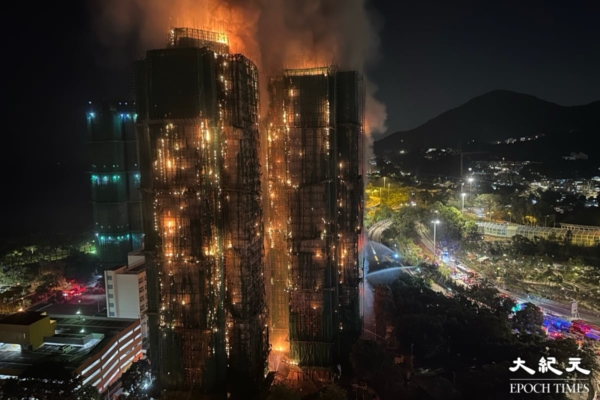
Hong Kong New Territories Tai Po Wang Fuk Court was hit by a devastating five-alarm fire on November 26, resulting in severe casualties. According to the latest police report on December 1, the fire has claimed the lives of 151 people, with the death toll still rising. Over 30 people are also missing. Following the fire, a report by the pro-Beijing “Ta Kung Pao” shed light on the dark side of Hong Kong’s building scaffolding industry, exposing issues such as exorbitant fees, bid rigging, kickbacks, and shoddy workmanship. However, the report has now been technically taken down from the official website of “Ta Kung Pao,” sparking speculation.
This sudden and massive fire quickly focused public attention on the potential safety hazards of maintenance works on old buildings, especially regarding the scaffolding which serves as a crucial medium for fire spreading. On November 28, the Hong Kong government held a press conference. Officials stated that the preliminary inspection of the scaffolding met fire resistance standards.
However, on the same day of emphasizing the compliance of the scaffolding, the pro-Beijing “Ta Kung Pao” published a series of investigative reports titled “Unveiling the Dark Secrets Behind Maintenance Scaffolding.” These four significant news articles published on page A7 directly linked the fire to longstanding flaws in Hong Kong’s building maintenance industry, drawing high attention.
The report revealed several core issues:
1. Exorbitant Fees and Bid Rigging: Lack of transparency in the bidding process has led to vicious bid rigging in the industry, driving project costs unreasonably high.
2. Kickbacks: The unhealthy industry ecosystem has led some companies to monopolize projects, involving complex networks of interests.
3. Shoddy Workmanship: To cut costs, some projects use inferior materials or lower construction standards, posing safety concerns.
The report not only discussed these issues broadly but also specifically targeted Hang Seng, the company contracted for the exterior wall maintenance works at Wang Fuk Court, exposing several negative records:
Hang Seng has been involved in violations of scaffolding and labor safety multiple times since its establishment 21 years ago, especially since 2018, with some cases leading to convictions and fines.
The company has faced lawsuits for not employing qualified personnel and multiple construction debt litigations from 2010 to 2019.
Reporters from “Ta Kung Pao” attempted to reach Hang Seng for verification, but the company’s doors were tightly shut, refusing to respond.
The report in “Ta Kung Pao” cited insights from industry representatives and insiders, painting a grim picture of the construction industry in Hong Kong.
An unnamed industry insider bluntly stated that bid rigging is rampant in Hong Kong construction companies, and competitors have been forced to withdraw from bidding due to malicious warnings, leading to the same companies winning contracts repeatedly. Hang Seng is identified as a renowned “winner” in bidding competitions, raising questions about its resources matching the high volume of projects.
The industry often resorts to extending project timelines to recoup profits from underbidding or using inferior materials through shortcuts.
Another construction industry source revealed that fire-resistant protective nets cost around HKD 90 per sheet, while non-fire-resistant nets cost just over HKD 50 and can be reused, leading the market to prefer the non-fire-resistant nets. He pointed out that relevant authorities rarely inspect the quality of protective nets, exacerbating safety hazards.
A tradesman named Wu highlighted that bamboo scaffolding and foam insulation are both flammable. After prolonged exposure to wind and sun, bamboo scaffolding becomes dry and highly flammable. In recent dry and windy weather conditions, the fire was able to spread rapidly from the bottom to the top within a short period, affecting adjacent buildings.
After the above reports were published, the electronic version of the newspaper was made available for viewing on the website as usual. However, on November 30, it was found that the report had been technically taken down from the “Ta Kung Pao” website.
Readers can still access the original webpage of the report by “skillfully changing the URL links of other pages on November 28,” bypassing the takedown.
This indicates that the measures taken by “Ta Kung Pao” are to hide rather than completely delete the report. This kind of handling is extremely rare, leading to general speculation that the report’s content may involve sensitive interests, putting pressure on the newspaper to quickly halt public dissemination of the report without openly admitting to withdrawing it or issuing correction statements.
This incident vividly reflects the complex pressures and challenges faced by the media in Hong Kong when conducting in-depth investigative reports.