
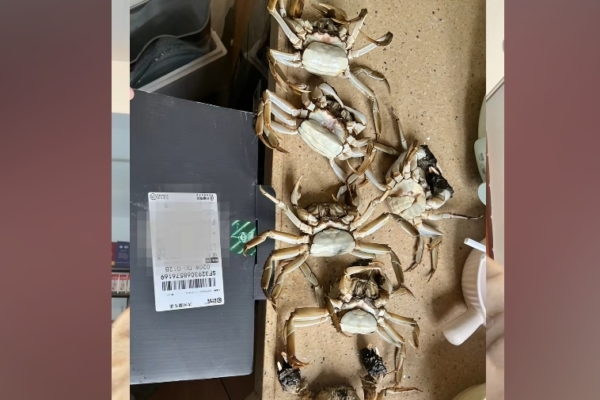
Recently, a woman named Gao in Jiangsu, who runs an online store selling hairy crabs, posted a video saying that a customer claimed that 6 out of the 8 crabs they purchased had died. The customer provided pictures and videos as evidence. After Gao refunded the money, she discovered that the pictures and videos of the dead crabs sent by the customer appeared to be artificially synthesized.
According to reports from various media outlets such as Qilu Evening News, on the evening of November 17th, a customer from Guangzhou bought a total of 8 crabs, consisting of 4 male and 4 female, from Gao’s online store. On November 18th, the customer received the hairy crabs and contacted customer service claiming that 6 crabs had arrived dead, requesting a refund. The customer also sent photos and two videos as proof of the dead crabs. In the videos, the dead crabs were marked with Gao’s store-specific crab tags.
After refunding the money, Gao carefully examined the photos and videos sent by the customer and noticed that the claws of the dead crabs in the photos were unnaturally raised, different from the typical posture of dead crabs. Furthermore, the first video showed 2 male and 4 female crabs while the second video showed 3 male and 3 female crabs, contradicting the actual purchase. Gao realized that the videos sent by the customer were likely AI-generated.
Subsequently, Gao released a video exposing the customer’s fraudulent behavior, but unexpectedly, the customer reported Gao for “suspected privacy infringement.”
Gao stated that initially, she did not want to dwell on the matter, but after receiving private messages threatening her safety, she organized evidence and on November 28th, she had a friend report to the police in the customer’s location.
On December 3rd, Gao informed Jiu Pai News that the customer involved had been administratively detained for 8 days, and the refunded amount of 195 yuan had been fully recovered.
Gao’s experience is not an isolated case.
According to reports from Yangzi Evening News, during this year’s Double Eleven shopping festival, many e-commerce platforms expressed frustration on social media, claiming that they suspected customers were using AI-generated fake images to request refunds. However, due to the lack of professional technical identification capabilities among small and medium-sized businesses, it was challenging for them to distinguish the authenticity of evidence with the naked eye. Many sellers had to opt for refunds to avoid prolonged disputes.
On the other hand, some businesses also misuse AI-generated false promotional images to deceive buyers. As a result, upon receiving the products, many buyers find discrepancies and fall victim to deceptive practices.