
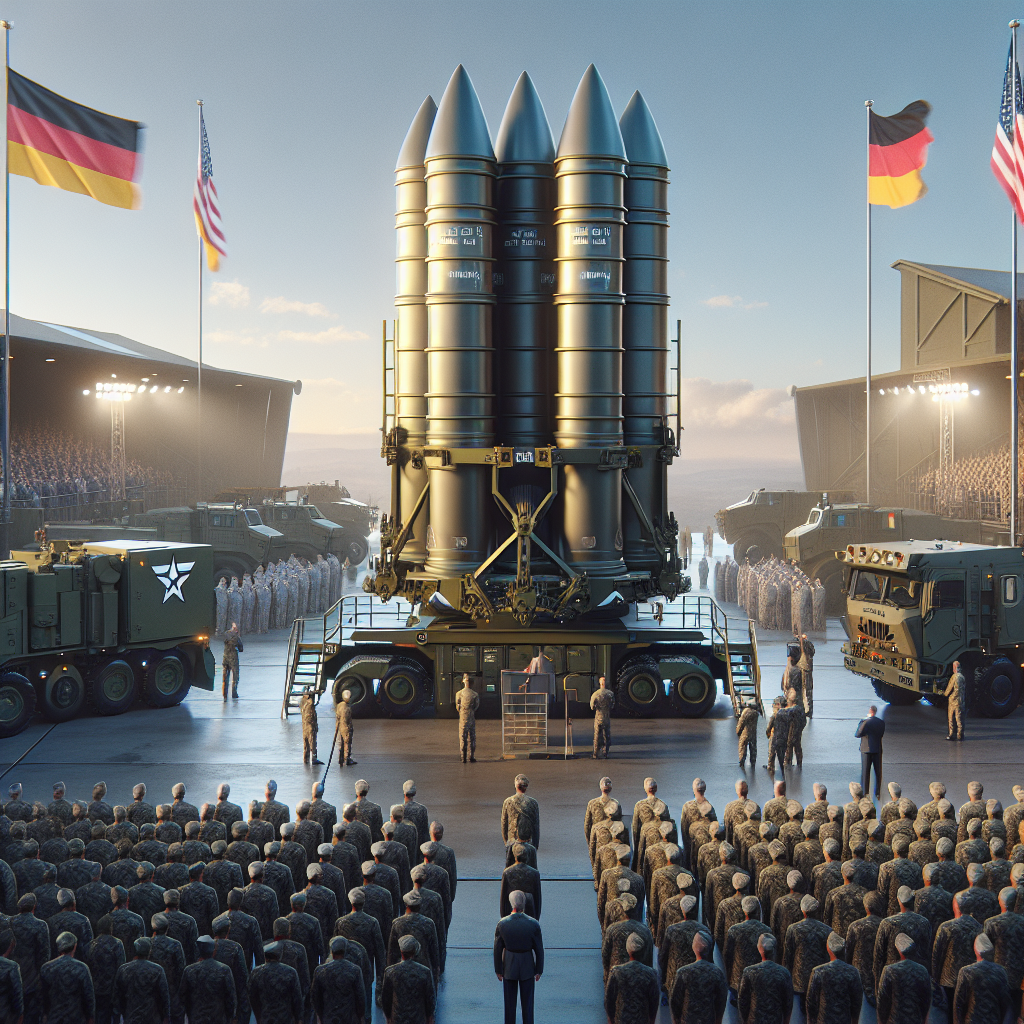
On December 3, 2025, at the Holzdorf Air Force Base in Germany, a set of the “Arrow-3” missile defense system, never before deployed outside Israel and the United States, officially entered service. This event marked not only the delivery ceremony of Germany’s €3.6 billion military procurement contract but also a significant defense turning point in Europe since the end of World War II. Eighty years later, the Jewish state is now protecting the territory of former aggressors with advanced technology. Simultaneously, NATO allies are monthly delivering hundreds of millions of euros in US weapons to Ukraine through the PURL mechanism, while the EU Commissioner for Defense publicly acknowledges that Europe needs to draw on Ukrainian military experience to counter Russian drones and hybrid warfare.
From the Baltic Sea to the River Elbe, a silent yet intense process of “remilitarization” is accelerating in Europe.
On Wednesday, December 3, 2025, Germany became the first European country to deploy the “Arrow-style” air defense system. This system is designed to intercept intermediate ballistic missiles from Russia to counter potential threats from Moscow.
The “Arrow-style” air defense system, developed in cooperation with the Israeli Aerospace Industries (IAI) and the US Missile Defense Agency, serves as a high-altitude defense system in conjunction with the “Iron Dome” system for intercepting short-range airborne threats, forming Israel’s missile defense system.
The “Arrow-style” system purchased by Germany is the latest version of the “Arrow-3”, with a shooting height of up to 100 kilometers (62 miles), capable of operating outside Earth’s atmosphere with a range of 2400 kilometers. This system complements Germany’s previously deployed “Patriot” and “IRIS-T” mobile short-range air defense systems, collectively forming a comprehensive missile defense system covering short, intermediate, and long ranges, as well as low and high altitudes.
The “Arrow-style” system has demonstrated excellent combat performance. According to the Israeli Aerospace Industries (IAI), the system thwarted missile attacks on Israel from Iran twice in April and October 2024. Since then, several countries have shown interest in acquiring this technology.
The deployment of the “Arrow-style” missile system in Germany also signifies the first deployment of the “Arrow-3” system outside Israel and the United States.
German Defense Minister Boris Pistorius stated that with this new system, Germany has acquired for the first time the capabilities for early warning and defense against long-range ballistic missiles.
In a statement, he said, “With this unique strategic capability among our European partners, we have strengthened our core position in Europe. We are not only protecting ourselves but also our partners. We are enhancing the European pillar of NATO and achieving NATO’s objectives.”
Israeli Ambassador to Germany Ron Prosor remarked, “Who would have thought that just 80 years after the liberation of Auschwitz, the Jewish state would be able to defend not only Germany but the entire Europe through its developed technology?”
The deployment ceremony of the “Arrow-style” system took place on Wednesday at the Holzdorf Air Force Base, located about 100 kilometers south of Berlin. Germany’s goal is to fully activate this missile defense system covering the entire country by 2030, with systems to be deployed in three locations in northern, southern, and central Germany.
In September 2023, following the outbreak of the Russia-Ukraine war, Germany allocated €3.6 billion (approximately $4.18 billion) to purchase the “Arrow-style” missile defense system from Israel. In August of the same year, the United States approved this arms sale, which is Israel’s largest-ever single defense sales contract.
Germany views Russia’s intermediate-range missiles as a major threat to its population and critical infrastructure. Berlin aims to strengthen its missile defense system with the “Arrow-style” system to prepare for a potential new Cold War with Russia.
The “Arrow-style” system can detect and intercept incoming missiles with a range of over 1,000 kilometers, regardless of whether these missiles are launched from land, air, or sea, thereby filling a critical gap in Germany’s territorial defense system.
NATO’s eastward expansion has shifted frontline defense to countries like Poland and the Baltic states. Nevertheless, in the event of a conflict, Germany remains a significant military staging ground.
Russia’s invasion of Ukraine has prompted a historic shift in Germany’s defense policy, leading Berlin to relax fiscal constraints and overhaul its military strategy. In June of this year, the German government approved a new defense spending proposal, aiming to more than double its military expenditure by 2030. Germany plans to invest a total of €649 billion (approximately $761 billion) in military over the next five years.
The new defense budget plan will allow Germany to increase its defense spending annually to meet NATO’s latest target of defense spending reaching 3.5% of the Gross Domestic Product (GDP) by 2029.
This year, Germany allocated €86 billion (approximately $101 billion) to its military sector, equivalent to 2.4% of GDP. If including aid to Ukraine, this figure rises to €95 billion (approximately $111 billion). It is projected to reach €162 billion (approximately $190 billion), including aid to Ukraine, by 2029. This spending plan will provide Ukraine with €9 billion (approximately $10.6 billion) in aid annually.
Amid ongoing intense attacks by Russia on the frontline and in the air, Germany is continuing to solidify its position as a major supporter of Kyiv in Europe.
Chancellor Friedrich Merz aims to make the German Armed Forces the “strongest conventional military in Europe.” In June, Merz defended the increase in defense spending in the German Federal Parliament, stating that the increase is “not to do America a favor, but because Russia is threatening the freedom of the entire European-Atlantic region.”
This summer, Washington nearly halted the unconditional delivery of weapons to Ukraine, instead urging European countries to purchase and donate equipment themselves. So far, Ukraine’s allies have responded to the US’ call.
On December 3, Wednesday, NATO Secretary-General Mark Rutte expressed confidence that Ukraine’s allies will pledge to donate $5 billion (€4.3 billion) in US weapons by the end of the year. According to Rutte, allies have committed to purchasing several billion dollars of US weapons based on the Priority Ukraine Requirements List (PURL) proposal.
The PURL initiative was launched jointly by NATO Secretary-General Rutte and US President Trump in July of this year to expedite the provision of US-manufactured weapons and equipment to Ukraine, with contributions from NATO member countries directly purchasing and delivering from US stocks to address Ukraine’s priority military needs such as missiles, air defense systems, and ammunition.
Currently, over 20 allies have made contributions to this initiative. This week, five allies announced new spending commitments, including Canada (€1.71 billion), the Netherlands (€2.14 billion), as well as Norway, Poland, and Germany, committing a total of €4.29 billion. Australia and New Zealand have recently pledged to participate in the program, despite not being NATO member states.
After a NATO foreign ministers’ meeting in Brussels on Wednesday, Rutte told reporters that the latest round of commitments “brings us one step closer to our target of $50 billion for the year.”
He added that the list of participating allies seems poised to increase, with only “a few countries” yet to approve the PURL plan five months after its launch. These countries include Italy and France, the latter more inclined to donate European-made equipment to Ukraine.
It is estimated that Ukraine will need at least €83 billion over the next two years to meet its military requirements.
In recent times, European countries have faced a series of activities suspected to be related to Russia and Moscow-planned hybrid attacks, including cyber-attacks, sabotage attempts, and drone and missile invasions of European airspace.
Unidentified drones have caused the closure of airports in the Baltic states, Eastern European countries, Belgium, and Germany. On September 19, three Russian MiG-31 fighter jets were accused of violating Estonian airspace. On September 22, the UN Security Council held an emergency meeting regarding Russia’s military aircraft entering Estonian airspace, with Russia denying the allegations at the meeting.
Polish Deputy Prime Minister and Foreign Minister Szydłowski accused Russia during his speech at the meeting, stating, “We are well aware that your country disregards international law and cannot peacefully coexist with neighbors. Your extreme nationalism is accompanied by expansionist desires. Unless you realize that the imperial era has ended, and the empire cannot be rebuilt, these desires will be endless.”
Szydłowski emphasized that Poland has only one request for the Russian government: “If missiles or planes invade our airspace without permission – whether intentionally or mistakenly – and are shot down, with debris falling into NATO territory, do not come to complain.” He warned Russia, “You have been warned.”
On November 16, an important railway line connecting Poland to Ukraine was found damaged in an explosion. On November 18, the Polish government announced that two suspects had been identified, two Ukrainians who cooperated with the Russian intelligence service, and had fled to Belarus. Moscow authorities dismissed this as “anti-Russian propaganda.”
The explosion occurred on the railway line that links the Polish capital Warsaw to the eastern border city of Lublin. This railway line leads to Ukraine and is one of the pathways for Western aid to deliver military supplies to Ukraine.
On December 2, EU Commissioner for Defense Andreas Kubilius told European News Channel that suspected provocations by Russia, including drone invasions and recent bombings on Polish railways, are changing war theory.
He said, “From a technical perspective, we currently lack sufficient detection capability and do not have economically efficient means to destroy drones.” He pointed out that a drone worth around €10,000 is being shot down by a missile worth €1 million.
Kubilius added, “This is not the optimal defense method, indicating that we are still far behind in our preparedness and understanding of modern warfare theory.”
Kubilius pointed out that in countering Russian provocations, the EU can learn a lot from Ukraine and Eastern European countries. He said, “The Ukrainians have set up a drone defense line and have effectively defended against hundreds of drones flying into their territory every night.”
Kubilius stated, “Today, under Putin’s leadership, Russia undoubtedly poses a greater threat to European security. We have witnessed the horrific war in Ukraine, and we foresaw Russia’s intentions nearly a decade ago.”
When asked if Russia would change, Kubilius said, “I still hope that at some point in the future, perhaps many years later, we’ll see a more normal Russia.”
As the radar of the “Arrow-3” scans the German sky for the first time, as US weapons continue to flow to the front lines in Ukraine from the PURL list, as Kubilius admits, “We are far behind in our understanding of modern warfare,” Europe is awakening from a 30-year “peace dividend.”
In the shadow of the Russia-Ukraine war, facing continuing provocations and hybrid threats from Russia, Europe is reshaping its defense capabilities at a historic pace. A “remilitarization movement” covering technology, political strategy, and military cooperation is quietly unfolding across the European continent. Over the coming years, this historic defense upgrade will become a critical cornerstone of Europe’s strategic autonomy.