
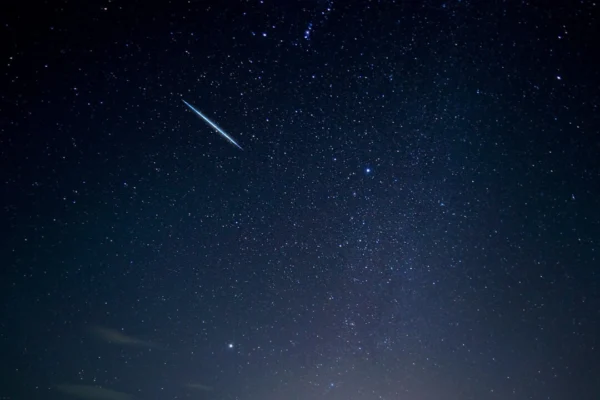
In news dated November 25, 2025, the bright star Castor shines in the northern hemisphere of the sky, about 52 light-years away from Earth, resembling the head of one of the twins in the Gemini constellation. Radiating from Castor in all directions is one of the most productive meteor showers in the world—the Geminid meteor shower, which occurs every December with dazzling brightness as it descends into Earth’s atmosphere.
Despite the unimaginable distance of Castor, the meteors appearing to emanate from there will actually be only about 60 miles above the Earth’s surface when they reach their peak next month, around December 13-14. With the sky dark enough during the waning moon, this famous meteor shower will be easily observable. Under ideal dark conditions, one can see up to 120 meteors per hour.
The point where meteors appear is called the radiant point, which is fixed in the sky. Meteor showers like the Geminids are usually named after the constellation where their radiant point lies, although they do not actually originate from those distant stars.
Initially, meteors are part of larger cosmic bodies such as asteroids or comets. When these bodies shed material, it creates a large cluster of space debris that scatters throughout the solar system, following similar paths as their parent bodies. When Earth’s orbit intersects with these debris streams, we witness meteor showers.
Meteors are essentially small space pebbles that fall to Earth. They burn and disintegrate upon entering the atmosphere due to friction. Because they appear as swiftly streaking, elongated light beams in the night sky, they are also known as shooting stars.
At times, meteors can burn brighter, leaving behind long trails of glowing gases called “persistent trains,” or more dramatically, “fireballs.” The Geminid meteor shower is known for its slow-moving, long-duration “Earthgrazers” that horizontally streak across the sky and occasionally break apart like spectacular fireworks.
Earth will pass through the debris stream of the Geminid meteor shower from November 19 to December 24, although the meteor shower will peak in mid-December. With the waning moon on December 11, coinciding with its peak, there will be minimal natural light pollution to dim the meteor shower. Assuming clear weather, the dark night sky will provide an ideal setting for observing the Geminids.
The primary challenge lies in whether people are willing to stay up late for this spectacle. Observers will need to wait until around 2 a.m. local time when the radiant point (near Castor) is at its highest position, offering the broadest view. However, even in the earlier evening hours when the radiant point is closer to the eastern horizon, some meteors are still visible.
The key is not to look for meteors near the radiant point, even though they appear to originate from there. Meteors are best observed as they streak across the sky, so it’s advisable to scan the entire sky. It is recommended to lie back on a reclining chair, wrap in a sleeping bag, and have a mug of hot cocoa to stay warm.
Now, why do meteors appear to radiate from the distant star Castor when we know they come from near-Earth objects and not from Castor itself? This is simply a visual illusion caused by single-point perspective.
Just like parallel railroad tracks appear to converge on the horizon, the debris stream of the Geminid meteor shower seems to converge at a point. These debris used to be a part of a larger space object in the solar system called 3200 Phaethon. While it remains unclear how these pieces broke off from the parent body, they continue to float along in orbit. When Earth passes through this debris stream, we trace the paths of meteors like following train tracks leading to the horizon, giving the appearance of convergence at Castor purely by coincidence.
Most meteor showers originate from comets that spend decades in deep space before entering the solar system, but the Geminids do not. As mentioned earlier, 3200 Phaethon is an asteroid, making it a rather unusual one.
Comets are massive, amorphous celestial bodies composed of cosmic particles ejected from a solid core that become active when approaching the Sun. In contrast, asteroids are simple space rocks that may have once been comets as well. They either become dormant or exhausted their volatile substances. 3200 Phaethon was initially thought to be a comet (1983 TB) before being confirmed as an asteroid.
After calculating its orbit, researchers found it to be matching with the Geminid meteor shower, posing a puzzle of unprecedented correlation between an asteroid and a meteor shower. Till date, scientists are still unraveling how this particular asteroid ejected those tiny meteoroids into space.
Unlike some comets that spend decades in deep space before entering the solar system, 3200 Phaethon orbits in our neighborhood. It completes one orbit around the Sun every 1.4 years, swinging very close to the Sun at perihelion—even midway between the Sun and Mercury—and extending beyond the orbit of Mars at aphelion.
In the near future, scientists may have the opportunity to closely study asteroid 3200 Phaethon. Japan’s DESTINY+ spacecraft mission is set to intercept this asteroid in 2028. Perhaps then, we’ll gain valuable insights into the origin of this famous meteor shower that captivates countless stargazers every mid-December.