
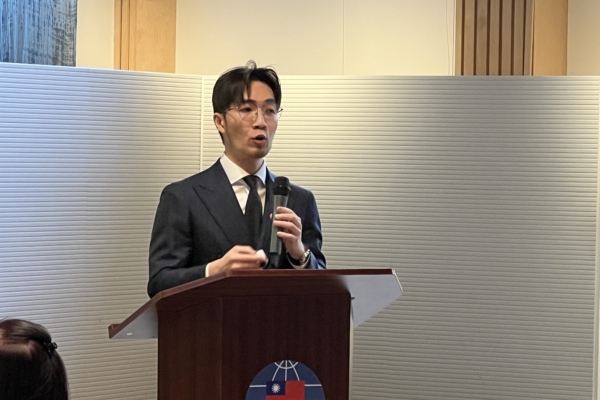
On December 6, the Economic and Cultural Office in New York and the Greater New York Area Overseas Community Emergency Assistance Association jointly organized the first anti-fraud seminar at the Overseas Community Center in Flushing. During the event, Legal Secretary Lai Yichen from the Economic and Cultural Office spoke about the forms of fraud that have emerged in recent years in both the United States and Taiwan, as well as preventive measures. Attendees also shared their own experiences and those of friends who have fallen victim to scams.
With over a decade of investigative experience at the Investigation Bureau of the Ministry of Justice in Taiwan, Secretary Lai emphasized that with the advancement of technology, various fraud methods continue to emerge, making it possible for anyone to become a victim.
“A simple method is, if you encounter unfamiliar information or suspect that you are being scammed, the first thing to do is to inform your family and friends, as having more people involved can lead to better decision-making,” said Secretary Lai.
The chairman of the Greater New York Area Overseas Community Emergency Assistance Association, Wang Jinzhi, expressed to the press that the reason for hosting this seminar was due to the increasing number of victims both domestically and internationally in recent times.
“Therefore, it is essential to share this knowledge with everyone to help overseas compatriots prevent falling victim to scams as much as possible,” Wang Jinzhi said. “With the rapid advancements in technology, falling for scams may not be due to lack of intelligence or carelessness, but rather the difficulty in preventing them. Therefore, understanding these issues and sharing them with friends and family is crucial. Prevention is key.”
Secretary Lai also emphasized that in the era of advanced AI, everyone is at risk of becoming a victim of fraud. The harm caused by fraud is significant, with wide-reaching impacts.
“In the past, I thought I was smart and knowledgeable, so I wouldn’t fall for scams. Only fools or those who trust others too much would be deceived. In reality, this is not the case,” he said before the seminar. “Fraudulent groups now tailor extremely crafty schemes targeting the weaknesses of individuals. No one is perfect, so we should not blame those who fall victim to scams. This is a perspective we must first acknowledge.”
You may have heard about phone scams or online fraud, but do you know how serious fraudulent cases are in the United States and Taiwan?
According to statistics from the Federal Trade Commission in the United States, there were 2.6 million reported cases in 2024, not including unreported incidents. In reality, a significant number of people choose to endure silently without reporting cases. This figure represents a 25% increase compared to the previous year in 2023. On average, victims lose $34 million to fraud every day.
The top four fraudulent methods in the United States in terms of amount are: investment fraud, impersonation scams, online shopping scams, and job offer scams. Among online fraud cases, the top five forms include: investment scams, business email scams, tech support scams, personal information leaks, and online romance scams.
In Taiwan, fraudulent cases increased threefold in 2024 compared to the previous year, with an average daily loss of NT$133 million. The top five fraudulent methods in Taiwan differ in ranking and types from those in the United States, including investment scams, false friendships, fake buyers and sellers, prize notifications, and online shopping scams.
The most common fraud tactics in both regions include impersonating government officials such as tax authorities, Social Security Administration, FBI, or customs officers. In one instance from 2023, a man in Texas received a call claiming his Social Security number was frozen and was deceived into buying $1,500 Target gift cards.
Other common tactics include impersonating banks or financial institutions, electronic gift card scams, tech support scams, romance scams, e-commerce fake sellers, and shopping scams, as well as investment scams.
During the seminar attended by dozens of members of the New York Taiwanese community, over ten compatriots stood up to share their experiences or those of friends who have been scammed to warn others against falling victim again. The cases they shared covered almost all the types introduced by Secretary Lai Yichen, with a majority occurring this year, confirming the endless variety of fraud methods and the widespread nature of victims among acquaintances. This newspaper will report in subsequent articles the stories of victims from Taiwan in New York.
Secretary Lai Yichen noted that while fraud is not a new topic, a new form of fraud emerged in 2023, known as AI fraud. With AI being able to mimic a person’s voice and appearance, even video commands can be fabricated. An accountant once received a video call from the company boss and proceeded to make a payment according to the instructions received. It was later revealed to be a scam where AI was used to create a fake video of the boss.
AI can be used for fraud but also for anti-fraud purposes. Secretary Lai suggested that in the event of suspicious information, aside from informing family and friends immediately, one can also turn to AI for help.
“Because AI involves big data analysis, if someone has encountered a similar situation before, AI will alert you, making it easy to discern if it’s a scam. This way, you can make better judgments,” he told the press.
This was the first time the Economic and Cultural Office hosted such a seminar. Deputy Director-General Zhang Lixian of the Economic and Cultural Office expressed surprise at the large turnout and warm reception of the event.
“I believe today’s event was a great success,” she told this newspaper. “Participants shared their own cases and provided new insights into the various tactics of fraud. We hope this opportunity raises awareness among more people to avoid falling victim easily.”
Among the attendees were Overseas Community Affairs Commissioner Chu Yuemei, Director of the Overseas Community Center Wang Yiru, as well as President Fan Bilian of the Greater New York Area Overseas Community Emergency Assistance Association.