
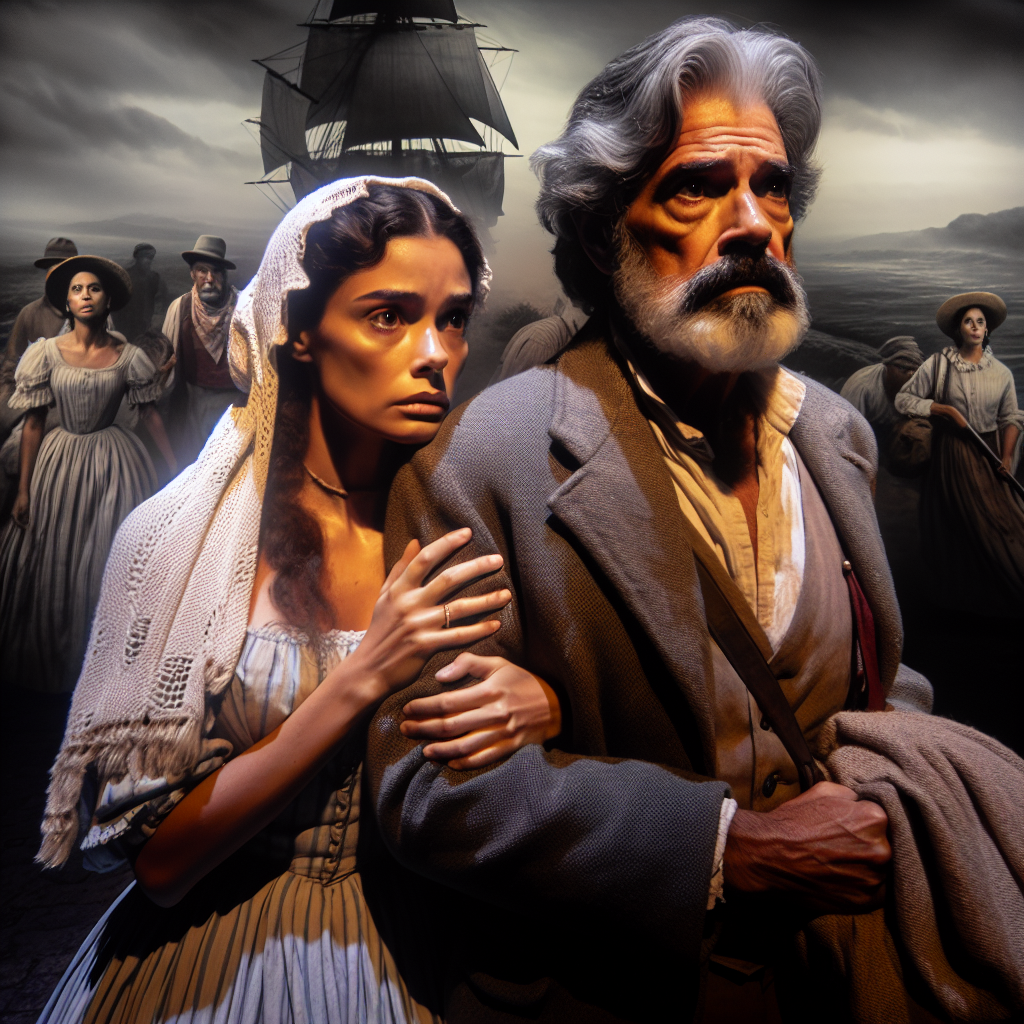
In the Caribbean nation of Cuba, under the long-standing dictatorship led by Fidel Castro (1926–2016), ordinary citizens Dionel and Marina Cotanda were forced to leave their beloved homeland and flee to the United States over 65 years ago. When they escaped Cuba, Dionel and Marina were not yet married and only had $65 with them, as the communist party had seized all their belongings. They were forced to exile to Tampa, Florida.
“My parents thought leaving Cuba was just temporary,” their daughter Lourdes Cotanda-Ercia told the Epoch Times.
However, the shadow of communism continued to loom over their homeland, prompting them to choose to settle in the United States. In the land of freedom, they built a fulfilling marriage, joined the military, obtained degrees, succeeded in their careers, and became outspoken community leaders. The couple raised three daughters and now have several grandchildren.
With the increasing concern about communism among young people in the United States, Florida decided to introduce the first curriculum teaching the dark history of this ideology. This history is all too familiar to the Cotanda family and other Cuban immigrants, making them very supportive of Florida’s initiative to offer this course to young students.
On November 13, the Florida State Board of Education voted, at the direction of state legislators, to include a curriculum on communist history in the social studies standards for students in grades six through twelve for the 2026-2027 school year.
Florida’s Commissioner of Education Anastasios Kamoutsas stated in a press release that the new “Comunist History” curriculum in Florida will ensure students understand the truth of life under communist rule and deepen their understanding of the freedom and welfare that define their country.
Reflecting on his escape from Cuba 65 years ago, Dionel Cotanda’s heart broke. An airport terminal in Cuba displayed a Spanish quote by José Martí, a leader in the Cuban independence war and renowned poet: “Only cowards abandon their homeland.”
“Did I make a cowardly choice by leaving?” Dionel asked himself at the time. However, over the years, witnessing Castro rise to the peak of power and intensify his ideological control over his neighbors in Cuba, as well as taking control of their businesses, strengthened Dionel’s belief that his initial decision was the right one.
In his doctoral thesis, he wrote that while he initially sympathized with Castro, he quickly turned against the communist party. He described his ideological shift as a “revolution of calluses,” metaphorically meaning a breakthrough or change. “You don’t react until they step on your toes,” he said.
At the time, Dionel worked at a Goodyear tire rubber company, where the Cuban government arbitrarily appointed a shoemaker to oversee the factory in Tampa simply because the shoemaker was a long-time member of the communist party. Dionel managed to secure a position to transfer to work in Tampa, Florida.
Marina Cotanda was studying journalism at the time. She recounted how she opposed Castro from the start, having witnessed firsthand how the dictator manipulated the minds of their neighbors.
She saw banners on many houses with the slogan “Fidel, this is your home.” Schools began teaching children to view Castro as their father. She also recalled living in an apartment in Havana, where she saw Castro and his associates wearing rosaries, attempting to deceive devout Catholics into revealing their identities in public.
Seeing the growing influence of communism in the United States worries Marina Cotanda. She stated that this issue is not only limited to the younger generation, as some adults with similar views already hold positions in American politics and education.
“The communists are here, infiltrating bit by bit,” she said. “I have no doubt about it. But they’re not openly revealing themselves yet.”
Another Cuban, Jose Ramon Perez Campos, who grew up on an island in Cuba and worked in film production, did not arrive in the United States until 1992. Now in his sixties and a grandfather, he spoke at a cigar shop in Little Havana, Miami, recounting how he witnessed the Castro regime plunder the money and land of the Cuban people. Despite producing several films, all decisions were ultimately controlled by the dictatorship, and his scripts were confiscated, leaving his films unreleased to this day.
“People have short memories,” he said. “I have lived through it myself — communism doesn’t work. If someone can tell me which socialist or communist system in any country works, I’ll give them a few cigars for free. You won’t find any examples. It doesn’t work in Nicaragua, it doesn’t work in Venezuela.”
This sentiment influenced Florida’s decision to incorporate communist history into the school curriculum. Before the unanimous decision, board member Layla Collins recalled a conversation with a man who fled socialism and was about to become a father himself. He expressed fear about the increasing allure of socialism in America.
Layla began to realize that there was a growing trend of communism nationwide in the United States and the conversation prompted her to have a deep discussion with her husband, who was a state senator at the time.
This conversation led to the drafting and submission of Florida Senate Bill 1264, signed by Governor Ron DeSantis in April 2024, mandating the inclusion of the history and dangers of communism in school curricula.
“I never thought we’d be faced with the current situation we’re in — political violence escalating, socialism and communism seeping into every aspect of our lives and our children’s education. But the patterns are profound and clear,” said Senator Collins.
According to a recent survey by the Cato Institute in Washington, D.C., and YouGov in London, while over 80% of Americans still hold negative views of communism, one-third of Americans under 30 have positive views of communist ideology.
The survey also found that 28% of residents in major cities have a favorable view of communism. These results were disclosed months ago by Zohran Mamdani, a democratic socialist running for mayor in New York City.
“This ideology has led to the oppression, suffering, and death of millions of people, and our students should receive education that reflects this reality,” Collins said.
However, Dionel Cotanda does not see the United States facing a threat of turning towards communism and socialism.
“I have confidence in the system here,” he said. “I believe the U.S. system is strong enough to overcome this issue.”
The next step for Florida’s education leaders is to incorporate these standards into textbooks and curriculum for implementation in the coming years.
“We’re adopting these standards today to garner them into the discussion for future curriculum considerations,” said Paul Burns, senior director of the Florida Department of Education, at the board meeting on November 13.
Yuleisy Mena, the executive director of the Bay of Pigs Museum and Library in Little Havana, who fled communist Cuba in 1992, hopes that the curriculum reform will bring a more balanced education.
“Students often receive education about fascism, especially through comprehensive and excellent Holocaust education; however, the history of communism and its real-world consequences are often not given equal depth of explanation,” she said. “To foster true critical thinking, students should equally encounter all major political systems, including verifiable statistics, human suffering, and historical consequences related to communist regimes.”
Having served as a social studies curriculum teacher for ten years and holding a doctoral degree, Mena now teaches at Florida International University.
While the curriculum reform will only impact students before high school graduation, Cotanda-Ercia is concerned about the pro-socialist atmosphere created by university professors.
“When my daughter Alexis attended the University of Florida, she quickly noticed that the professors there were very open-minded,” she said.
Cotanda-Ercia mentioned that to secure an A, her daughter would write essays based on the professors’ viewpoints rather than her own. Her nephew did the same.
“They did it just to get through the course. But at that time, it was a big deal,” she said.
A recent survey conducted by Northwestern University and the University of Michigan found that 88% of students pretended to hold left-wing views to appease their professors.