
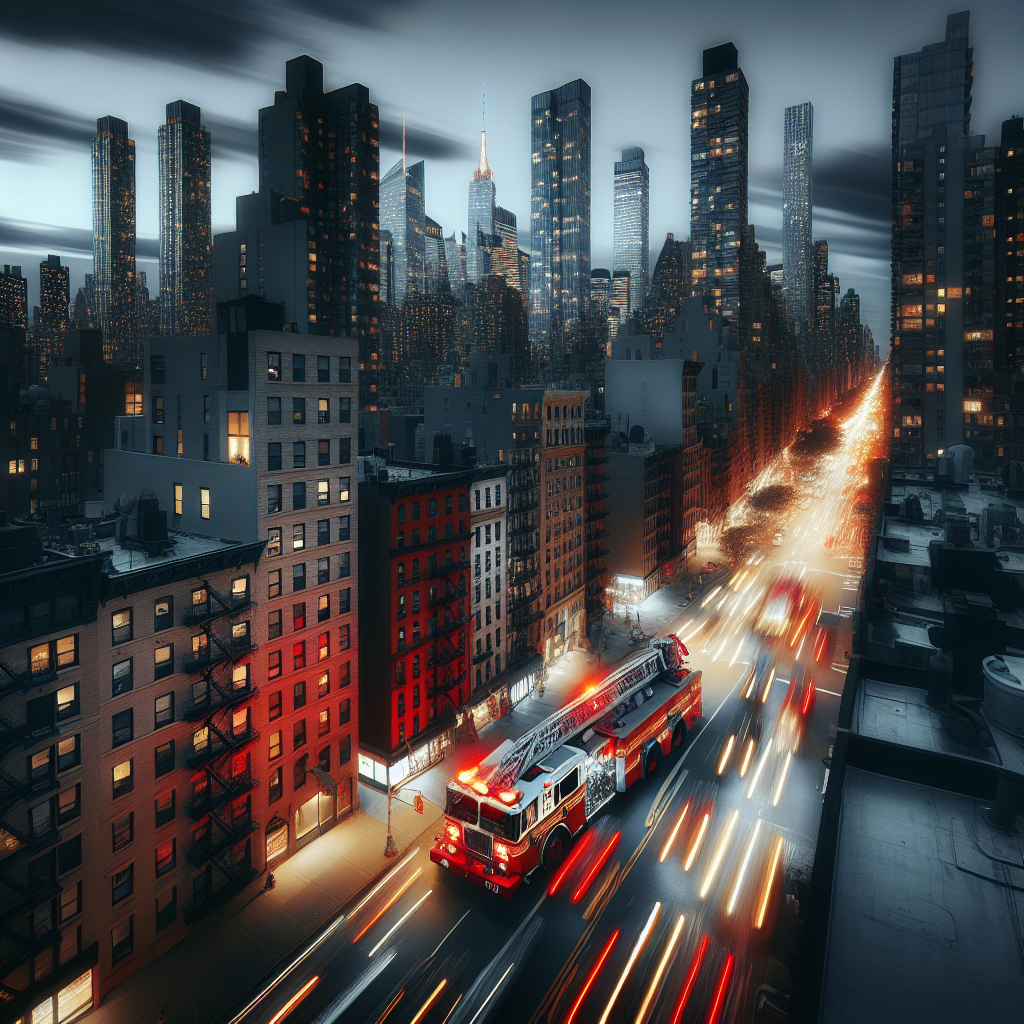
In New York City, the total number of buildings has reached the million mark, with an estimated daily occurrence of around 63 “serious level” fire incidents. The sight of fire trucks speeding through the city streets with blaring sirens has become the most vivid impression of the New York City Fire Department (FDNY) for many residents. However, beyond just firefighting, the scope of responsibilities and organizational scale of FDNY may far surpass what most people imagine.
FDNY is not only the largest fire department in North America but also the second-largest globally, following only the Tokyo Fire Department in Japan. Whether it’s high-rise fires, subway platform emergencies, hurricanes, floods, or even terrorist attacks, whenever individuals or the entire city face a crisis, FDNY steps up and goes all out. As one of the important guardians of the lives and properties of over eight million residents in New York City, FDNY has integrated into the collective memory of New Yorkers, becoming a symbol of the city’s spirit.
The history of the firefighting industry in New York dates back to the voluntary firefighting squads as early as 1648. It wasn’t until 1865 that the New York State Assembly established the “Metropolitan Fire Department (M.F.D.),” marking the establishment of a modern firefighting system. On July 31 of the same year, the first professional firefighting squad officially began duty in Manhattan.
In 1870, “M.F.D.” was incorporated into the New York City municipal administration, and the name “New York City Fire Department (FDNY)” was first used. On January 1, 1898, FDNY officially took over all firefighting and emergency medical services in the five boroughs of New York City, enduring industrialization, urban density, and population explosions over the past nearly 130 years, becoming a benchmark institution for international metropolitan firefighting and emergency management.
FDNY has borne the crucial responsibility of saving lives and assisting the injured since its inception. Today, its mission has become more comprehensive and multidimensional, namely: “To serve as the first response unit for fires, public safety and medical emergencies, disasters and terrorist attacks, ensuring the safety of life and property for residents and visitors of New York City.” In addition to this, it also undertakes tasks such as fire prevention, fire cause investigations, and public safety education, playing vital roles in homeland security and large-scale disaster response.
Due to the significant responsibilities it carries, FDNY must always maintain a high state of readiness to respond promptly to various threats and challenges. This state of “readiness” and six additional commitments collectively form the core values of FDNY:
– Service: Always responding to citizens’ calls for help, continuously guarding and dedicating themselves selflessly;
– Bravery: Facing fear head-on with valor, empathy, and skilled expertise;
– Safety: Building a safety barrier for the public with state-of-the-art equipment and continuous training;
– Honor: Every turnout carries the reputation and dignity of the entire team;
– Dedication: Performing duties with professionalism and integrity, meeting expectations;
– Equity: Reflecting fairness principles in citizen services and employee career development.
FDNY is widely regarded as one of the busiest and most professional emergency response organizations globally, with over 17,000 staff members, including 11,000 firefighters and fire officers, 4,500 emergency medical service technicians (EMT), paramedics, and officers, as well as 2,000 civilian personnel, including fire safety inspectors.
Within the 302 square miles of land in New York City, FDNY operates 218 firehouses, 39 EMS stations, and over 1,300 various firefighting vehicles, specialized units, ambulances, and fireboats, providing comprehensive coverage for the city.
Operating in a quasi-military manner, FDNY’s highest-ranking official is the Fire Commissioner, who is also the head of the organization, overseeing administrative and logistical matters with a Deputy Commissioner and multiple Assistant Commissioners. The Chief of Department is the highest-ranking uniformed officer, coordinating firefighting, emergency medical services, training, fire prevention, and other core business lines. It further branches down into five borough commands, nine divisions, and nearly 50 battalion level units, extending to individual fire squads and rescue units.
With its vast scale and military-style hierarchy, FDNY can respond to calls for help from any corner of the city within minutes.
For ordinary citizens, when facing a kitchen fire at home, FDNY’s firefighting support can arrive within minutes; in cases of sudden family illnesses during the night, FDNY’s emergency medical services will promptly respond; when smelling gas, suspected carbon monoxide poisoning, or illegal tapping of hydrants, dialing 911 or 311 can swiftly engage FDNY and relevant departments to help you through the crisis.
However, behind each seemingly ordinary call for help, FDNY needs to take intensive action, sometimes even facing life-and-death challenges. According to public information from the city government, FDNY handles over millions of emergency calls annually, including highly dangerous missions. The main types of public services that FDNY provides include:
– Fires/Explosions: Residential fires, restaurant grease fires, construction site accidents, high-rise electrical shorts, etc.;
– Emergency Medical Services: Heart attacks, strokes, severe accidents, subway platform injuries, street unconsciousness, etc.;
– Technical Rescues: Building collapses, elevator entrapments, high-altitude falls, water rescues, etc.;
– Hazardous Substances: Chemical leaks, toxic gases, suspicious packages, etc.;
– Prevention/Inspections: Inspecting building fire systems, issuing violation tickets, etc.;
– Public Education: Conducting fire prevention and evacuation training in schools and communities; promoting free smoke detectors, CPR courses, etc., through organizations like the FDNY Foundation.
Although public education may not be the most urgent item, it significantly enhances public awareness of fire and safety, transforming post-rescue into preventive measures, directly reducing the occurrence of various accidents. FDNY is not just an “emergency tourniquet” in critical moments but also a “prevention needle” controlling the source of accidents.
In news reports, New York City firefighters are often referred to as “New York’s Bravest,” symbolizing the bravest individuals in the city.
September 11, 2001, marked the darkest day in American history and the heaviest day in U.S. fire service history. As the World Trade Center towers emitted billowing smoke, pedestrians on the streets screamed in fear, the FDNY almost simultaneously activated its crisis response, mobilizing a large number of personnel and vehicles to the scene for rescue operations within a short period.
The terrifying disaster brought unforeseeable difficulties. As masses were evacuated from the scene, firefighters who did not receive evacuation orders in time bravely ascended stairwells shrouded in smoke and high temperatures, hoping to rescue more lives. It was the last time they were seen.
In the end, a total of 343 FDNY rescue personnel remained forever in the rubble. The rows of names on the World Trade Center memorial wall not only carry the painful memories of New Yorkers but also commemorate countless expressions of gratitude. Yet, this is not the end. Over the years, a large number of firefighters who participated in the rescue and cleanup at Ground Zero have been diagnosed with various cancers and respiratory diseases due to prolonged exposure to toxic dust and chemicals. According to FDNY data, the number of individuals who died from 9/11-related illnesses exceeds the number of personnel who died on that day. Every year, new names are added to the memorial wall.
What is deeply moving is that many children of those who perished have chosen to join FDNY in the following years. They don their forefathers’ uniforms, carrying on the glory of this profession. Some have their fathers’ names and squad numbers tattooed on their arms, some clutch their fathers’ photos at promotion ceremonies, constantly reminding themselves why they fight. In those moments, FDNY no longer remains just a government body but transforms into a communal spirit of generational heritage.
New York City is the core hub of global finance, culture, and creativity, its vitality stemming from the unprecedented density and ceaseless pulse of people. FDNY is the critical force safeguarding this vitality.
In terms of institutional structure, FDNY has forged New York’s most crucial safety cornerstone with its mature, comprehensive “rules, systems, and professional framework,” enabling the super-dense, high-risk, super city to operate steadily. From high-rise fires to subway injuries, from chemical leaks to cardiac arrests, FDNY curbs numerous disaster events in their early stages. It is not just a team but also a reassuring guarantee.
At the spiritual level, FDNY embodies the courage of New York. The resilient figures who ascended against the tide on 9/11, countless emergency rescue cases, all externalize a belief that makes New Yorkers believe that someone will step forward for them in times of danger; in the darkest moments, someone is willing to share the risks for them. This trust itself is the source of resilience in New York City’s spirit.