
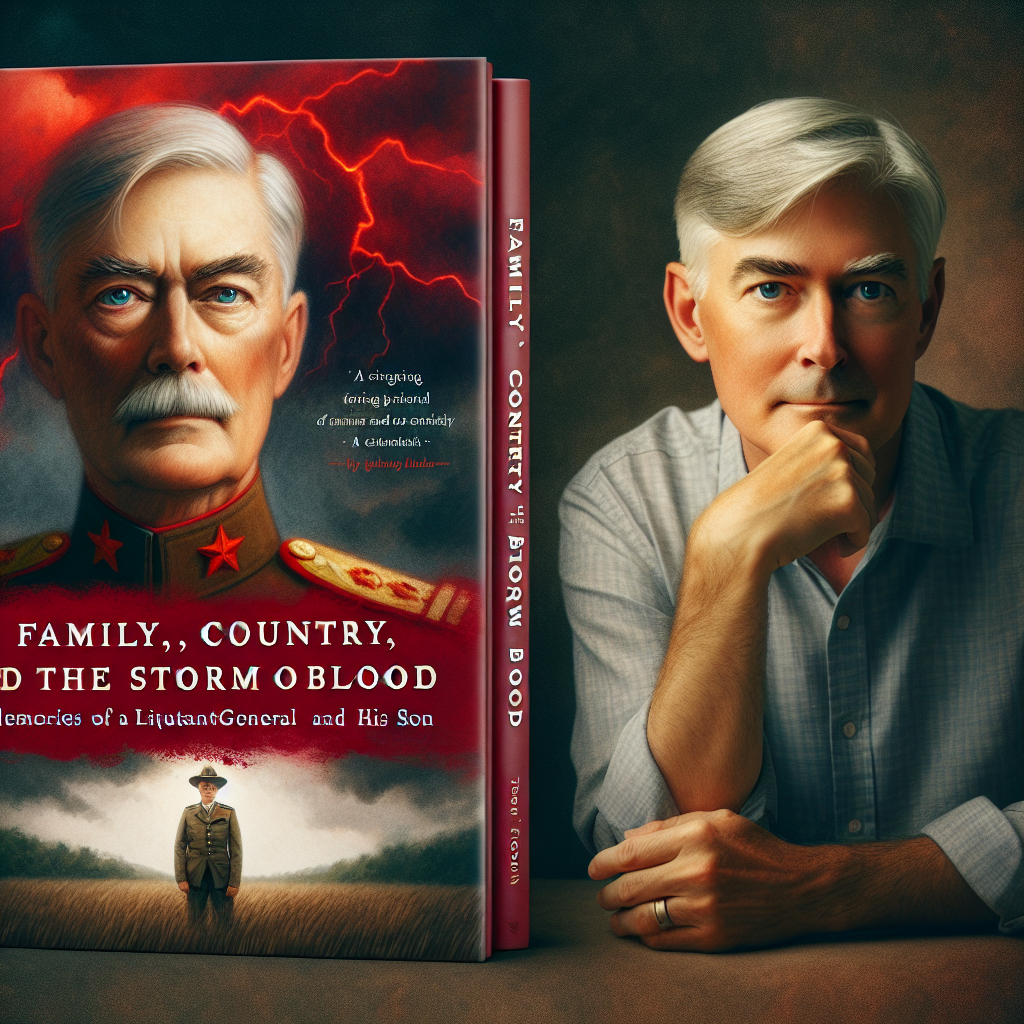
【Epoch Times News December 4, 2025】 Lieutenant General of the Nationalist Party, senior “POW” Wen Qiang and his son Wen Guanzhong (retired professor of economics at Trinity College, USA) jointly authored the memoir “Family, Country, and the Storm of Blood – Memories of Wen Qiang and His Son After the Calamity” (Volume One, Volume Two), recently published by Boden Publishing House. The book launch was held on December 2 in Manhattan, New York.
Wen Guanzhong shared that his father’s life reflected the great turmoil China experienced for over a century. The story of the Wen family, with its tragedies and separations, serves as a microcosm of the Chinese people’s hardships. He also narrated his father’s nearly 27 years of brainwashing in Communist prisons, reflecting on his father’s thoughts and changes in his later years.
Wen Qiang, a graduate of the Whampoa Military Academy’s fourth class, participated in the Northern Expedition, witnessed the Nanchang Uprising, and held positions within the Communist Party, including serving as a Standing Committee member of the Sichuan Provincial Party Committee and Acting Secretary of the Military Commission. He later defected from the Communist Party, returned to the Nationalist Party in 1936, and quickly became a key figure in the military intelligence organization formed to resist Japan. He eventually rose to the rank of Lieutenant General in the Republic of China Army.
During the Huaihai Campaign, he served as the Chief of Staff for the Xu Zhou Elimination Headquarters and was captured by the Communist forces in January 1949. He endured almost 27 years of torment in the Good Deeds Forest Prison and Qin Cheng Prison before being released as one of the final “pardoned prisoners of war” in 1975.
After the outbreak of the Civil War between the Nationalists and the Communists, Wen Qiang arranged for his wife and children to move to Taiwan. However, upon learning of Wen Qiang’s capture, his wife disregarded all risks and returned to the mainland in search of him. Upon hearing news of the imminent blockade of Shanghai, she sent a telegram instructing the nanny to take the children on the last ship from Taiwan to Shanghai, reuniting the family in Shanghai.
As the wife of a “war criminal” and a returnee from Taiwan, she was labeled as a “counter-revolutionary,” stripped of her public position, and subjected to three years of forced labor. She was continuously interrogated about her return from Taiwan and whether she had any “special missions.” Unable to bear the humiliation, one spring night in 1955, she died by inhaling gas at home.
From that moment, Wen Guanzhong and his brother became “orphans” facing hardships, but their grandmother, a member of the “red category,” never abandoned the children of the “black category” descended from “counter-revolutionaries.” She endured humiliations alone, supporting the shattered family on her own. In her final moments, she awaited Wen Qiang’s release for a last reunion. Wen Qiang passed away at the age of 95 in 2001.
The memoir is divided into Volume One and Volume Two. Volume One titled “Memories After the Calamity” was finalized in 1997, representing Wen Qiang’s legacy. Volume Two titled “Blood, Tears, and Storm” was tearfully penned by Wen Guanzhong, capturing the interactions between father and son and the poignant story of the grandmother, a former nanny, nurturing the descendants of the Wen family amid the tumult of political movements.
In the preface of the book, Wen Guanzhong wrote, “From my father and my own experiences, it is evident that on the path towards the noble ideal of common prosperity, there are too many temptations and misconceptions, with Communism being the most alluring yet treacherous path.”
Wen Guanzhong mentioned that his father completed the memoir “Memories After the Calamity” at the age of ninety but only wrote his life until 1949, refusing to delve into the unbearable prison years. When the manuscript was submitted to the National Committee of the Chinese People’s Political Consultative Conference, he expected swift publication, only to receive the response questioning why, as a war criminal, he didn’t address his reform in the Good Deeds Forest and Qin Cheng prisons.
Facing the rejection of his manuscript by the Political Consultative Conference, his father did not compromise or gloss over the years of unjust imprisonment, refusing to conform to the Communist narrative or make any further revisions.
In recent years, after Wen Guanzhong’s retirement, he dedicated time to thoroughly reviewing his father’s legacy. Under the invitation of Boden Publishing House President Rong Wei, the memoir was published, allowing the precious historical materials to see the light of day once again.
In Volume One, Wen Guanzhong included three of his own articles. He analyzed the reasons behind his father’s abandonment of the Communist party’s violent path in his final years and return to the Three Principles of the People. He also delved into the cruel reality of the Communist war criminals and the amnesty policy, and the enduring injustice his father faced.
The most touching part of the book is the story of the grandmother – despite the mother’s suicide and her will that the children be sent to an orphanage and the grandmother take all the money and valuables back to the countryside for retirement, she never abandoned the Wen family, standing by them through thick and thin.
In the ruthless political struggles, the grandmother displayed a great human spirit. During an interview with this newspaper, Wen Guanzhong expressed, “This is the essence of traditional Chinese culture running through her veins – kindness, love, and gratitude, values that people should preserve and promote.”
He further stated, “In the cruel class struggle that stirs up enmity with hatred, modern China is still embroiled in political movements and running the country on the basis of these movements, rather than through constitutional governance and the rule of law.”
At the book launch event, several experts and scholars highly praised the memoir. Legal expert Yu Ping said, “The history of the Wen family is unparalleled, embodying the suffering of the Chinese people.”
Scholar Zhang Aimei remarked, “The grandmother, as part of the ‘red category,’ enduringly cared for the Wen family, descendants of the ‘black category,’ showcasing her great humanity in stark contrast to the ruthless Communist system.”
Political commentator Hu Ping commented, “This memoir is deeply emotional, with a compelling and intricate storyline. It should be adapted into a film.”