
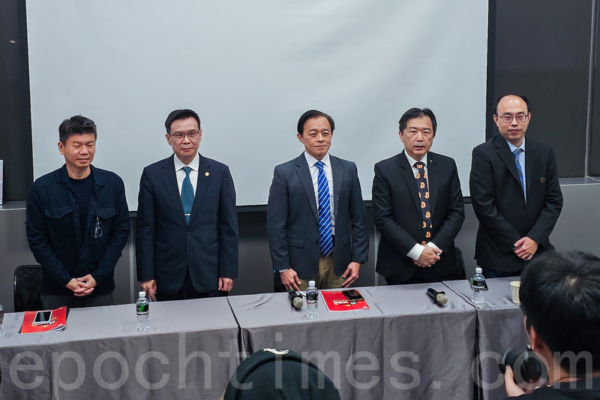
On November 29th, the Taiwan “National Anti-Counterfeit Society” held its annual forum with two main themes. One of the themes focused on “Dispelling Fraudulent Signals from Rhetoric.” Experts revealed the operationalization of fraudulent groups as an industry, urging the public to be vigilant.
The “National Anti-Counterfeit Society” stated that one of the forum themes invited government departments, civil organizations, and the industry to participate, focusing on third-party payment, digital anti-fraud efficiency, AI, and fraudulent tactics. After being certified by the International Fact-Checking Network (IFCN), the association became the third organization in Taiwan to receive international recognition for fact-checking, continuing to deepen its fact-checking capabilities through public-private cooperation. This forum was also deemed an important milestone in promoting a healthy information environment.
Chairperson of the “National Anti-Counterfeit Society,” Gu Ling-Ling, pointed out that with the difficulty in identifying artificially fabricated news in the past, the use of generative AI today has made distinguishing fake news even more challenging. This technology is now even being utilized in fraudulent activities, making AI against AI a growing trend.
Minister of the Digital Development Department of the Republic of China, Lin Yi-Ching, stated that the government continues its active efforts to combat fraud, such as establishing the “Online Fraud Reporting and Inquiry System” in 2024. This system follows a semi-automated operational process to verify fraudulent messages and report them for removal from platforms.
Lin Yi-Ching reported that within a year of the website’s launch, over 220,000 fraudulent messages had been removed and that platforms like Meta were used as training data for algorithms. He emphasized that combating fraud is a battle between good and evil, requiring an expansion of the “team of good” assisted by AI tools for a more efficient fight.
Director of the Fraud Supervision Center of the Investigation Bureau of the Republic of China Ministry of Justice, Chen Mao-Yi, emphasized that fraudulent groups have moved towards “industrialized operations,” with roles specializing in hacking, script design, call centers, money laundering, and additional contributing factors. With roles spread across borders, investigations become even more challenging. He warned that when encountering fraud, individuals must be cautious, as “seeking verification” can dismantle most scripted fraud scenarios. The government has also established dedicated units to work collaboratively in building an anti-fraud network.
Secretary-General of the Anti-Fraud Alliance and Assistant Professor at the Department of Crime Prevention and Control of Ming Chuan University, Lin Shu-Li, believes that “AI technology is a double-edged sword” and identifies three major poisons of fraud: hacker attacks, social engineering, and money laundering. He highlighted elderly populations as high-risk groups, advocating for prioritizing fraud prevention education and protective measures for this demographic.
Chairman of the Taiwan Digital Security Development Association, Liu Yan-Bo, urged the government to collaborate with social media platforms to strengthen “ad review” and “take down mechanisms,” supporting the enactment of relevant laws to require platforms to implement real-name advertisement regulations.
Vice-Secretary-General of the Republic of China Third-Party Payment Service Industry Association, Chen Yan-Fu, emphasized that in preventing fraud, there is a need for “more thoughtful and slower action.” The government should integrate operators and civilian reporting mechanisms to rapidly intercept fraudulent patterns and encourage the sharing of these patterns among members to expedite interception.
The “National Anti-Counterfeit Society” called on media, educational institutions, and various sectors of society to recognize the dangers of false information, collectively fostering a healthy information environment. They welcome like-minded partners to join hands in deepening the professionalism of fact-checking, expanding educational influence.