
【Epoch Times News on February 3, 2025】(Reported by Ning Haizhong and special reporter Chang Chun)
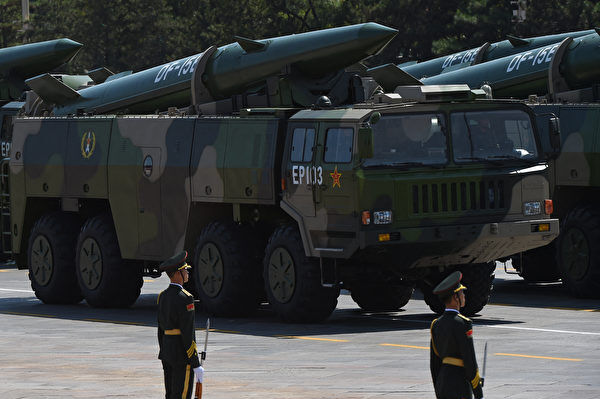
Editor’s Note: Recently, the Chinese Communist Party (CCP) has been showcasing its military achievements frequently. The stealth fighter J-35A has been touted as the “world’s best stealth performance,” following the official launch of the first domestically produced 076 type amphibious assault ship, which has sparked enthusiasm among some nationalistic Chinese internet users. In recent years, the CCP has deployed J-20 fighter jets, Dongfeng missiles, Type 071 large landing ships, and other military equipment in military exercises near Taiwan, creating a tense atmosphere. However, Chinese military industrial enterprises have long been plagued by corruption and infighting.
The China Shipbuilding Heavy Industry Group, responsible for refitting the Ukrainian Varyag aircraft carrier into the Liaoning, the first domestically made aircraft carrier, and for building the domestic aircraft carrier Shandong, saw its general manager Sun Bo and chairman Hu Wenming fall from grace. Tan Ruisong, former chairman of the China Aviation Industry Corporation, which produces the J-series fighter jets, was ousted last year for corruption. Yang Wei, an expert known as the “Father of the J-20,” was recently dismissed. Senior executives of China Shipbuilding Group, which produced the domestic 076 amphibious assault ship, have also recently been secretly purged.
The military strength of the CCP is a topic of interest in the international community, with various reports and analyses providing different perspectives. Recently, in an exclusive interview with the Epoch Times, former senior military industrial figure Zhao Jie, who has been directly involved in military product manufacturing for 13 years, shared his insights, shedding light on the CCP’s military industrial capabilities.
Born on October 14, 1991, in Luoyang, Henan Province, Zhao Jie is a member of the China Democratic Party and has been in the United States since 2023. He studied CNC machine tool programming at Luoyang Motorcycle Technical Institute in 2006 and worked in military product machining at Luoyang OEMT Precision Parts Manufacturing Company until 2023, when the company was reorganized into the Luoyang Ouchi Precision Parts Manufacturing Company, where Zhao Jie served as the deputy head of the technical department.
Interviewer: Please introduce the specific military products you have encountered during your work in China, as well as the situation of military research and development institutions you were in contact with.
Zhao Jie: When I first joined Luoyang OEMT Precision Parts Manufacturing Company, we were informed that companies with foreign backgrounds were not allowed to engage in the research and production of military products. In 2011, the company was reorganized and renamed Luoyang Ouchi Precision Parts Manufacturing Company. During my work, I participated in the design and production of many CCP military products, such as the Z-10 armed helicopter, J-20 fighter jet, and Thunder series air-to-air missiles.
I worked on the production line for five or six years, then moved to the technical department and later to the marketing department. I came into contact with officials from many research institutes and military representatives, visited many institutes’ confidential departments.
Luoyang is a heavy industrial city where many CCP military industrial projects are based, such as the Luoyang First Tractor (Manufacturing) Factory, which manufactures army tanks and armored vehicles, as well as the Luoyang Northern Industrial Group (affiliated with the China Ordnance Equipment Group), Luoyang Air-to-Air Missile Research Institute (612 Institute), Luoyang Electro-Optical Equipment Research Institute (613 Institute), China Aerospace Optoelectronics Technology Co., Ltd. (158 Factory), China Shipbuilding Heavy Industry Group’s 725 Research Institute, and Henan Diesel Engine Heavy Industry Co., Ltd. Many of these units’ products have been worked on by our company, with a focus on air force products.
Interviewer: Your company seems to be a private enterprise, but it has been producing military products all along. Is this related to the CCP’s recent military-civilian integration efforts?
Zhao Jie: The original Luoyang OEMT Precision Parts Manufacturing Co., Ltd. was not founded by Chinese people; it was established by a Chinese national with Thai and American citizenship. The company was later renamed, and I know that the leaders of both the Luoyang Electro-Optical Equipment Research Institute (613 Institute) and the China Air-to-Air Missile Institute have shares in our company, though not personally but through their close relatives. They receive dividends from the company each year.
Although we are a private enterprise and our name may not have much to do with military industry, all our work is related to military products. The Air-to-Air Missile Research Institute and Electro-Optical Equipment Research Institute, these two air force research institutions, design products, and when the drawings are completed, we are responsible for production. If improvements to the process are needed or redesigns are necessary, we discuss how to proceed together.
Interviewer: The situation of the CCP’s military product production and research and development seems opaque, with rapid development in recent years. What are your thoughts on this?
Zhao Jie: In fact, it was only after the collapse of the Soviet Union that the CCP’s military industry experienced a surge in development. After the Soviet Union’s collapse, the economy faced a crisis and needed to sell equipment, such as the Su-27 fighter jet, Kilo-class submarines, and Ukrainian equipment, including the Yebao hovercraft (referred to as the Type 728 hovercraft by the CCP), which were sold to China for imitation. We undertook a lot of this imitation work—I personally experienced the Su-27, which the Chinese copied into the J-11 on a 1:1 scale. The Z-10 armed helicopter, with its optoelectronic devices, sights, and mechanical parts, was also produced by us.
After coming to the United States, I met many Chinese people who spoke to me about the CCP’s J-20 fighter jet, and more recently, the sixth-generation fighter. They seemed to think that various weapons were quite advanced, but I told them that they didn’t really understand. The CCP’s system means that technology can only be imitated and lacks true innovation. Having worked with 613 Institute for so many years, I know firsthand that under a dictatorship, corruption thrives—leaders at 613 Institute are greedy and eager for achievements. Important projects that would normally take a long time to accomplish and develop are rushed and copied hastily. This is a nationwide phenomenon.
Why do I frequently compare the current state of the Chinese military industrial system with that of the Soviet Union? Both are dictatorships that concentrate all funds intended for civilian purposes on military endeavors. They may produce through imitation or some limited innovation, but the products are like fireworks, blooming briefly, or like balloons—just inflated. In contrast, the Western military industrial complex involves multiple industries, including materials, semiconductors, and machining, showcasing a country’s comprehensive strength through a single military industry.
The apparent prosperity in military industry that you see is partly due to imports from the Soviet Union, Ukraine, or purchased from the international arms black market.
Interviewer: Do you have any insights into the local military industrial system in Luoyang and the international arms black market trade?
Zhao Jie: Because I worked in the technical department for several years, we often communicated with and got to know people from 613 Institute. Later, when I moved to the marketing department, I had to entertain some leaders or military representatives from research institutes, bribing them through meals. In the Chinese environment, companies need to engage in these practices to secure contracts.
As an external contractor, I wasn’t allowed to visit their internal facilities, but since I knew many leaders in the marketing department, they took us deep into 613 Institute, specifically the Luoyang Electro-Optical Equipment Research Institute (613 Institute) and directly into its core.
I went in and saw. Leaders told me that certain items, like a laser target designator mounted on an aircraft, were purchased from the international arms black market. When I visited, it had already been disassembled, with each part laid out. They said we needed to measure it on a three-dimensional coordinate system, replicate it in a 1:1 ratio, remake and assemble it, then hand over the task to our unit within a specified time frame to complete. It was a difficult task; assembling nine parts, involving coordination among multiple departments, while ensuring a certain level of precision. It took us four and a half months to finish processing.
I also saw scraps from helicopters, products from fighter jets, and parts possibly from some military equipment. This leader said these items were left behind by American and Western countries. For example, when the American military withdrew from Afghanistan, they left behind many weapons and equipment. Many countries have left behind a large number of Western and Soviet-era equipment, which the CCP buys at high prices through political and monetary transactions, bringing them back and distributing them to various research institutes domestically for 1:1 replication.
I even saw things similar to engine blades that were damaged, indicating that the CCP searches many countries worldwide, especially in conflict zones, to purchase and scavenge for such items.
I’ve seen similar things at peer companies, as well as during visits to 613 Institute, 610 Institute, and 725 Institute. All the top-notch machine tools, measuring equipment such as coordinate measuring machines—the best of which can measure down to nanometer precision—all the cutting tools we use are sourced mainly from abroad. That’s why we are able to take on projects from these CCP research institutes; 80% of what we use comes from foreign countries. Our coordinate measuring machines come from Germany, five-axis machine tools from Czechia, and all measuring tools are Swiss made. Our cutting tools are top brands from Germany and Japan; second-tier brands come from South Korea and Taiwan, and lower-tier ones are domestically produced, like Fujian Jinlu and Zhuzhou Diamond, for example.
The CCP’s key machinery comes from abroad. Once they dare to wage war against Taiwan, the West could cut off the supply of these machines immediately.
However, I suspect that 613 Institute did not purchase equipment through regular channels; it was likely acquired through the black market. Western countries require China to purchase advanced five-axis machine tools from the United States, Japan, and Germany, but only if they report the intended use—which can be for civilian purposes—before permission is granted to sell. After the sale, the installation site of this machine tool must be GPS tracked; any movement will immediately lock down the machine tool, rendering it inoperable, with the entire operator interface disabled. The machine tool is effectively rendered unusable if the location is altered. Prior notice must be given to the foreign equipment selling companies, and according to the agreement, military production is forbidden.
However, during my time at 613 Institute, I saw some CNC machine tools specifically used for military production. I asked the leader at the time about a five-axis machining center, good quality with dual power heads and a dual clamping system, saying, “Where did you purchase this?” Because the five-axis machine tool we bought from Czechia was single-clamping and single-power heads, when purchasing it, we had to explain its use for many days. We had to emphasize that it was mainly for civilian production, and only then did they agree to sell it to us.
The CCP may be able to clandestinely produce some items, but once they need to engage in actual warfare, their daily production capacity is limited, and warfare is about exhaustion: the rate of production must keep up with the rate of depletion.
Interviewer: You mentioned corruption in those military units. The CCP’s anti-corruption campaigns in the military industry seem effective. In your work, how does corruption affect the military industry?
Zhao Jie: For example, in a project, where you are responsible for the helmet of the Z-10 helicopter, if the budget allocated by the state is ten million yuan, sometimes half of the budget is not met, with most of it siphoned off by corruption. For instance, the state gives the 613 Institute ten million yuan; the institute takes away five million and then subcontracts the remaining five million to us external units. However, we cannot take the full five million, needing to set aside nearly one million to bribe the leaders at 613 Institute, so only around four million remains for your entire production cost—materials, including labor. How could we possibly develop good products under these circumstances?
Moreover, when we were tasked with replicating weapons, making prototypes was a one-off process. They would give us ample time to complete it; for example, it took us four and a half months to make a prototype. After it was verified as being qualified, they would then order 100 or 50 sets. This is where corruption truly manifests. The state might purchase a product, say, for half a million yuan per set; they would give only a quarter to us, who would then have to bribe them, after which we must buy materials. And when the final products are produced, some have very poor precision, even substandard. For example, if they demanded a tolerance size of a hair’s breadth, which is 0.01 millimeters, sometimes the machining error could be 0.03 or 0.04 millimeters, which would still pass inspection because they took bribes and let these products through.
Another example is a bolt on the Z-10 helicopter, which the 613 Institute contracted out for production to an external contractor. This bolt required a specific hardening method for high hardness, but because of cost considerations, they skipped the hardening process. After the bolt was produced, without visible defects, only detectable through instruments, with 613 failing to check, they mounted the bolt directly onto the aircraft. During a test flight, the aircraft crashed due to the bolt failure—it was a serious incident.
This incident was later reported and criticized; the photos of the aircraft wreckage were shared in our WeChat group. This must have been in the summer of 2021. Later, I attended a meeting with our leaders at the research institute, where they displayed photos of the aircraft wreckage. Upon seeing it, I realized that it was the Z-10 helicopter that had crashed while taking off during training.
Interviewer: In all these years working in the military industry, what has been the darkest thing you have seen?
Zhao Jie: During my time in the marketing department for a year and a half, I interacted with the ministers inside those research institutes, including retired deputy directors and directors of 613, as they had arranged their close relatives to be placed at the institute. Therefore, even though they had retired, they still wielded significant power. Sometimes we asked them out to dinner; they themselves expressed that they didn’t care at all. For instance, there was a leader who had retired; at private banquets, he was somewhat uninhibited, drinking a bit. He said, “Xiao Zhao, let me tell you, I really look down on the amount of money you gave me.”
Every Lunar New Year, we give a bonus ranging from eighty thousand to a hundred and fifty thousand yuan, based on the tasks given to us by the working relatives of these leaders. They even said they were unimpressed by the money we gave them.
After they retired, some of these leaders, despite their extensive power, expressed a complete disregard for money, food, or even beautiful women. They just liked to retain control and had a craving for power. During their tenure, they established a civilian company and used it to purchase expensive foreign flow valve controllers, one set costing 300,000 yuan. Upon returning, they deliberately damaged some inconspicuous parts of the components, claiming that the damage was accidental. Then, they reported it as scrap, sold it as scrap metal at the price of such, to an external company which they controlled, who then repaired the damaged sections and resold the item to 613. This was one of the darkest scenes I have witnessed within the CCP system.
Some retired leaders once told me something that left a deep impression on me. They said that after retiring, they lost the power that gave their lives meaning and no longer had any purpose. Despite having ample food and all sorts of beautiful women, the thing they truly enjoyed was holding power. When they were in office, they maintained control over the purchasing of foreign products. Some even set up a private company for the purchases and resold the equipment to the institutes. For example, they would purchase expensive flow valve controllers, claiming it was costly, and when damaged, they sold it back as scrap to a company that they controlled, which would then repair the believed-to-be faulty parts, reselling it back to 613. This was a dark moment I witnessed under the CCP system.
These retired leaders also mentioned to me one phrase that had a profound impact: upon retirement, they lost power, leading to a loss of significance in life. Regardless of having enough food and all kinds of comforts, what they truly pursued was a higher-ranking position. However, without powerful connections, their prospects for advancement were slim. I saw some instances where they began to exhibit borderline psychological characteristics, deriving satisfaction through tormenting others, seeking pleasure by making life difficult for others.
Interviewer: Finally, how do you evaluate the CCP’s military industrial complex and the direction of this regime? What should the West do?
Zhao Jie: Based on my personal experience, the CCP’s military industrial complex may seem prosperous on the surface, but it is similar to historical examples like the Qing Dynasty’s Beiyang Fleet or Russia’s so-called “Steel Bear” grouping—unfit for actual warfare. They are like inflated balloons, appearing strong and large but easily pierced by a needle.
I firmly believe that we, members of the China Democratic Party, are on the right side of history. The CCP need not be overthrown; it will crumble on its own. This has been evidenced by the fate of the Soviet Union.
Of course, I also call on the international community to adopt stricter measures to sanction private companies connected to the CCP government or collaborating with the CCP. This would particularly involve restricting the import of materials from the West, including cutting tools, machine tools, and various other supplies. Without access to the raw materials and machinery necessary for military production, the CCP would be unable to continue its activities.