
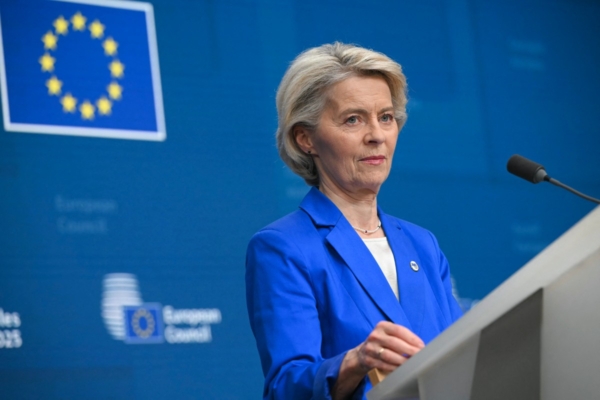
The European Union announced on Wednesday, December 3, that a temporary agreement has been reached to completely phase out Russian natural gas by the end of 2027, aiming to reduce dependence on Russia and increase financial pressure on the country. The temporary agreement must be approved by the Council and the European Parliament before it can be formally adopted.
The European Union Council’s press office stated that the rotating presidency of the Council and representatives of the European Parliament reached a temporary agreement on “the gradual elimination of Russian natural gas imports.” This provision is a core element of the EU’s energy crisis response plan “REPowerEU,” aimed at ending reliance on Russian energy, ensuring energy supply security, and achieving energy independence.
The temporary agreement requires EU countries to gradually stop importing Russian liquefied natural gas (LNG) and pipeline natural gas, and to completely stop importing Russian LNG by the end of 2026. Additionally, starting from the fall of 2027, the import of Russian pipeline natural gas will be fully prohibited.
Danish Minister for Climate, Energy, and Utilities, Lars Aagaard, said, “This is a significant victory for us and the whole of Europe. We must end the EU’s reliance on Russian natural gas, and the EU’s permanent ban on importing Russian natural gas is an important step in the right direction. We are pleased to have quickly reached an agreement, demonstrating a strong determination to enhance security and safeguard energy supply.”
During the Russia-Ukraine war, Russia used natural gas supply as a weapon, causing significant disruptions to the European energy market.
Six weeks after the regulation takes effect, new contracts for Russian natural gas imports will be prohibited. Existing contracts during the transition period will be preserved, with modifications limited to specific operational purposes, and import volumes cannot be increased.
For short-term contracts signed before June 17, 2025, the import of Russian liquefied natural gas will be banned from April 25, 2026, and the import of pipeline natural gas will be banned from June 17, 2026.
Long-term contracts for liquefied natural gas will be prohibited from January 1, 2027, in sync with the 19th round of sanctions. The ban on long-term pipeline natural gas contracts will come into effect no earlier than September 30, 2027, provided that storage goals are expected to be met, and no later than November 1, 2027.
The European Council and the European Parliament require prior authorization for both types of natural gas imports. Information required for applying for authorization for existing Russian natural gas imports during the transition period must be submitted one month before import.
For non-Russian natural gas, relevant documentation must be submitted at least five days before import. Natural gas imported through the Strandzha 1 interconnection point must be submitted seven days in advance.
To ease administrative burdens, countries meeting certain conditions can import natural gas without the need for prior authorization. Conditions include being a major gas-producing country, banning the import of Russian natural gas, or having facilities without gas input or reception. The European Commission may update the exemption list based on monitoring and may remove countries if evasion behavior is detected.
The agreement requires all member states to submit plans on how to source natural gas or oil from multiple sources. Member states must notify the European Commission within one month after the regulation comes into effect whether they have signed Russian natural gas supply contracts or have implemented domestic prohibitory measures.
Member states still importing Russian oil must also submit plans to halt related imports. The European Commission stated that legislative proposals to gradually phase out Russian oil imports will be submitted no later than the end of 2027.
The European Council and the European Parliament have added penalties for violators in the agreement, with deterrent fines and a maximum fine amount for companies and individuals. Additionally, the agreement includes suspension clauses allowing temporary suspension of the ban in case of emergency threats to one or more member states’ energy supply security.
The temporary agreement sets stricter conditions for “temporary lifting of import bans,” which can only be activated under the following circumstances: (1) there must be valid reasons for lifting the ban, not arbitrary; (2) member states declare a state of emergency; (3) the ban can only be temporarily lifted; (4) only short-term contracts may be applicable.
The European Commission will review the implementation of each country within two years after the regulation takes effect.