
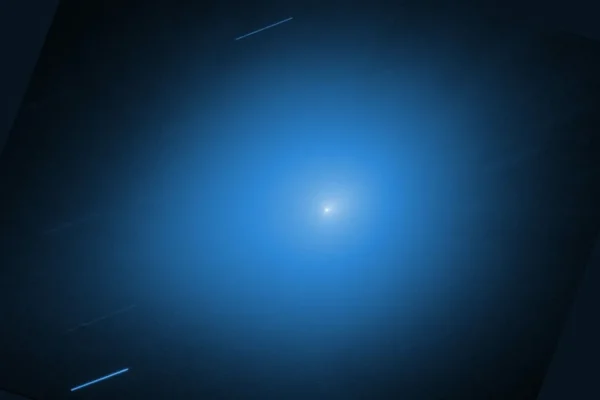
Interstellar visitor 3I/ATLAS has sparked a global space mission race as it exits the solar system. The latest X-ray observations have not only captured the brilliance it emits, but also revealed the astonishing scale of the rare comet’s interaction with the solar system environment.
The X-ray Imaging and Spectroscopy Mission (XRISM), a collaborative effort between the Japan Aerospace Exploration Agency (JAXA), the National Aeronautics and Space Administration (NASA), and the European Space Agency (ESA), made the groundbreaking first X-ray observations of 3I/ATLAS.
In late November, XRISM successfully captured the comet, revealing a faint X-ray radiation structure extending up to 400,000 kilometers (250,000 miles) around it. This marks the first time that humanity has detected X-rays from an interstellar comet.
These rays are believed to be the result of a “charge exchange reaction” between gases released by the comet and solar wind from the sun, providing direct evidence of how this interstellar object is influenced by the solar system environment.
However, researchers caution that further analysis is needed to exclude the influence of instrument noise and ultimately confirm whether this massive 400,000-kilometer structure belongs to the comet itself.
As the third interstellar object observed so far and currently following a hyperbolic trajectory, meaning it will permanently leave the solar system, the global space telescopes are racing against time to gather data on 3I/ATLAS.
JUICE: The European Space Agency’s Jupiter Icy Moons Explorer (JUICE), originally destined for Jupiter, observed 3I/ATLAS from 66 million kilometers away in early November. The limited data returned confirmed the comet has a plasma tail and a dust tail.
Hubble: NASA’s Hubble Space Telescope captured clear images of the comet on November 30, showing its teardrop shape and confirming its rapid departure along a trajectory unrestrained by the Sun’s gravity.
The comet is set to reach its closest point to Earth on December 19, at a distance of approximately 270 million kilometers, posing no threat to our planet.
As 3I/ATLAS continues its journey farther away, scientists are eagerly awaiting more high-resolution images and particle data from the JUICE mission in February to provide the final clues about the composition and origin of this rare interstellar object.