
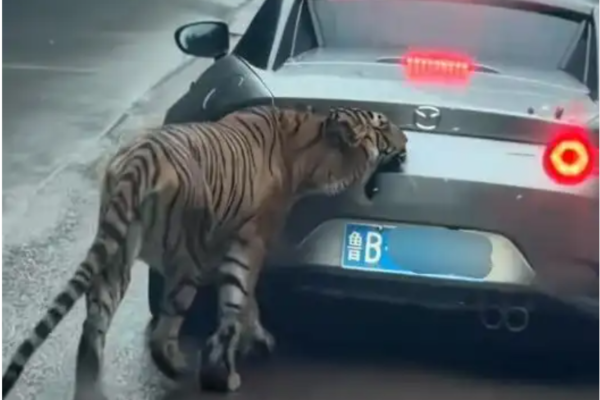
On December 7th, a woman in Chongqing drove her car into the predator area of a zoo and was chased and bitten by a tiger, causing damage to the paint of her vehicle. This incident has sparked a public reflection on the safety of driving close to wild animals in zoos. The news quickly went viral.
According to a video released by media outlets like 5 Video under the CCTV on December 8th, a tiger was seen chasing a silver sedan, repeatedly pouncing on the rear of the car and biting it.
In the video, a woman said, “Perhaps my car was the smallest, and the tiger kept chasing and biting it. There was no food in the trunk, so only a bit of paint was bitten off from the back.”
Following the release of the video, the public expressed relief that the visitor was unharmed, but it also reignited the discussion on the safety of “self-driving through predator areas.”
Currently, some wildlife parks in China, such as Beijing, Qinhuangdao, and Luoyang, allow visitors to drive through areas where tigers, lions, bears, and other predators roam freely, promoting it as an “immersive experience.” Tragic incidents have occurred in the past where visitors exited their vehicles within the zoo premises, attracting predators and leading to fatal attacks. In September 2025, at Qinhuangdao Wildlife Park, two tour buses collided, and visitors got off their vehicles in the predator area, attracting a white tiger. In 2016, at Beijing Badaling Wildlife Park, a visitor who exited their vehicle was attacked by a tiger, resulting in one death and one injury, which caused a public outcry.
In response to these incidents, the mainland Chinese self-media personality, “Hot Search Stroller,” stated on December 9th that a tiger’s biting force can reach 450 kilograms, enough to break through regular car windows or tear apart door seals. Once a vehicle malfunctions, the glass shatters, or a passenger protrudes, the consequences could be unimaginable.
Furthermore, the management of zoos amplifies these risks. These parks generally require visitors to “lock their doors and strictly prohibit exiting the vehicles,” repeatedly emphasizing this through informational cards, broadcasts, and patrol vehicles. However, safety management still relies on the visitors’ awareness, lacking intelligent monitoring and emergency interception systems. In the event of a collision, malfunction, or visitor error, the consequences are unpredictable.