
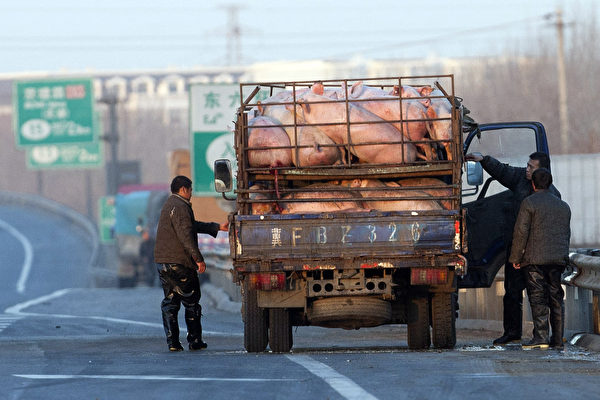
Three of China’s major listed pig companies, Muyuan Foods Co., Ltd. (Muyuan), New Hope Liuhe Co., Ltd. (New Hope), and Wens Food Group Co., Ltd. (Wenshi) have all released their sales data for November on December 5th and 6th, revealing a concerning trend of five consecutive months of year-on-year stagnant revenue growth.
Wenshi was the first to unveil its data on December 5th, showing in its “November 2025 Main Product Sales Briefing” that its sales revenue for live pigs was 5.199 billion yuan, up 2.99% month-on-month but down 14.19% year-on-year.
On the 6th, Muyuan and New Hope successively presented their “November 2025 Sales Briefing” and “November 2025 Live Pig Sales Briefing.” Muyuan reported a revenue of 9.39 billion yuan from selling commercial pigs, down 9.1% month-on-month and 20.43% year-on-year. New Hope’s revenue from selling live pigs was 1.812 billion yuan, a decrease of 5.53% month-on-month and 11.61% year-on-year.
According to the data, all three companies experienced a year-on-year decrease in sales revenue, but interestingly, the data also indicated a year-on-year increase in the quantity of commercial pigs sold by all three enterprises. Wenshi sold 4.3535 million live pigs, an increase of 49.71% year-on-year; Muyuan sold 6.602 million commercial pigs, a 11.8% year-on-year growth; New Hope sold 1.5675 million live pigs, a 24.44% year-on-year increase.
Moreover, on December 6th, The Paper reported that these three pig companies have been experiencing stagnant revenue growth in live pig sales for the past five months.
In addition, when looking at the average selling price, all three major listed pig companies have witnessed a year-on-year decrease, ranging between 28% to 31%. In November, Muyuan’s average selling price for commercial pigs was 11.56 yuan per kilogram, a 28.73% year-on-year decrease. Wenshi’s average selling price for hogs was 11.71 yuan per kilogram, down 29.92% year-on-year. New Hope’s average selling price for commercial pigs was 11.54 yuan per kilogram, a 30.02% year-on-year drop.
New Hope attributed the larger year-on-year price decline to the changes in the Chinese live pig market.
From the end of October to the end of November, the price of pigs in China has shown a downward trend, dropping to 11.3 yuan per kilogram. Entering December, the Chinese live pig market has been weak, with prices hovering around 11.4 yuan per kilogram.
China National Radio and “Pig Friends Baba” stated on December 4th that with the peak demand for traditional pork products approaching, the price of pork may gradually rise to around 12 yuan per kilogram before the Winter Solstice (December 21st). However, after the Winter Solstice, as market demand decreases and the willingness to sell pigs remains strong among breeders, the industry still faces significant overcapacity, which may weigh on pork prices. Some institutions are concerned that the quoted prices for standard-weight pigs (typically weighing around 100kg to 125kg) may once again show a downward trend.
Public data indicates that year-on-year figures can eliminate seasonal factors, providing a more accurate analysis of long-term trends; identifying an enterprise’s long-term trends, especially during unstable economic environments; year-on-year data allows for a fairer comparison across different years of economic environments, market conditions, and policy backgrounds. On the other hand, month-on-month data focuses on short-term fluctuations and is often influenced by seasonal factors, leading to larger fluctuations in the growth rates reflected by it.