
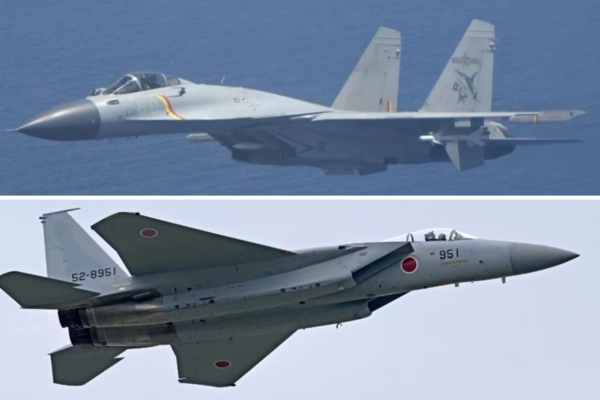
On Monday, December 8th, the Japanese government rejected the Chinese Communist Party’s claims regarding the monitoring and harassment of Chinese military aircraft by the Japan Air Self-Defense Force over the weekend. The previous day, Japan stated that a Chinese J-15 fighter jet had locked onto a Japanese Air Self-Defense Force aircraft with its radar.
In a press conference on Monday morning, Chief Cabinet Secretary of the Japanese government, Toshihide Kinbara, stated, “China (the CCP) claims that the Self-Defense Force aircraft seriously impeded the safe flight of Chinese (CCP) aircraft, but this claim is unfounded.”
Kinbara mentioned that during the “dangerous” incident that occurred in the international waters southeast of Okinawa on Saturday, Chinese Liaoning carrier-based aircraft had radar-locked Japanese aircraft, and Japan “will continue to respond calmly and resolutely”.
Radar, more specifically the fire-control radar on aircraft, is used to lock onto enemy targets when launching missiles, emitting a potential attack signal.
The first time the Chinese military targeted Japanese Self-Defense Forces with radar was in January 2013. At that time in the East China Sea, Chinese navy ships targeted a Maritime Self-Defense Force escort ship with fire control radar to prepare for firing.
Radar is a device that measures distances to the other party through calculating radio wave reflections, mounted on ships or fighter planes. It is used not only for search purposes but also to confirm the distance to attack targets when launching missiles at enemy targets. Once the radar is activated, it could be seen as entering the attack preparation stage.
The Japan Times reported that some former Self-Defense Force officials stated that activating aircraft’s fire-control radar is seen as a highly provocative act because it is the first step before opening fire on a target.
The Defense Ministry determined that during the incident on Saturday, Chinese aircraft using radar was not for search and rescue purposes, as Self-Defense Force aircraft were only sporadically under attack.
The incident sparked strong opposition from Japan’s ruling party. The Liberal Democratic Party held an emergency meeting on Monday (8th) morning to hear explanations from the Defense Ministry and discuss countermeasures. Anger over China’s actions was expressed during the meeting as being “extremely dangerous and absolutely unacceptable”.
Takahiro Kobayashi, the head of the LDP’s Policy Affairs Council, stated: “This could very easily lead to an accidental conflict.”
Gonichi Onodera, chairman of the LDP’s Security Investigation Committee, mentioned: “The level of danger has undoubtedly escalated significantly, and this should be viewed as a provocative act.” Some senior members of the party also called for the LDP to officially pass a resolution condemning China (CCP).
The Defense Ministry stated that between the 6th and 7th of the radar-incident days, a total of 100 takeoffs and landings were confirmed on Chinese Liaoning carrier, so the Self-Defense Force had to urgently scramble fighters in response.
This radar incident occurred at a time when relations between Japan and China continue to deteriorate. Previously, Japanese Prime Minister Sanae Takichi stated on November 7th during a parliamentary session that in certain “worst-case scenarios,” such as a blockade of Taiwan by China, it would pose a “threat to Japan’s survival”. This statement drew a strong reaction from China.
China increased pressure on Japan due to Takichi’s remarks, and this radar incident is the first known event involving the Chinese military. Experts believe that this incident is undoubtedly related to the controversy sparked by Takichi’s remarks about “Taiwan’s situation”.
The Japan Times reported that Lyle Morris, a China expert at the Asia Society Policy Institute’s China Analysis Center, stated: “I believe this is clearly a deliberate move by the Chinese military.” He pointed out that the location of the incident between the main island of Okinawa and Minamidaito Island to the east is close to Japan, making it a provocative location.
He added, “Combined with the landing and takeoff of Liaoning (military aircraft), it appears to be sending a strong signal to Tokyo. I think the Chinese military has been eager to take some provocative actions, such as radar locking, to exacerbate the already tense situation between China and Japan.”
China attributed the responsibility for this radar-locking incident to Japan. Chinese Defense Ministry spokesperson Zhang Xiaogang stated on Sunday that the activities of harassing Liaoning carrier aircraft group by the Japanese Self-Defense Forces, multiple incidents of aircraft intrusion into China’s publicly designated training areas.
According to the Japanese Defense Ministry, as of Sunday, the carrier group with the involved aircraft is sailing in waters near Japan and continue their airborne exercises. The Defense Ministry stated that the Liaoning carrier and three other vessels are conducting aircraft landing and takeoff training in waters near Okinawa.
[End of Article]