
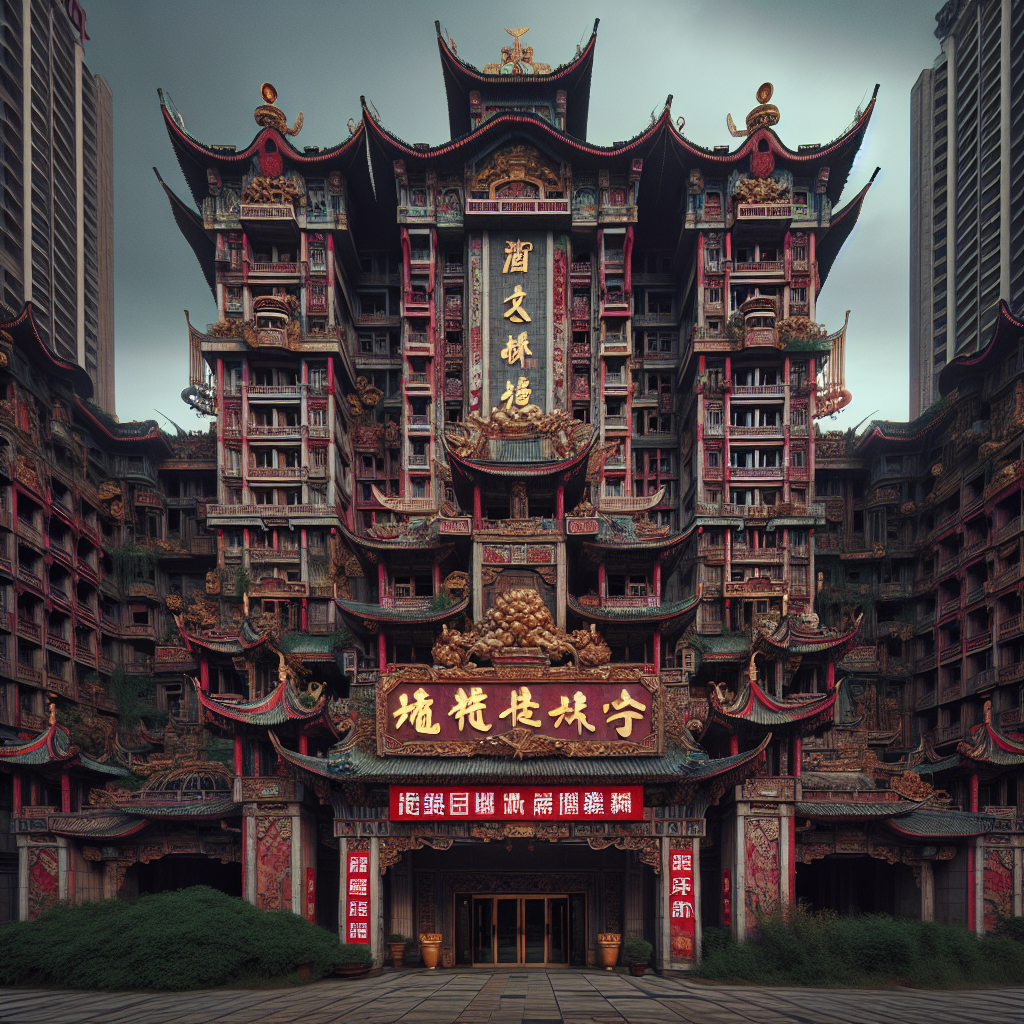
In recent years, China’s five-star hotel industry has been struggling, with many well-known luxury hotels quietly closing or changing ownership. Some are even being sold at a low price and left abandoned for years. Industry experts point out that the wave of closures of these luxury hotels is closely related to the decline of China’s real estate market. The signs indicate that with the poor state of the Chinese economy, the customers for high-end hotels have also disappeared.
According to reports from various Chinese media outlets such as The Paper, Sohu, and Jiemian News, five-star hotels have always represented the highest level of the hotel industry in terms of style and profitability. However, in the past two years, many have been abandoned, facing closures, sales at low prices, and abandonment.
This wave of closures actually began in 2023.
In December 2023, properties such as The Ritz-Carlton Tianjin, InterContinental Sanya, and the Helios Valley Hot Spring were sold as non-performing asset packages, with a total transaction price of 2 billion RMB. Hotels such as Bvlgari Hotel Shanghai, Sheraton Sanlitun Beijing, Fairmont Nanjing, and The Westin Chongqing Liberation Monument, as well as the Westin Beijing Chaoyang that hosted the U.S. President, were also put up for sale in 2023.
The Beijing Eclat Hotel Sanlitun, where prices exceeded 30,000 RMB per night, announced its official closure in June 2024. Information about the sale of Sofitel Hotel Beijing was announced in August 2024, with a price tag of 2.8 billion RMB.
Shandong Blue Horizon Hotel Group, which once owned more than eighty mid-to-high-end hotels and ranked among the top sixty hotel groups in China, was declared bankrupt and underwent a reorganization process in November 2024. By July 2024, with an asset-liability ratio as high as 107.99%, all 58 hotel projects put up for auction had no takers.
At the end of 2024, Shanghai Mandarin Hotel She Shan Hao Yue Ge was rebranded less than two years after its opening, bidding farewell to the market as it entered into bankruptcy liquidation and sought investors. Currently, it is indicated as temporarily closed on online platforms. The GreenTree Hotel in Yangzhou District of the West Zone ceased operation, and the Pullman Sofitel Grand Hotel in Ningbo had closed its doors earlier in 2024.
According to media data, the number of changes in star-rated hotel brands in 2024 nearly doubled compared to the previous year. Approximately 42% were due to brand-switching and about 33% were delistings, with rebranding accounting for approximately 25%.
Data from the Ministry of Culture and Tourism of the CPC shows that in 2020, there were 850 five-star hotels in China, but by the third quarter of 2024, the number had decreased to only 736, indicating a reduction of 114 hotels in just five years.
The first internationally-managed hotel in Wenzhou, the Wyndham Grand Hotel, which was a popular choice for wedding banquets among locals, was sold in March 2025. The transaction price was over 45.34 million RMB. Previously, it had failed to attract buyers in two auctions. Compared to its initial auction price of 70.85 million RMB, the hotel saw a reduction of over 25.5 million RMB this time.
The first five-star luxury business hotel, the Fulihuahua Grand Hotel in Keqiao District, Shaoxing City, Zhejiang, was put up for auction again with a price of 202 million RMB. This marks the hotel’s second auction, with plans to cease operations in May this year.
The Guilin Lijiang Hotel, a high-end foreign-related five-star hotel in Guilin City, has been in operation along the Li River since 1986, with nearly 40 years of history. After multiple previous auctions with a starting price of 140 million RMB, the hotel recently reappeared on the market with a price drop of over 50 million RMB.
Moreover, the iconic Hilton Hotel in Foshan is up for auction with a price tag of 1.5 billion RMB, while the Manmade International Hotel in Dongguan is priced at 176 million RMB.
Currently, there are still many hotels on the market desperately seeking buyers. The once sought-after five-star hotels in China are gradually being abandoned, becoming undesirable assets.
The Kai Xuan Hot Spring Hotel in Guangxi, an investment of over one billion RMB, has ceased construction and remains abandoned for 20 years with no takers. In Shijie Town, Dongguan, the former five-star Nanshui Garden Hotel has been closed for over a decade, attracting no interest.
Many of those taking over the abandoned five-star hotels are coal bosses or cement bosses. For example, the hotel “Lanlight Ji Zhuang” in Emeishan was taken over by the Ulan Group, affiliated with a large coal enterprise in Ordos City, Inner Mongolia. The Huacheng Hotel in Xi’an Tai Ping Fang, which signed a contract with the Hilton Luxury Brand LXR for its first Chinese store, was acquired by a coal boss from Yulin in northern Shaanxi. The Shanghai Bvlgari Hotel, a property under Shanghai Zhi Di under Huacheng, was bought for 2.4 billion RMB by the cement giant Jiangsu Golden Peak Cement Group.
According to Chinese media, the luxury hotel craze in China began during the real estate expansion era. At the beginning of the 21st century, some local governments, in order to attract investment, required developers to build five-star hotels when acquiring land. Developers were happy to oblige because even if the hotel operated at a loss, obtaining the land and boosting surrounding property values would ultimately be profitable. Consequently, luxury hotels sprung up nationwide. Many local governments even directly incorporated the construction of star-rated hotels into their own land auction documents. Sometimes, they were even bundled and sold together with residential properties.
As an example, in Dongguan in 2021, the urban land + commercial finance land in the Songshan Lake area was explicitly required to introduce a world-renowned resort brand hotel management group within the plot. They were specified as one of Aman, Banyan Tree, Bvlgari, Park Hyatt, or Peninsula, with the brand name pre-designated.
In some fourth-tier cities, such as Qiannan Prefecture in Guizhou Province, their 2013 government plan draft publicly stated the promotion of the construction of seventeen five-star hotel projects in eleven counties and cities.
Starting from 2000, there was a real estate frenzy for twenty years. However, by 2020, the official Chinese government introduced the three red lines policy to restrict real estate development financing, leading to a cooling down of the real estate market. Facing enormous pressure on real estate leverage, five-star hotels became assets that needed to be divested to retrieve capital.
On March 13th, blogger “Chen Xiaoxi Loves Fishing” analyzed, “Now, there are luxury five-star hotels being auctioned all over the country. Due to the overall downturn in the economy and a decreasing number of corporate travelers, five-star hotels are facing severe losses. Additionally, many five-star hotels were invested in by real estate companies back in the day. As these real estate companies collapse, it results in the influx of these five-star hotels into the market. It appears that a trend of large-scale sell-offs of five-star hotels is emerging in China.”
A seasoned industry professional stated that 2025 will see a year of concentrated transfers for all hotels, with at least half of them facing bankruptcy. This is not just alarmist talk, but a stark reality.
The current issue is, where will the remaining 700-plus five-star hotels find their customers?
According to data from the Ministry of Culture and Tourism of the CPC, in the third quarter of 2024, the average price of a stay in a five-star hotel was 599 RMB, a 5% year-on-year decrease, and the average occupancy rate dropped by 4%. Similarly, data from the Beijing Municipal Bureau of Culture and Tourism show that in the first ten months of 2024, Beijing’s five-star hotels accommodated 3.93 million guests, a decline of 1.33 million from the peak in 2018.
Professionals in the real estate and financial industries, who used to be part of the middle class, would choose high-end hotels for business trips. However, with the collapse of the real estate sector and the tightening policies in the financial industry, the luxury hotel sector has been directly impacted.
Reports have emerged about employees of financial institutions facing significant pay cuts. Reuters disclosed on January 14th this year that the Chinese authorities had cut the overall income of the employees of the three major financial regulatory agencies—The People’s Bank of China (PBOC), the China Banking and Insurance Regulatory Commission (CBIRC), and the China Securities Regulatory Commission (CSRC)—by approximately 50%.
On March 1st this year, the China Securities Association released draft regulations stipulating that if employees of securities firms indulge in “excessive luxury” living, the companies will be penalized.
Professor Xie Tian from the University of South Carolina previously told NTD Television that about five or ten years ago, China began attracting a large influx of foreign capital, with many foreign businessmen and employees of foreign enterprises flocking to China, thus creating demand for such business hotels. However, that golden age has passed, and the influx of foreign tourists into China has significantly decreased, which will undoubtedly impact high-end hotels.
In addition to the decrease in foreign investment and withdrawal, Xie Tian also cited internal economic challenges within the CPC as a significant factor. He mentioned that China has cracked down on corruption in recent years, resulting in restrained public spending. With regional governments facing financial deficits, there are restrictions on using public funds for lavish spending, leading to declines in various sectors, including stays in hotels and dining at high-end restaurants. This interconnected decline is affecting the luxury hotel industry.
It’s not just the five-star hotels, but the entire hotel industry in recent years that has been facing a crisis.
According to data service provider STR, as of September 2024, mainland China’s hotel industry saw a 6% year-on-year decline in the annual Revenue per Available Room (RevPAR), a 4% decrease in Average Daily Rate (ADR), and a 2% drop in occupancy rate. ADR has been declining for three consecutive quarters.
Similarly, international hotel groups such as Hilton, Marriott, Hyatt, Wyndham, and Accor in the global market have shown an upward trend, except in the Greater China region where the RevPAR has declined.
In fact, for the past two years, news concerning the unfavorable economic situation in China, bankruptcies among the middle class, and a downgrade in consumer spending have dominated the media.