
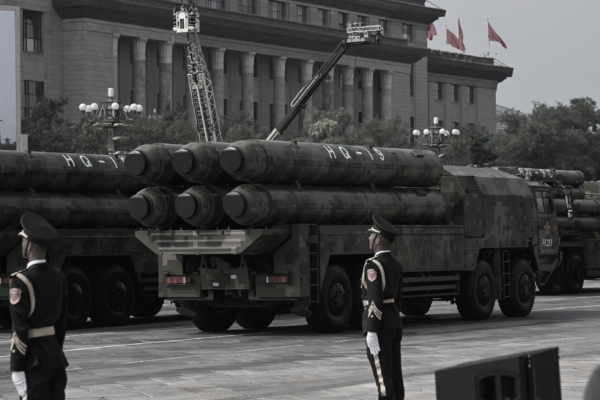
The reputable international think tank recently released a research report showing that while arms exports are experiencing strong growth globally, the revenue of major Chinese military enterprises in 2024 has decreased against the trend. The report suggests that the slowdown in weapons contracts and procurement in China is due to the anti-corruption efforts that have hindered the completion of these transactions. However, experts believe that besides anti-corruption measures suppressing sales, there are deeper economic challenges and unfavorable export conditions as multiple reasons.
According to a recent study by the Stockholm International Peace Research Institute on December 1, driven by conflicts in Ukraine and Gaza, along with global and regional tensions, the revenue of major arms and military services companies worldwide surged. In stark contrast, the revenue of Chinese military enterprises witnessed a decline.
Data reveals that in 2024, the revenue of major Chinese military enterprises dropped by 10% to $88.3 billion, marking the largest percentage decrease among countries with arms export companies. Among them, the largest ground weapons producer in China, the China North Industries Group Corporation, saw the biggest decline. Its 2024 weapon revenue plummeted by 31% from $20.31 billion in 2023 to $13.97 billion, dropping from 10th to 11th in global rankings. China’s largest military aerospace manufacturer, Aviation Industry Corporation of China, had a sales figure of $20.32 billion in 2024, ranking 8th globally, but decreased by 1.3% compared to 2023. The revenue of China Aerospace Science and Technology Corporation (CASC) also declined.
Only two Chinese companies in the top 100 list recorded an increase in weapon revenue: China State Shipbuilding Corporation and China Aviation Engine Group achieved growth rates of 8.7% and 9.6%, respectively.
The report points out that after senior executives of these companies were dismissed in recent years due to anti-corruption investigations, the government reviewed contracts, leading to delays in fulfillment.
In 2023, Beijing’s anti-corruption campaign reached the top levels of the military, with the Rocket Force becoming a key target. In October this year, nine senior military leaders, including Vice Chairman of the China Central Military Commission He Weidong, were expelled from the Party and military on corruption charges.
Senior military commentator Mark stated to Epoch Times that based on the aforementioned report, the China North Industries Group Corporation experienced the largest revenue decline, mainly producing army equipment, indicating a reduction in China’s procurement of army equipment.
He believes that the decrease in China’s arms revenue is due to the possible scrutiny, cancellation, or price adjustments of many contracts post-anti-corruption measures and adjustments in China’s military expansion direction.
Mark expressed that in the case of China focusing on a military invasion of Taiwan, the navy and air force become the main forces, while the army becomes relatively less important. Under the poor economic conditions in China, there would be reductions in army equipment orders to ensure the development of the navy, air force, and Rocket Force for potential conflicts with the United States.
He gave an example that in the Russia-Ukraine war, drones and unmanned vessels played significant roles, and China has increased investments in research and development in these areas, which the China North Industries Group Corporation is not proficient in. Therefore, the decline in revenue is related to China’s overall military strategy shift, implying a decrease in traditional procurement of artillery, ammunition, and firearms.
However, Mark emphasized that financial difficulties and economic challenges have a decisive impact on the development of China’s military industry. If the budget is cut, the army might be the most affected.
Furthermore, Mark stated that the overall poor economic situation in China has led to a downturn in orders, significantly impacting the modernization of equipment. If China’s economy continues to contract, even if the country wishes to maintain a policy of militarism, military spending will inevitably shrink. Ensuring the stability of income for military officers and soldiers is essential; otherwise, they may leave their positions, and as a result, there might be cuts in weapon equipment costs.
Su Ziyun, Chief of Taiwan’s Defense Strategy and Resources Institute, pointed out that besides the internal pause in procurement due to anti-corruption issues, the overall decrease in revenue of Chinese military enterprises is mainly due to unfavorable export conditions. Russia’s weapons performance is unsatisfactory, and Chinese-style weapons still follow old Russian designs, affecting their exports. Currently, many market shares have been taken by South Korean weaponry.
He analyzed that another reason for the decline in the revenue of Chinese military enterprises is many of the weapons sold in the past have issues such as cutting corners and shoddy materials, leading to a temporary halt in procurement. Moreover, with leaders being removed from their positions, there is a disruption in the chain of command, requiring a review of the actual performance of some weapons and equipment, resulting in a decrease in the current statistics of arms sales.
According to official announcements, the Chinese military has suspended bidding qualifications for over a hundred suppliers since last year. The “Military Procurement Network” of China released a notice on November 9 stating that several institutions, including the Institute of Mechanics of the Chinese Academy of Sciences, Beijing Institute of Technology, Beijing Jiaotong University, Harbin Institute of Technology, and Harbin Engineering University, have been suspended from bidding for material engineering procurement by the Central Theatre Command (institutions and directly affiliated units) due to bid-rigging and corruption practices.
There have been concerns among observers that China is advancing its military preparations and complex threats towards the 2027 point aiming to forcibly unify Taiwan. 2027 coincides with the “100th anniversary of the founding of the People’s Liberation Army of China.”
Researcher Xiao Liang from the Stockholm International Peace Research Institute stated that the deployment of advanced systems by the Chinese Rocket Force and Beijing’s aerospace and network plans may be affected. Previously, China aimed to achieve key capabilities and combat readiness goals before its “100th anniversary of the founding of the People’s Liberation Army,” but now, uncertainty has significantly increased.
Mark suggested that economic difficulties or anti-corruption efforts causing a decline in arms revenue will not hinder China from engaging in various provocations externally to divert domestic focus. Perhaps, China’s military actions abroad would become more aggressive or even risky, similar to Russia’s bold move to wage war against Ukraine. Authoritarian regimes do not prioritize the lives of their people, which is where the danger lies.
Su Ziyun also highlighted that the export of weapons fluctuates, with most market shares currently controlled by Western countries, temporarily restraining the external influence of China’s military capabilities. However, caution should be maintained, as China’s military arms are competitively priced, and they might focus on expanding their influence through weapon exports.
Furthermore, Su Ziyun noted that corruption within the Chinese military has always been opaque, making it challenging to tackle, thus affecting the long-term development of its military capabilities.