
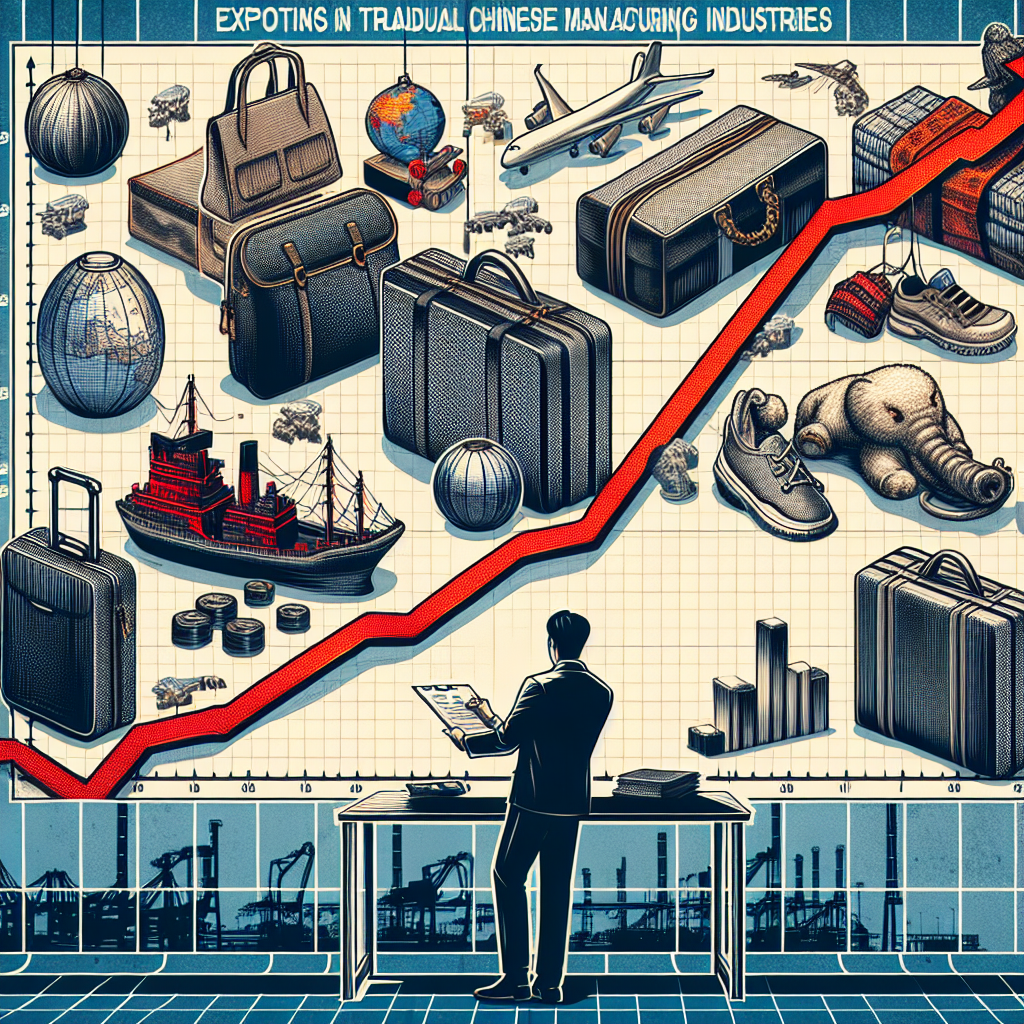
In the first 11 months of this year, exports of traditional Chinese manufacturing industries such as baggage, footwear, toys, and lighting fixtures have seen a comprehensive decline. Analysts believe that the economic situation in China continues to deteriorate, facing challenges in development momentum, leading to accelerated relocation of enterprises.
The data released by the General Administration of Customs of the Communist Party of China on Monday, December 8, showed that exports of labor-intensive traditional manufacturing industries have significantly decreased in the first 11 months of this year, with industries like baggage, footwear, toys, and lighting fixtures all experiencing declines of over 10%. Additionally, China’s mobile phone exports dropped by 11.2%.
The export volume of the clothing industry in the first 11 months saw a 4.4% decline, according to a briefing on the economic performance of the Chinese clothing industry released by the China Garment Association on December 9, indicating that Chinese clothing enterprises are facing difficulties in survival.
The briefing stated that from January to October this year, due to weak international market demands, disturbances caused by US tariff policies, and insufficient growth momentum in domestic consumption, the economic performance of the Chinese clothing industry is under severe pressure, with significant decreases in key indicators such as production, exports, and profitability. Market competition intensification, declining export prices, and fluctuations in the exchange rate of RMB have continually squeezed the profit margins of enterprises.
Bloomberg reported that the Politburo meeting convened on Monday, December 8, signaled that the domestic economic situation in China continued to worsen, with economic growth showing clear signs of cooling after months of sustained decline in consumer spending and rapid investment slowdown.
Tao Chuan, Chief Economist of Guolian Life Securities, stated in a report that the meeting emphasized the need to “adhere to innovation-driven development and accelerate the cultivation and expansion of new growth drivers”, contrasting with the relatively mild expression in July’s meeting about “accelerating the cultivation of internationally competitive emerging pillar industries”.
Bloomberg cited the perspective of Lu Ting, an economist at Nomura Securities in Japan, who believes that the content of the meeting indicates increased concerns in Beijing about the recent economic slowdown and urges Beijing to take bolder measures to address the real estate crisis, boost consumption and business confidence, and improve trade relations.
Lu Ting mentioned, “Beijing has already used up all possible policy tools,” and added that “the market is expecting the economy to truly bottom out and for deflation to truly end, but patience may still be required.”
Several reports from Dajiyuan this year have shown that traditional manufacturing industries in China, such as clothing and footwear with thin profit margins, are continuing to relocate to Southeast Asia.
Blogger “My Heart Roams the World” recently posted stating that this round of industrial chain restructuring is not merely a simple geographic shift but a dual attraction of cost restructuring and policy dividends.
For labor-intensive industries, the stark differences in labor costs can directly reshape a company’s profit curve. In 2025, manufacturing workers in the Pearl River Delta receive monthly salaries of 6000 to 7000 yuan, while in Vietnam, wages for the same positions are around 3000 yuan.
In addition to labor costs, China’s land rents have tripled in the past decade, and the continuous elevation of environmental compliance standards has put immense pressure on mid-to-low-end manufacturing enterprises that rely on economies of scale. The policy combination in Southeast Asian countries has enhanced their cost advantage.
Vietnam has introduced a stepped income tax incentive, allowing eligible manufacturing firms to enjoy a significant policy where they are entirely exempt from taxes for four years, half-reduced for nine years, and a further 10% reduction for the following fifteen years, as well as exemptions on fixed asset investments from import duties.
More importantly, capitalizing on the dividends of regional trade agreements, Vietnam has signed 17 bilateral and multilateral free trade agreements, leveraging the RCEP framework to enjoy lower tariff barriers for exports to the US and Europe, making it a key attraction point for foreign investments.
This triple advantage of “cost competitiveness, policy dividends, and trade facilitation” has made Southeast Asia a natural choice for global industrial chain diversification.