
Nepal’s anti-corruption agency has formally filed lawsuits against 55 individuals and a Chinese construction company, including five former ministers and ten senior officials, accusing them of irregularities in a China-funded airport project in Pokhara, Nepal’s tourism center.
The Commission for the Investigation of Abuse of Authority (CIAA) submitted the charges to a special court on Sunday, December 7, alleging collusion between officials and the Chinese company to inflate the cost of the Pokhara International Airport project. The airport, costing $216 million, is part of China’s Belt and Road Initiative and was funded by the China Export-Import Bank for a 20-year loan.
The anti-corruption agency alleges that the contractor, China CAMC Engineering Co., Ltd., in collusion with Nepali officials, inflated project costs by 30%-50% through manipulating the bidding process and material procurement, resulting in a loss of approximately $74.34 million. CAMC Engineering is a subsidiary of China National Machinery Industry Corporation.
The CIAA stated that the contractor “maliciously altered the airport’s estimated cost, unreasonably raised the estimated value, and made Nepal pay excessive amounts.”
The anti-corruption commission is seeking to recover a total of $63 million in compensation from the defendants, marking the largest corruption claim by the agency to date.
Pokhara International Airport was touted as a national pride project for Nepal and had a grand opening in January 2023 but has struggled to attract international flights.
In November 2023, following reports in foreign media exposing issues with the project, the CIAA officially launched an investigation.
Due to the airport’s meager revenue, there are increasing doubts about Nepal’s ability to repay the 20-year loan to Beijing.
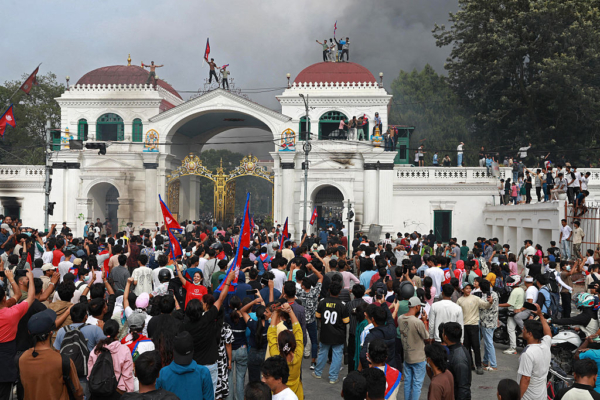
In September 2025, protests led by Nepalese youth overturned former Prime Minister KP Sharma Oli. The protests initially stemmed from a brief social media ban but quickly evolved into a broader accountability movement targeting corruption, entrenched nepotism, and a culture of impunity in politics. At the time, the Communist Party premier Oli had just concluded a visit to Beijing.
To quell the protests, an interim government led by former Chief Justice Sushila Karki promised a zero-tolerance approach to corruption.
This marks Nepal’s first legal action against a large-scale Chinese infrastructure project on the grounds of corruption, seen as an effort by the Nepalese government to regain public trust.
Earlier this year, Nepal ranked 107th out of 180 countries in Transparency International’s Global Corruption Perception Index.
Nepal is set to hold elections on March 5 next year.
During Oli’s tenure, Nepal’s relations with China grew increasingly close. Oli made multiple visits to Beijing and signed several agreements related to the Belt and Road Initiative.
Many of China’s overseas projects face allegations of overpricing, feasibility concerns, or debt risks, including Indonesia’s high-speed rail project. Jakarta recently initiated debt restructuring negotiations with Beijing regarding the project.
China is Nepal’s second-largest trading partner after India and a significant source of loans and construction technology for Nepal.
In response to the allegations regarding the airport project in Nepal, the Chinese Ministry of Foreign Affairs stated that the project “strictly adheres to quality standards,” denied corruption charges, and emphasized that the airport operates normally.