
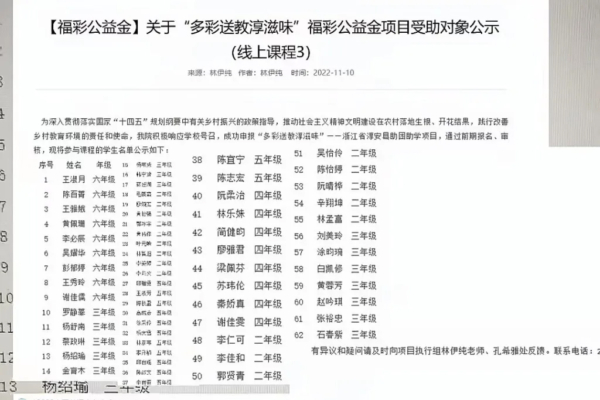
Hangzhou Normal University College of Humanities recently announced a list of recipients of the welfare lottery fund, which was discovered by netizens on December 5th to be identical in part to some names and order in the Baidu Library’s “10,000 Chinese Common Names Encyclopedia,” raising suspicions of falsification of the list. The related list was subsequently deleted from the official website. The school reported that they have set up an investigation team to thoroughly verify the incident.
This controversy began with the online course list of “Colorful Teaching with Pure Taste” posted by the Hangzhou College of Humanities. Several netizens pointed out that 62 names of students in the “Online Course 5” list were completely identical to a segment in the Baidu Library’s public document, and the “Online Course 6” list was also found to correspond to another segment of the same document, without any adjustments or deletions of names. Netizens questioned the lack of school-specific characteristics in these lists, stating that it seemed “like they were copied and pasted in its entirety.”
Subsequently, the incident sparked discussions on social media platforms. Some users claimed: “This couldn’t be a coincidence, even the order of the names is the same, it’s like using a name database as a student list.” Others expressed concerns, saying, “The welfare fund uses public financial resources, and falsifying the list is very serious.”
An anonymous teacher surnamed Liu from a university in Zhejiang, when interviewed by Da Ji Yuan, said: “I also noticed this matter. The list of beneficiaries is the most basic proof of a public welfare project and a direct basis for whether the funding is put into practice. If the beneficiaries are fictitious, then there may be risks of falsification in all subsequent training, courses, and expenditure of funds.”
Mr. Liu stated, “Now that this matter has been exposed by netizens, it has had a significant impact, and they (the school) naturally panicked and hurriedly investigated the reasons. I heard from people in the school office that the Municipal Education Bureau is also very nervous. However, downplaying major issues is their consistent style.”
Online, some netizens further questioned whether the project implementation process actually existed. A local parent from Hangzhou commented, “If the list doesn’t match, did the courses really take place? Were there any teachers giving lectures? These all need to be investigated thoroughly.”
Facing continuing public opinion unrest, the Hangzhou Normal University College of Humanities issued a statement on December 6, stating that they have established an investigation team to conduct a thorough verification of the incident and will announce the results to the society after the investigation concludes. However, the school did not explain why the list matched an online document or the reason for deleting the list.
A student surnamed Xu from the Chinese Language and Literature Department at Zhejiang University, in an interview, expressed that this matter has caused strong reactions locally: “This is clearly a scandal. There are many opaque operations in public welfare projects at universities, which were discovered by students this time, and many insiders are unaware of them.” He believes, “If the list can be falsified, the project execution may also likely be falsified.”
Subsequently, mainland communication agencies and media reporters re-registered on the official website of the Hangzhou Normal University College of Humanities to check, finding that the controversial list had been deleted. Journalists tried to verify the situation by calling the college multiple times but were unsuccessful.
According to a previous announcement by the Alumni Association, in June 2022, the Alumni Association and the College of Humanities applied for the “Colorful Teaching ‘Pure’ Taste – Assistance and Education Project for the Poor and Students in Chun’an County, Zhejiang Province,” which was approved by the Zhejiang Provincial Civil Affairs Department with a fund of 450,000 yuan. The project includes online and offline teaching, donation of bookshelves and books, provision of learning materials, claiming to have benefited over 200 left-behind children.
Regarding the scandal at Hangzhou Normal University, mainland philanthropist Qian Jun believes that whether the relevant projects have actually been implemented is the core issue of this list incident. He said, “If the list of beneficiaries is false, then are the activity records complete? Is the benefit real? These all need to be investigated.”
Qian Jun told reporters that compared to public school-reported philanthropic project funds, funds received by private philanthropic organizations are often subject to stricter monitoring. He revealed, “The sources of private donations are often investigated by public security, and they are prohibited from accepting donations from overseas, with many restrictions.”
As of now, the teaching team involved in the project has not publicly responded. Some netizens are calling for the education authorities in Zhejiang and Hangzhou to intervene in the investigation, emphasizing that the welfare fund belongs to public finance and the compliance and flow of funds must undergo scrutiny.
As of December 8, the incident is still brewing. Many netizens are worried if other public welfare projects such as art, music, and volunteer teaching also have similar issues. One netizen wrote, “If the list is fake, and the courses weren’t held, then whose account is the welfare fund sitting in? That’s what everyone is most concerned about.” The school has apologized to the public, while netizens have stated they will continue to follow the developments of this matter.