
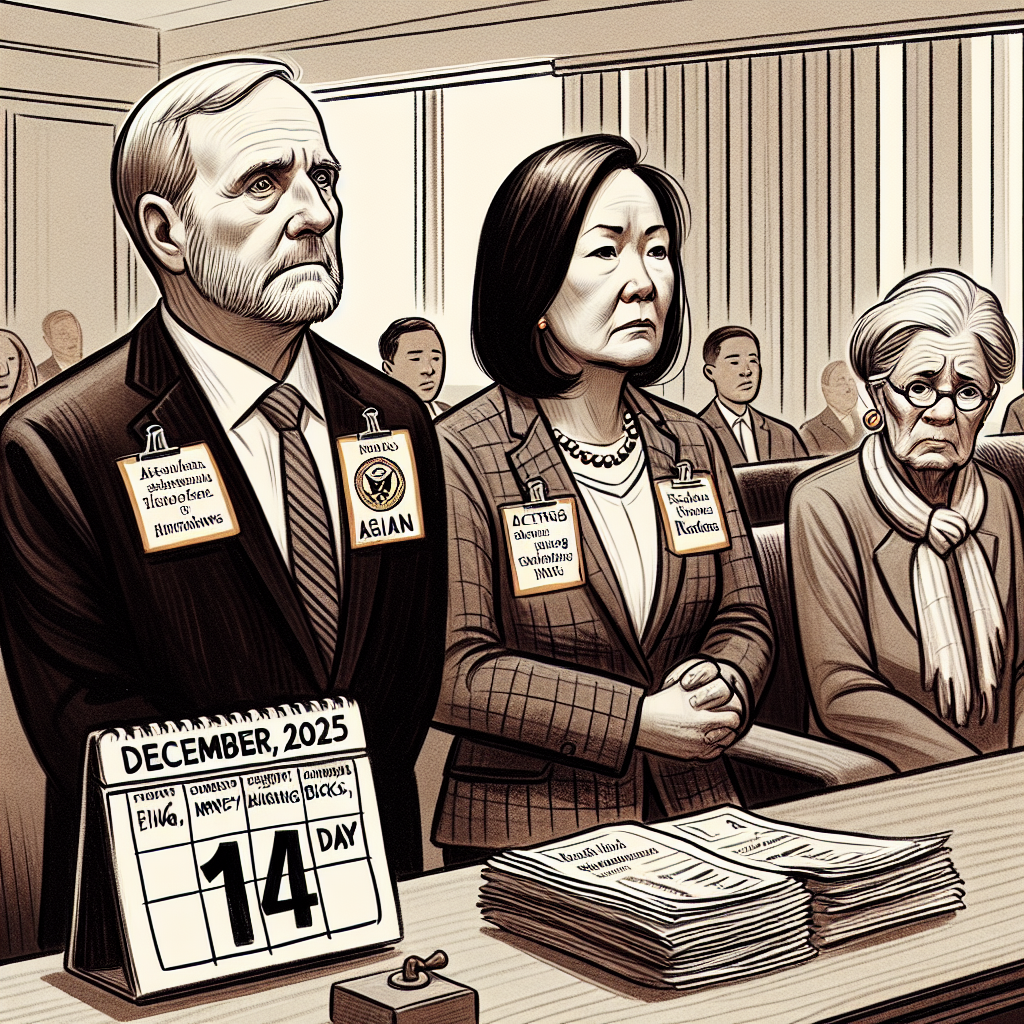
On December 9, 2025, in New York, the trial of Sun Wen, former deputy chief of staff to Governor Hochul of New York, and her husband Hu Xiao, on charges of acting as illegal foreign agents, accepting kickbacks, and money laundering, entered its 14th day on December 8. On that day, Sun Wen’s mother, Sun Meiping, testified as a defense witness. The prosecution repeatedly questioned the source of the cash found in a bank safe deposit box under Sun Meiping’s name, leading to inconsistencies in her responses that raised doubts.
Sun Wen was born in Nanjing in mid-April 1984. Sun Meiping stated that Sun Wen was not yet six years old when the family immigrated from China to the United States in 1990, and the reason for their immigration was that “Sun Wen’s grandmother believed in the quality of American education.”
It is worth noting that they arrived in the United States during a special historical period following the events of June 4, 1989. The U.S. had special policies for Chinese citizens residing in the country which allowed them to apply for green cards if they arrived before April 11, 1990, likened by the Chinese community to a “large amnesty.” Sun Wen’s family arrived during this historical window.
Sun Meiping mentioned that Sun Wen became a naturalized U.S. citizen at the age of 13 or 14. When she first arrived in the U.S., Sun Meiping worked in a Chinese garment factory, then in 1997 she transitioned to a U.S. company, occasionally doing alterations and tailoring until her retirement in 2020 at the age of 66. Sun’s father owned a dry cleaning business which he later sold.
Hu Xiao and Sun Wen met in 2011. At that time, Hu Xiao was working at a electronics store in a New York retail chain, and Sun Wen was already involved in politics, serving as the chief of staff in an official’s office. They got married in 2013 at a golf club on Long Island, New York, and also met Hu’s relatives in China.
In 2008, Sun Meiping rented a safe deposit box at a TD Bank in Flushing, where she kept her “private funds.” FBI found $130,000 in cash in that safe deposit box and another $270,000 in a safe deposit box at her residence. The focus of the court hearing that day shifted to the actual source and timeline of this cash.
During the trial, the prosecution focused on the $130,000 found in a TD Bank safe deposit box under Sun Meiping’s name, attempting to dismantle the claim of it being “savings accumulated over the years” through timelines and financial logic.
Sun Meiping repeatedly emphasized that the money came from her frugal living in the U.S. for over 30 years, proceeds from selling real estate in China (1.2 million RMB), and savings from occasional odd jobs, asserting it had no connection to Sun Wen and Hu Xiao. However, the bank records and the cash itself presented a completely different picture.
Firstly, the timing of deposits and withdrawals from the safe deposit box was unusual. According to TD Bank records, after renting the box in 2008, Sun Meiping made several deposits in the initial years but did not visit the bank between 2015 and 2019. However, she made three visits in a span of just over three months in 2021 on July 15, August 19, and October 7.
The prosecution pointed out that this sudden surge in visits coincided with significant changes in Hu Xiao’s financial situation. Around 2021, Sun Wen and Hu Xiao had accumulated significant assets under their names, including a $4 million mansion in Long Island, a property in Hawaii (nearly $2 million), and multiple cars, which starkly contrasted their reported modest income from the company.
Secondly, there was an issue with the dates marked on the cash bundles. When FBI opened the TD safe deposit box in July 2024, they found $130,100 in cash neatly bundled and labeled with handwritten dates as “October 6, 2021,” with many bills being brand new. The prosecution questioned how years of sporadic saving could suddenly be consolidated into a precise amount of $130,000 all marked for the same date – October 6, 2021. Sun Meiping explained that during the pandemic in 2021, she felt anxious and thus on October 7, she reorganized the cash stored over the years by counting, bundling, and dating them. As for the discrepancy with the labeled date of October 6, she mentioned that she might have remembered incorrectly.
This number was then traced back to earlier evidence. Text messages from March 10, 2017 between Sun Wen and her mother showed Sun Meiping explicitly mentioning the amount of “$130,000” and expressing reluctance to loan more money to Hu Xiao, stating “130,000 is not a small amount… 30,000 for your wedding, 100,000 for his business, there should be returns annually, right?” The prosecution pointed out that the “130,000 USD” in the safe deposit box was not a randomly appearing sum but could be traced back to 2017 when Sun Meiping lent money to Hu Xiao, which was now returned.
When directly asked if she had lent this $130,000 to her son-in-law Hu Xiao, Sun Meiping denied it in court. She instead claimed, “I once gave Sun Wen $100,000 before her marriage, and the wedding expenses in the U.S. were covered by the bride’s side.” Regarding the financial transactions around 2017, she explained, “There was a time when someone asked if Hu wanted to invest in a project. But at that time, I didn’t have money to lend to them.”
Subsequently, the prosecution presented text message evidence reading, “The $130,000 is what my husband and I lent to you.” Faced with this statement, Sun Meiping explained, “The $130,000 is a significant amount for my husband and me. If we give away more, it won’t be acceptable. Because I gave them money and didn’t get any dividends in return. If it’s not for dividends, I don’t need to work two jobs so hard.”
In summary, Sun Meiping’s explanations regarding the source and purpose of the cash in the safe deposit box were repeatedly revised. After the prosecution presented text messages and bank records, her statements had to be adjusted multiple times, shifting from “I didn’t have money to lend” to “I wanted dividends” and then to “this money comes from savings accumulated over the years.”
Regarding border inspection issues, the prosecution mentioned that when Sun Meiping was questioned by Customs and Border Protection (CBP) upon re-entering the U.S., she stated that she had “no funds other than cash at home.” It wasn’t until CBP showed her photos of the large amount of cash stored in the TD Bank safe deposit box that she acknowledged its existence, explaining, “A safe deposit box is for safekeeping, so I didn’t mention it.” She denied intentionally concealing the information in court, emphasizing that “I acknowledged it upon seeing the photos.”
Lastly, the prosecution questioned the inconsistency in Sun Meiping’s description of the condition of the cash. When she requested the government to return the seized cash, she told investigators that the cash in the safe deposit box had “all gone moldy,” but the cash presented in court was well preserved with many new bills, not aligning with her claim of being stored for many years. She simply responded, “They didn’t let me smell it.”
Additionally, in July 2024, when the FBI searched Sun Wen’s parents’ residence, they found another $270,000 in cash with bundles marked as July 16, 2021, which Sun Meiping said was written by her husband. She stated that the sources of this money included their retirement funds, income from caring for Sun Wen’s son for seven years, and red envelopes given by relatives and friends over the years.
Regarding any dealings with Chinese officials, Sun Meiping denied that Sun Wen had visited China as a representative of the Governor, only mentioning that her daughter went to Jiangsu to meet with “friend-type officials.” However, family group chat records presented in court showed that in 2017, Sun Wen informed her mother that officials from Henan had given her $200 in cash in a red envelope, to which Sun Meiping initially denied and later claimed she was “not very clear.”
Finally, the court mentioned the discovery of luxury items in Sun Meiping’s bedroom by the FBI, including a pearl necklace, a jewelry certificate, and a business card labeled “China Jiangsu Representative Office in the Eastern U.S.” When the investigators arrived, they also saw Sun’s father wearing a silver Rolex watch, which they immediately took off and put in a suitcase.
When questioned about owning expensive items, Sun Meiping denied buying designer bags and explained that the Rolex watch was a second-hand purchase for her husband made two to three years ago at a price of over $10,000. She said, “He loves it for a lifetime, and because he can’t bear to wear it, the protective film is still on it.”