
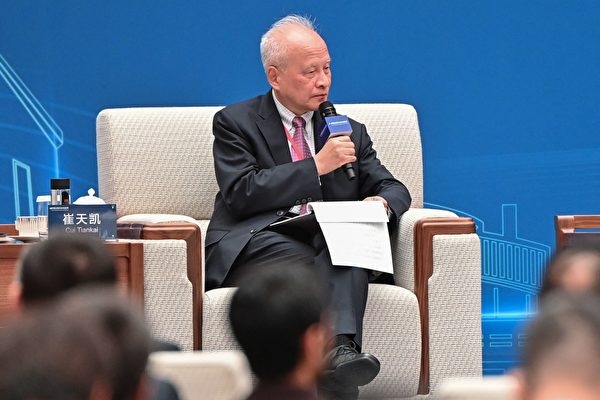
On Wednesday, August 28, according to sources familiar with the matter as reported by the Financial Times, Beijing’s efforts to establish contacts with the campaign team of US Republican presidential candidate Donald Trump have been unsuccessful.
It is reported that despite multiple attempts by Beijing, including sending former Chinese Ambassador to the US Cui Tiankai to establish connections, these outreach efforts have largely failed. Cui Tiankai is one of the Chinese officials with extensive connections in Washington.
The article mentions that meetings between Chinese officials, visiting scholars seen as agents of Beijing, and US lawmakers have been difficult, and now outreach efforts with Trump’s team are facing similar obstacles.
Steve Yates, Chairman of the American Council on China Policy, told the Financial Times that meetings between Trump’s team and Chinese officials have “hardly yielded benefits.” The council maintains contacts with several former officials from the Trump era.
Yates stated that Trump’s views on China are well-known, and there is a risk of being “misunderstood” during meetings. He added that the former president’s campaign team is currently focused on winning in November.
“Trump’s campaign team members and proxies are much more disciplined than in 2016,” Yates said. He was a proxy for Trump’s campaign team and served as Deputy National Security Advisor to Vice President Dick Cheney.
Victoria Coates, former Deputy National Security Advisor in the Trump administration now working at the Traditionalist Foundation, mentioned how even routine meetings between Trump’s transition team and Russian diplomats in 2016 were used to tarnish senior officials.
“Potential officials for a future Trump administration are cautious about meeting with hostile countries such as China because these meetings could be manipulated or misconstrued to imply collusion with the enemy,” she said.
Many other countries are also trying to establish contact with Trump’s advisors to avoid repeating the mistakes of 2016 when they missed out on building relationships due to neglecting the opportunity presented by Trump’s election victory.
Trump’s advisors are keen on avoiding a repeat of 2016. Meetings between Trump’s campaign team and Russian officials prior to the inauguration, including with the Russian Ambassador to the US Sergei Kislyak and then-National Security Advisor Michael Flynn, sparked the years-long Russia investigation.
Dennis Wilder, former CIA analyst on China issues, mentioned that Beijing has been actively seeking opportunities to connect with Trump’s campaign team but has been unsuccessful.
Wilder, who was a senior advisor on Asia affairs in George W. Bush’s White House, stated that some believe China is gathering intelligence rather than seeking genuine discussions.
While Cui Tiankai is considered a legitimate diplomat, he now serves as an advisor to the China Institute of International Studies. Wilder pointed out that the institute is not an official intelligence gathering agency but is used by Chinese intelligence agencies to engage with interested international visitors.
Robert Daly, director of the Kissinger Institute on China and the United States at the Wilson Center, described Cui Tiankai as an “outstanding emissary” but noted that the situation in Washington has changed.
“Why would there be any benefit for Trump’s team to meet with Cui Tiankai at this stage, as any such discussions could be interpreted as an attempt by China to exert influence?” Daly questioned.
According to sources, some Trump advisors are concerned that meeting with Chinese officials could harm their chances of working in the future government. There are also concerns that meeting with Chinese officials could impact future security clearance applications.
Following Vice President Harris replacing Biden as the Democratic presidential candidate, Washington diplomats are busy establishing contacts with Harris’s team. However, experts suggest that it is currently unclear who she will choose to provide advice on Asian policy.
Harris’s campaign team did not respond to requests for comments on whether the Financial Times had been in contact with Chinese officials.