
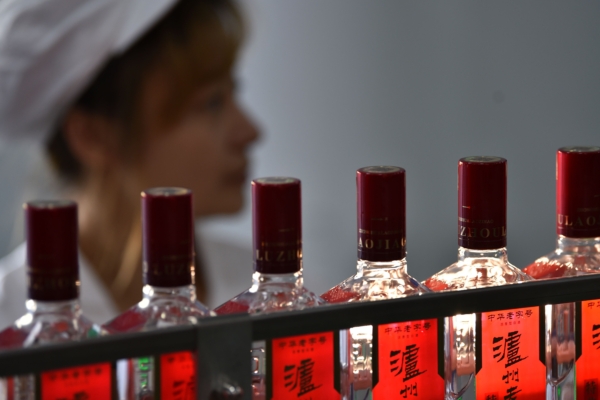
China’s economy continues to decline, and the once prosperous Baijiu industry has also entered a cold winter. Insiders lament that the cold winter of the Baijiu industry is just beginning.
According to reports from mainland media, the third quarter financial reports of the Baijiu industry in 2025 show that Wuliangye’s profits have halved, and a large number of second and third-tier brands are facing comprehensive difficulties. Baijiu is China’s main distilled liquor, accounting for over 90% of the national sales.
As the industry leader, Maotai from Guizhou, in the third quarter of this year, Maotai recorded a revenue of 39.064 billion yuan, an increase of only 0.56% year-on-year; with a net profit of 19.224 billion yuan, an increase of only 0.48% year-on-year.
Since the beginning of the year, a price war among high-end liquors has erupted, getting caught in serious internal competition. Data from “Southwest Liquor Price” shows that brands like Jiannanchun Crystal Liquor, Jinsha Abstract, and Zhenjiu Thirty Years, all saw a month-on-month decrease in terminal prices on November 30th, with only a few products like Guojiao 1573 showing a slight price rebound.
The continuous decline in Maotai’s price has made distributors uneasy. Baijiu distributor Qian Cheng told Epoch Times that Maotai’s price cut has caused a major shock. “This round of price reductions is in the thousand yuan price range. Maotai used to cost over 3,000 yuan per bottle, but now it has been reduced to 1,650 yuan per bottle, and it will continue to drop.”
He recalled that in the past, gift consumption was popular, as long as one dared to set a price, someone would buy it. It was driven by social trends, and consumption was irrational. At that time, Maotai, Wuliangye, and Langjiu developed with reform and opening up, catering to the market with a gifting attribute.
Data from Morningstar shows that there are over 8,000 Baijiu distilleries in China, some of which have histories of hundreds of years. However, with the collapse of real estate, a decrease in new projects, and a reduction in celebratory events and banquets, the social aspect of high-end liquor has suddenly cooled down.
Qian Cheng said, “Now the economy is collapsing, and urban construction has reached saturation. Real estate, earthworks, home furnishings have all stopped. Do we still need so many gifts? These premium liquors will definitely be left behind ‘the altar.'”
Another regional distributor, Zhang Jun (pseudonym), also told Epoch Times that the contraction of the large infrastructure and real estate industries directly impacted Maotai’s sales volume.
He said that selling houses, constructing buildings, and various stages of construction, renovation, etc., all require using Maotai to entertain some important clients and give gifts. Maotai plays a crucial intermediary role.
“Now with the real estate downturn and the ban on alcohol issued by the authorities, the quantity of banquets and gifts has drastically decreased, making it very difficult for distributors,” he said.
Qian Cheng believes that Maotai’s price cuts will inevitably become more significant. “Their (other distilleries) total volume is not increasing, under the pressure of price competition, other distilleries will perish. The future market will consolidate around a few renowned liquors, making it very difficult for other brands to survive.”
Faced with the continued slump in the market, he said, “Now is the time to tighten our belts and prepare for the tough times. This cold winter is not just for a season; it may be very, very long.”