
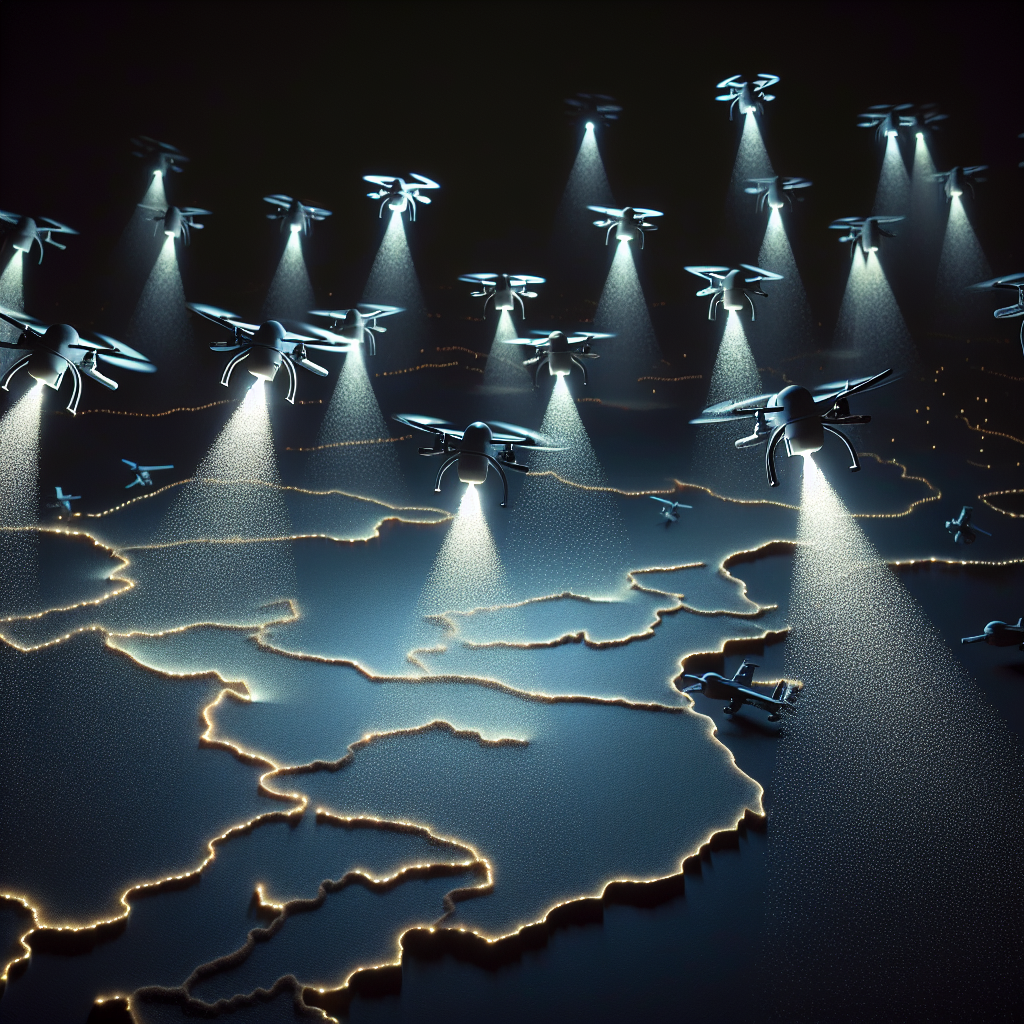
In late November, a strange phenomenon of “late-night unmanned aerial vehicles” has emerged in over a dozen provinces in China. These drones hover in the sky at midnight, spraying unidentified liquids, exhibiting suspicious behavior, sparking various speculations among the public. However, the official authorities have remained silent. Are these late-night drones for epidemic prevention or biological warfare? Could the CCP possibly resort to “epidemic warfare beyond limits” again?
Furthermore, in recent days, there has been incessant debate in Taiwan about whether the CCP will invade Taiwan in 2027. But if the CCP mobilizes military force, how will the war unfold? Where might the CCP launch the most intense amphibious landing battle? Let’s discuss these topics in this episode.
Hello everyone, I am Tang Hao. How are you doing today?
Today, we want to talk to you about two topics.
Topic 1: Widespread reports of drones flying at night in China, spraying unidentified liquids—What’s the purpose?
Topic 2: CCP’s military invasion of Taiwan—Has the landing location been determined?
Let’s dive into the first topic.
Recently, a peculiar phenomenon has been observed in many parts of China, with unmanned aerial vehicles flying at night and spraying unidentified liquids, causing anxiety among local residents.
Since late November, reports of nighttime drone activities have emerged across China, from Liaoning and Inner Mongolia in the northeast, to Beijing, North and South China, as well as Guangdong, Guangxi, Guizhou, and other regions. These reports have sparked public concern, especially in densely populated areas of eastern China. However, the nature of the liquid being sprayed remains unknown, and the authorities have not provided any explanations.
Some netizens speculate that the drones are spraying pesticides, which seems plausible if they are operating in rural areas or farmlands where farmers might conduct nighttime pest control. Yet, many drones have been sighted hovering over urban areas, spraying liquids above residential buildings in the dead of night. Some residents have even captured these drones, leaving the public puzzled. Why would spraying pesticides in urban areas clandestinely benefit the people?
Additionally, feedback from some netizens indicates that after the drone spraying, they smelled an odor resembling burnt wires and experienced headaches or fever. The activities of these “late-night drones” remain unclear, but they are likely not benign. Three abnormal points stand out regarding this issue:
Suspected Point 1: Lack of Official Notification
Firstly, the Chinese authorities have not informed the public. Normally, if the authorities were conducting disinfection or chemical spraying in residential areas, they would notify residents in advance, indicating the timing and precautions. However, in the case of these nationwide late-night drones, no such warning has been issued.
Suspected Point 2: Absence of Official Promotion
Secondly, the Chinese authorities have not actively publicized their actions. If the authorities were disinfecting or controlling pests for public health, they would typically promote and publicize their efforts through media channels. Yet, so far, there has been no such promotion.
Suspected Point 3: Lack of Official Clarification
Thirdly, despite the phenomenon of late-night drones continuing for half a month, the public’s suspicions are growing, with many netizens suggesting that the CCP is “poisoning” or spreading diseases among the people. Surprisingly, the authorities have not come forth with any clarification or explanation, causing a notable absence of debunking rumors. However, it has been observed that Chinese-controlled online platforms like Douyin are deleting some of these types of videos.
So, what are these drones really spraying? Currently, the authorities remain silent, and the public lacks definitive answers. However, we can speculate from a logical standpoint that apart from pesticides, there are two main possibilities:
Possibility 1: Disinfection or Epidemic Prevention
Firstly, it could be for disinfection or epidemic prevention purposes. Spraying unidentified liquids in urban or residential areas at night may be part of a large-scale public disinfection effort to prevent the outbreak of new epidemics. Given the severe situation with the “Type A influenza” epidemic in China, with 17 provinces reaching “high epidemic levels” and over 12 million cases in Beijing alone, along with reported fatalities, winter being a peak flu season, and schools mandating mask-wearing, such nocturnal actions could be seen as a measure to protect public health. However, if this were the case, why the secrecy and lack of transparency?
If the drones were indeed deployed by the authorities for “disinfection and epidemic prevention” but are shying away from public acknowledgment, there is a possibility that the current epidemic situation is extremely dire, with potentially higher fatality rates. Therefore, the authorities might be apprehensive about creating panic or exacerbating the already struggling economy with further setbacks due to public fear.
The second possibility, as speculated by many netizens, is that the CCP is “poisoning” or “spreading diseases” among the populace. While the notion may seem implausible that a government would resort to poisoning its own people, given the previous incident of the virus leak from the Wuhan Institute of Virology, many have heightened vigilance toward the CCP. After all, the Communist Party operates without humanity and moral boundaries, weaponizing anything for power struggles under its concept of “unrestricted warfare.” However, allegations of poisoning or spreading diseases are serious accusations that require thorough verification, and currently, we lack sufficient evidence to confirm.
In the absence of direct evidence, let’s engage in reverse reasoning: Does the CCP have a motive to orchestrate a large-scale epidemic? What benefits would such an outbreak bring them? Indeed, there are advantages:
Firstly, with China’s economy in a dire state, plummeting real estate prices, and a significant number of unemployed individuals—leading many migrant workers to return home early—civilian discontent is on the rise. The CCP’s greatest fear at this point is the escalation of discontent into “civil unrest.” In this scenario, a major epidemic could provide Beijing with the opportunity to reimpose “dynamic zeroing” and enforce nationwide lockdowns, thereby preventing public gatherings and suppressing the possibility of civil unrest.
Secondly, as the CCP finds itself increasingly isolated internationally—embroiled in disputes with Japan, facing impending high tariffs from the United States, and even warnings from Europe to raise tariffs—triggering another large-scale epidemic could divert global attention, shifting the focus from foreign affairs to domestic crises, while weakening the economic strength of other countries. This form of “unrestricted warfare” could be viewed by the CCP as a turning point, creating chaos to their advantage.
However, the true purpose of these “late-night drones” remains unclear: Are they for epidemic prevention, biological warfare, or something else entirely? If you have any thoughts, please feel free to share. But it’s crucial for friends on both sides of the strait to remain vigilant against the flu epidemic in China and potential outbreaks of other diseases.
Given that the CCP’s Politburo Standing Committee members, including State Chairman Han Zheng and Central Commission for Discipline Inspection Secretary Li Xi, have been absent for an extended period, they likely face severe health issues, possibly due to epidemic-related complications.
Recently, President of the Republic of China (Taiwan) Lai Ching-te mentioned that the CCP aims to achieve “military unification with Taiwan by 2027,” sparking heated discussions. However, Lai Ching-te clarified that it’s not a definitive timeline but rather aims to “complete military preparations for unifying Taiwan” by 2027.
This point is not contentious. As previously analyzed, 2027 marks the CCP’s centenary and a crucial year for Xi Jinping’s reelection during the “21st National Congress.” Therefore, Xi has likely directed the PLA to complete the military preparations for invading Taiwan by 2027. Nevertheless, as emphasized earlier, this is a military goal, not a fixed timeline, subject to adjustment based on the CCP’s actual readiness and the international situation.
One crucial question arises: If the CCP attacks Taiwan militarily, where will they choose to land? On December 6, The Wall Street Journal published an article analyzing the prospects of a cross-strait conflict. According to the article, if the CCP were to engage in warfare with Taiwan, it would likely follow three stages:
In the first stage, the CCP would launch a large-scale missile bombardment to weaken Taiwan’s aerial defense and command systems, undermining Taiwan’s defense will and paving the way for subsequent amphibious landing operations.
The second stage would involve sea crossings to transport hundreds of thousands of troops to land on Taiwan.
In the third stage, breakthroughs would be made on the beachhead, advancing toward Taipei to swiftly occupy Taiwan.
Do you know which stage is the most challenging? Correct, it’s the second stage of sea crossings, given the uncertainty of weather and sea conditions in the Taiwan Strait. For instance, the summer brings typhoons, while strong northeasterly winds prevail from October to March/April each year, creating unstable maritime conditions.
Furthermore, with over 100 kilometers of width, the CCP’s sea-crossing endeavors would likely be targeted by Taiwan or even U.S. missiles, resulting in significant casualties. Additionally, Taiwan’s western coast features shallow waters, preventing large transport ships from approaching close to shore. Troops would need to transfer to smaller boats about 1000 meters offshore for landing operations, but this intermediate transfer process is highly susceptible to targeted attacks.
Therefore, The Wall Street Journal posits that if the CCP invades Taiwan, it would constitute the “most challenging amphibious landing operation in history,” with the U.S. Indo-Pacific Command warning of a “hellish scenario.”
Alright, assuming that the CCP successfully crosses the sea, where would they choose to land? The Wall Street Journal suggests the northern Taoyuan coastline, encompassing the areas of Dayuan, Guanyin, and Xinwu.
Considering Taiwan as a whole, it offers limited favorable terrain for a large-scale military landing. While the eastern coast has deep waters, the adjacent mountains are unfavorable for landing. The western coastal areas mostly feature narrow sandy beaches, coupled with shallow waters that hinder the rapid transportation of a large force to shore, posing high risks at every juncture.
If the CCP attempts a southern landing, even if they succeed, it would necessitate a four to five-hour drive to mobilize troops to Taipei for a “decapitation battle.” This strategy introduces excessive variables and logistical risks, potentially endangering the campaign. Hence, the CCP might dare to directly target the Taoyuan coastline, which, if successful, allows for the immediate occupation of Taoyuan Airport, followed by taking Taipei Port. This approach would enable the CCP’s large military and transport ships to enter Taiwan, with the main force advancing into Taipei City through the Danshui River Valley to execute the “decapitation and occupation.”
While The Wall Street Journal’s analysis is sound, I must emphasize that although the Taoyuan route is geographically closer to Taipei, it might lead the CCP closer to hell than heaven.
Knowing the Taoyuan coastline well, locals are aware that while it may consist of sandy shores, the beaches are narrow with scarce cover. Surrounding the sand are either woods, roads, or farmlands, oftentimes bordered by small hills, offering little concealment. This poses a high-risk battleground that is easy for snipers or strafing upon troop landings.
Moreover, Taiwan’s Coast Guard and Army headquarters maintain a strong presence in Taoyuan, practically guaranteeing meticulous defense in the potential landing areas of Taoyuan and the Danshui River estuary to counteract the CCP’s intentions for a “capital decapitation battle.”
Hence, irrespective of where the CCP chooses to land, should they realize a military assault on Taiwan, they will face significant casualties and losses. If the U.S. and Japan intervene in defense of Taiwan, the CCP’s prospects of seizing the island will significantly decline, possibly leading to a defeat. In this scenario, Xi Jinping’s road to reelection in 2027 would become uncertain and fraught with challenges.
*2026 Shen Yun performances are around the corner. By purchasing tickets for shows within the U.S. and entering the promo code “NTDTH26” on the Shen Yun website, you can waive ticket processing fees. Please make good use of this offer by visiting the Shen Yun site:
https://shenyun.com/
Subscribe to the “Crossroads: The Epoch of the World” channel:
https://newswecantrust.com/crossroads
Subscribe to the YouTube channel:
https://newswecantrust.com/TangHaoView
Compilation of Tang Hao’s poems:
– Production Team of “Crossroads: The Epoch of the World”