
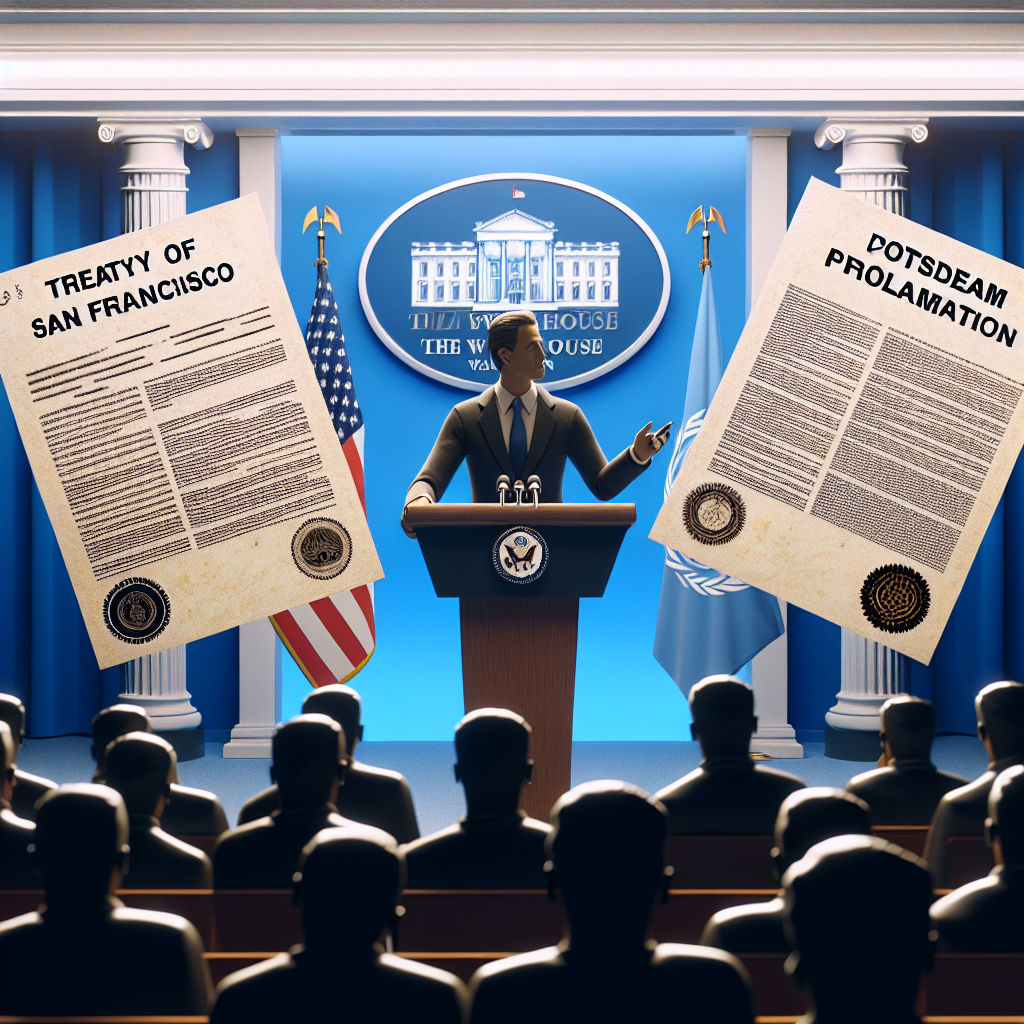
In recent days, a spokesperson from the Chinese Foreign Ministry has been denying the legality of the “Treaty of San Francisco,” claiming that the “Cairo Declaration” and the “Potsdam Proclamation” are the only international legal documents that hold authority under international law. How does the international community and legal experts view this situation?
The denial of the “Treaty of San Francisco” by the Chinese Foreign Ministry spokesperson has sparked controversy and discussions, leading to a new phase in the diplomatic conflict between China and Japan regarding the issue of Taiwan.
The controversy began when on November 26, Kashiwasato stated that (Japan) had given up all rights under the “Treaty of San Francisco” and did not recognize the legal status of Taiwan. In the following days, the Foreign Ministry spokesperson refuted this statement.
The main argument put forth by the spokesperson that the “Treaty of San Francisco” is illegal and invalid is based on the fact that the treaty was a document of Japan’s separate peace with other countries, excluding the main parties of China and the Soviet Union during World War II, which violated the provisions of the 1942 “Declaration by United Nations” signed by 26 countries.
It was also pointed out that Kashiwasato selectively avoided discussing the “legally binding” nature of the “Cairo Declaration” and “Potsdam Proclamation,” while solely highlighting the “illegal and invalid” aspect of the “Treaty of San Francisco.” Several international documents related to Japan and Taiwan are involved here and deserve further discussion.
The “Declaration by United Nations” primarily involves requiring signatory countries to utilize all available resources in the war effort, prohibiting individual ceasefire or peace agreements with enemy nations.
However, the “Treaty of San Francisco” was signed in 1951 by a group of 49 countries collectively, not individually by Japan and a single country. The treaty explicitly stated that each signatory country must cooperate with other signatory countries and cannot make individual peace agreements with enemy nations, without the requirement of unanimous consent from all signatory countries.
While the Soviet Union did participate in the conference, it vehemently opposed the treaty due to the Cold War and the context of the Korean War but refused to sign it. China was not invited to the conference due to disagreements among attending countries on whether to invite the Communist Party of China, which had just gained control of the mainland, or the Republic of China on Taiwan. Most major countries at the time did not recognize the Communist Party of China’s authority, and the United States’ ally in the Asian theater was indeed the Republic of China, hence the exclusion of the Communist Party of China was considered normal.
Emphasizing the “Cairo Declaration” and “Potsdam Proclamation” while denying the “Treaty of San Francisco” is not solely a legal issue but also a matter of perspective. Even though all three have international legal relevance, the question remains why the latter was considered illegal while the former two were seen as lawful.
The “Cairo Declaration” in 1943 was merely a wartime political commitment by the leaders of the United States, the United Kingdom, and China, outlining the return of Taiwan to the Republic of China from Japan. As Japan was still engaged in combat at the time, the declaration did not hold international legal significance.
Similarly, the “Potsdam Proclamation” called for Japan’s unconditional surrender, which was not a matter of international law but one of the surrender conditions referenced in the “Japanese Instrument of Surrender.”
Only the Chinese Communist Party regards these two documents as legal instruments; as unilateral political assertions, they have not been accepted by the United States, Japan, the European Union, or the international legal community. The final legal basis for Taiwan’s status was determined by the “Treaty of San Francisco” in 1951 and the “Sino-Japanese Treaty” of 1952, with the former being a multilateral treaty signed by the Republic of China and Japan to compensate for China’s absence at the “Treaty of San Francisco.”
Both treaties only required Japan to relinquish all rights, titles, and claims over Taiwan, the Pescadores, as well as the Spratly and Paracel Islands without making any statements about the sovereignty of Taiwan, as it was deemed a matter for the victorious countries to decide.
The “Cairo Declaration” is a political statement of the signatory countries during wartime, while the “Potsdam Proclamation” served as an ultimatum to Japan for unconditional surrender. Japan was not obligated to comply with the terms of these declarations, and the “Treaty of San Francisco” remains one of the most significant post-World War II international treaties with clear legal standing and continued full effectiveness to this day, establishing Taiwan’s final legal status according to Article 2(b) which stipulates that Japan renounces all rights, titles, and claims over Taiwan and the Pescadores.
The “Treaty of San Francisco” in 1951 met all the criteria of international treaties, involving negotiations with 52 countries, official signatures from 49 countries, subsequent ratification by the Japanese parliament in April 1952, approval by the United States Senate in March 1952, and registration with the United Nations in accordance with Article 102 of the UN Charter upon its enforcement in April 1952, legally binding all signatory countries and recognized as current international law in 2025.
Although there is no direct judgment from the International Court of Justice (ICJ), the treaty has been indirectly cited multiple times as a legal basis for post-World War II territorial dispositions. Mainstream international law textbooks such as Oppenheim’s, Shaw, Brownlie, and Crawford all categorize it as a “typical multilateral peace treaty example.”
From the seemingly assertive remarks by the Chinese Foreign Ministry spokesperson, one might perceive that Japan is in violation of international law, while in reality, on this issue, it is China that diverges from the international community’s norm.
The “Treaty of San Francisco” is unequivocally an internationally recognized legal document. Japan can only abide by and reference it, not the “Cairo Declaration” or “Potsdam Proclamation.”
The history of China’s non-compliance with international law dates back, despite recent attempts by the Chinese Communist Party to portray itself as upholders of the international order. President Xi Jinping claimed at the 70th United Nations General Assembly debate, “China will always uphold the international order, and adhere to the path of cooperative development.”
In practice, however, China not only fails to acknowledge the decisions of the “International Tribunal for the Law of the Sea” concerning the South China Sea arbitration case initiated by the Philippines but has also reneged on its commitment to demilitarize certain islands in the South China Sea.
Another example is the “Sino-British Joint Declaration.” Despite being an official statement signed by the leaders of China and the UK and deposited with the United Nations for registration, since 2017, the Chinese Communist Party has been reclassifying the agreement as a historical document without practical significance. This led to the G7 issuing a joint statement in 2019 reaffirming the importance of the “Sino-British Joint Declaration.”
China’s selective acknowledgment of international agreements demonstrates a concerning trend. While it is not unusual for countries to have reservations about recognizing specific international laws or clauses, rejecting them on unjustifiable grounds, especially when it undermines major international legal frameworks, is disconcerting.
While the Chinese Foreign Ministry spokesperson may be presenting arguments through official channels, even though they may be construed as twisting the truth, it is a more civilized approach compared to Shanghai’s treatment of Japanese artists.
In Shanghai, two Japanese singers, Ayumi Hamasaki and Makoto Otsuki, were abruptly stopped from performing – one was notified a day before the show while the other had the power cut off midway through the performance. These were not spontaneous decisions but meticulously planned actions designed to maximize economic losses and psychological harm to the artists. The level of malice behind such actions is difficult to fathom.
In contrast, similar performances in Beijing and Guangzhou were not halted. Although this phenomenon is not unique to Shanghai, it is unlikely to be driven by explicit orders from higher authorities. Instead, it could be the result of vague directives aimed at teaching Japan a lesson in other areas, leading to differences in implementation across regions.
Interestingly, in the case of the canceled performances in Shanghai, the organizers likely suffered the most significant losses. As per the contracts, the Japanese artists’ teams may still receive full compensation and possibly even damages, leaving the organizers to bear the entire financial burden, risking bankruptcy along with reputational damage.
The Foreign Ministry spokesperson has stated that inquiries regarding the canceled performances should be directed to the organizers, placing the onus on them for the consequences resulting from political decisions made above, leaving them caught in a crossfire. Ultimately, the Chinese authorities gained nothing and instead exposed their actions in a negative light to the world.
On the other hand, Ayumi Hamasaki’s reputation soared as she meticulously completed her entire performance to an audience of 14,000 empty seats. While she was once a leading figure in Japan’s music industry, many Chinese Americans I know only became aware of her through this incident and greatly admired her for her dedication.
For a long time, the Chinese Communist Party has held almost exclusive discourse on relevant historical documents related to Taiwan’s status or certain islands in the South and East China Seas, largely due to most Western countries adopting appeasement policies towards China.
However, over the past decade, particularly during the first term of President Trump, the US State Department began challenging China for narrative control. Thus far, the US has clarified its “One China Policy” instead of the “One China Principle,” while emphasizing the importance of the Three Communiqués, the “Taiwan Relations Act,” and the Six Assurances. Multiple national parliaments, including the European Parliament, have passed resolutions confirming the lack of stance on Taiwan in accordance with UN General Assembly Resolution 2758, with the Czech Republic refusing to include the “One China Principle” in friendly city agreements.
The existence of international legal documents does not solely result from the actions of powerful nations but is rooted in their justifiability for broad acceptance. This is a concept that the Chinese Communist Party fails to comprehend.