
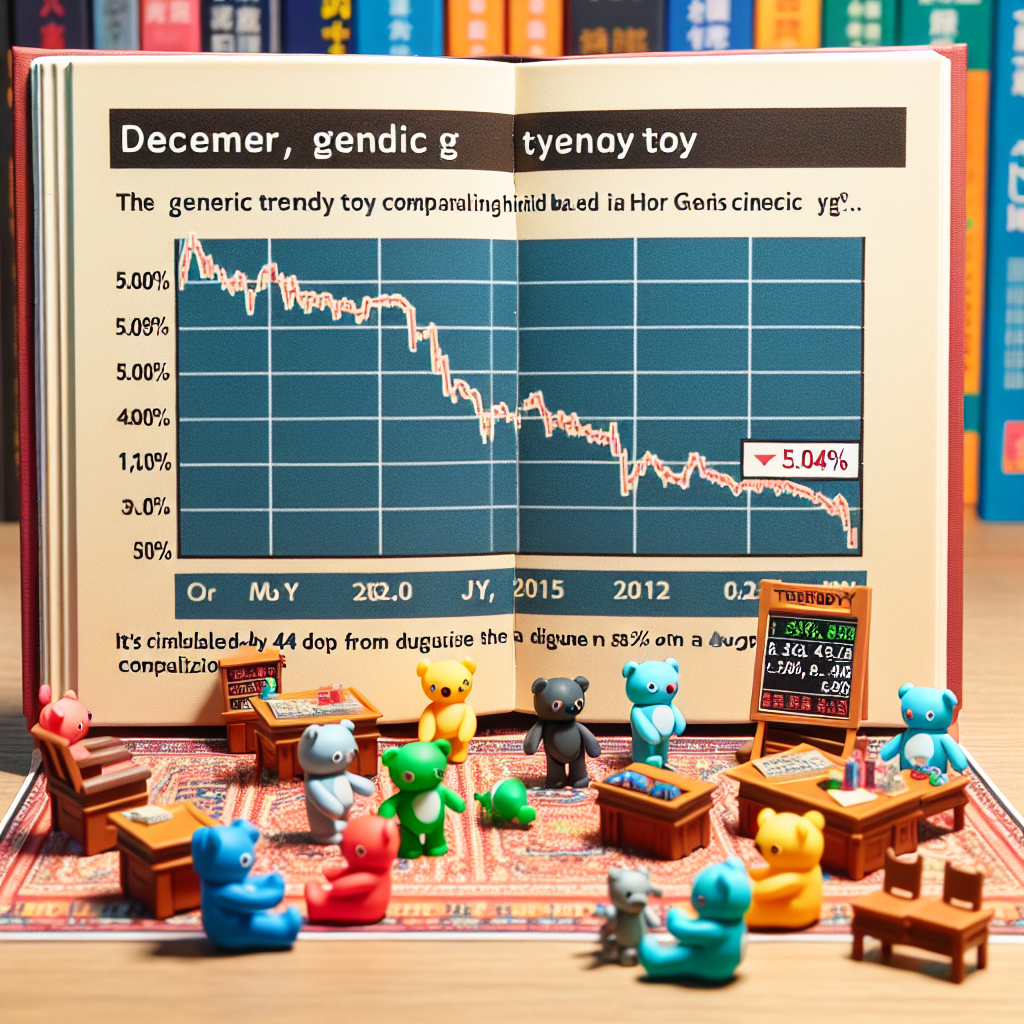
On December 9, 2025, the leading Chinese trendy toy company Pop Mart encountered a cold winter as its stock on the Hong Kong Stock Exchange continued to fall, dropping by 5.04% on that day. Compared to its peak in August this year, the stock has plummeted by 44%, leading to a market capitalization loss of over 200 billion Hong Kong dollars (approximately 180 billion Chinese yuan).
According to analysis by private equity investment professionals in China, the downfall of Pop Mart can be attributed to its bubble-like expansion detached from value. Investors are advised to maintain a long-term perspective and adhere to the principle that buying stocks means buying into the underlying businesses.
On December 9, the stock price of Pop Mart experienced another significant decline, dropping by over 6% at one point during the trading session before closing down by 5.04% at 190.3 Hong Kong dollars per share, with a total market value of approximately 255.62 billion Hong Kong dollars. The previous day, on December 8, the stock suffered an 8.49% drop at the closing, reaching 200.4 Hong Kong dollars per share and a total market value of around 2691.26 billion Hong Kong dollars. The highest stock price of Pop Mart in August was 339.8 Hong Kong dollars.
As the stock faces pressure, short-selling activities continue to accumulate. Several overseas investment institutions have issued bearish reports on Pop Mart, with some even predicting a revenue decline of 10% to 20% in the Chinese and overseas markets for the company in 2026.
Data from the Hong Kong Stock Exchange shows that as of the closing on December 8, the short position amount for Pop Mart reached 1.092 billion Hong Kong dollars, marking an increase of 210.58% compared to the previous trading day, with a short ratio of 19.23%. According to S&P Global data as of December 4, the short selling shares of Pop Mart have risen to 6.3% of the total outstanding shares, reaching the highest level since August 2023.
Market analysts point out that the decline in stock price is mainly due to concerns from investors about the underperformance of sales during the company’s “Black Friday” promotion in the United States and the bearish reports released by several foreign institutions which further dampened market sentiment.
Despite Pop Mart disclosing a 1200% year-on-year growth in the U.S. market in its third-quarter report, a Bernstein analyst specializing in Asian consumer stocks based in Hong Kong stated that “the continuous weakening of Pop Mart’s stock price is largely due to the weakening offline sales trend in North America throughout November. It is expected that the sales growth in the U.S. market for Pop Mart this quarter has slowed to below 500%, presenting a stark contrast to the super high growth rate in the third quarter, directly impacting investors’ confidence in the continuation of high growth in overseas business.”
Morningstar analysts mentioned that a sales decline for Pop Mart in the U.S. market could undermine market confidence in the company’s growth prospects. Overseas sales momentum has been a key indicator closely monitored by investors.
It is worth noting that Pop Mart currently heavily relies on a few hit IPs like Labubu, and the issue of a single-product structure is becoming increasingly prominent. Against a backdrop of lacking new revenue growth engines, there is a clear division in the market on whether the company can maintain its high-growth model.
On the evening of November 13, the launch of new Labubu products by Pop Mart led to a noticeable decline in interest, with premiums in the secondary market notably dropping. The premium for hidden items contracted by over 50%, while prices for 3.0 and 4.0 regular items on second-hand platforms fell below the official retail prices.
Data from Qian Dao platform indicates that the average transaction price for the Labubu 3.0 series regular item “Joy” over the past three days was 87.7 yuan, falling below the official retail price of 99 yuan. The product had reached a peak of nearly 400 yuan on June 16. The average transaction price for the hidden item “Id” over the last three days was 569 yuan, nearly an 85% decline from the peak of around 3,892 yuan on June 16.
In a recent research report, Deutsche Bank pointed out that Pop Mart has significantly increased Labubu’s production capacity from an average of 10 million units per month in the first half of the year to 50 million units per month by the end of the year. For a trendy toy brand relying on unique design and scarcity, large-scale production may erode the “scarcity premium” of the IP, signaling a decline in popularity.
Deutsche Bank termed this as the “availability paradox,” where an increase in supply may transition Labubu from a symbol of scarcity to a mass-consumer product.
On December 9, Zhang Yankun, Executive Director and General Manager of Houen Investments, analyzed that the evaporation of over 200 billion Hong Kong dollars in market value and a 44% stock price plunge for Pop Mart within four months is not a coincidence but rather the combined result of multiple operational risks and shifting market trends.
The rapid decline in the North American market growth from 1200% to below 500%, bursting the overseas growth myth causing panic, coupled with bearish scrutiny and institutional short-selling, became direct stimuli for the stock crash.
Yankun stated that the deeper reasons for the collapse lie in Pop Mart’s persisting high premium model backfiring: with a product premium nearly 20 times, quality control issues arising frequently, improper employee remarks sparking the so-called “shearing of leeks” controversy, scarcity diminished with soaring production capacity, prices slashed in the secondary market, leading to a complete breakdown of consumer trust. Additionally, the reliance on a single IP, the rational consumption return of Generation Z, and stricter regulations have further heightened operational pressures.
This case profoundly confirms the core logic of value investment: choosing a stock essentially means selecting a company, and only companies possessing long-term sustainable development capabilities, prioritizing consumer trust, and maintaining a healthy business model can navigate through market cycles.
“The downfall of Pop Mart stems from its detachment from value leading to a bubble-like expansion, disregarding product essence and user experience. Investors must uphold a long-term perspective, adhere to the principle that ‘buying stocks means buying into companies,’ carefully assess the core competitive strength, profit sustainability, and risk management capabilities of companies, reject chasing emotional bubbles of short-term speculation, and achieve stable growth in the capital market,” Zhang Yankun wrote.