
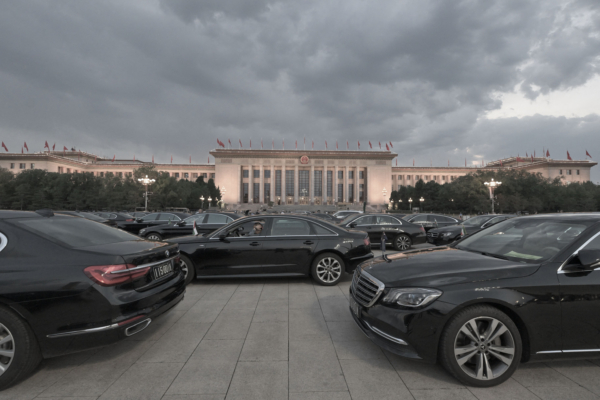
Under the political and economic turmoil, the Chinese Communist Party held its annual Central Economic Work Conference in Beijing. Despite recent mysterious absences, Li Xi, a key figure, was also present at the meeting. Analysts believe that this conference took place amid political and economic uncertainties, with the official reports lacking innovation, indicating a lack of effective measures to tackle economic challenges.
The Communist Party’s Xinhua News Agency reported on December 11 that the Central Economic Work Conference was held in Beijing from December 10 to 11, with Xi Jinping and seven other members in attendance. The official media reported that Xi Jinping attended the meeting and delivered a speech, while Li Keqiang made concluding remarks.
According to the official communique, the conference summarized the economic work of 2025, analyzed the current economic situation, and laid out economic work plans for 2026, largely reiterating the content of a recent Political Bureau meeting.
The conference claimed that over the past five years, they have “effectively responded to various challenges” and that the upcoming “Fourteenth Five-Year Plan” will soon be successfully completed. In the coming year, as the “Fifteenth Five-Year Plan” begins, the focus will be on “adhering to the general principle of seeking progress while maintaining stability”, and addressing risks in key areas, stabilizing employment, enterprises, markets, and expectations.
The meeting also mentioned that “there are still many old problems and new challenges, the impact of changes in the external environment deepens, and contradictions between strong and weak demands within the country are prominent”. However, it claimed that the “supporting conditions for long-term improvement of the economy and the basic trend remain unchanged”.
In the economic work arrangements for next year, the conference put forward eight main points, including “adhering to domestic demand domination”, “adhering to innovation-driven development”, “adhering to reform and breakthrough”, “adhering to opening up”, “adhering to coordinated development”, “adhering to dual carbon leadership”, “adhering to putting people’s welfare first”, and “adhering to securing the bottom line”.
Commentator Li Lin commented that compared to the Nine-point Working Content of the Central Economic Work Conference in 2024, this year’s expressions are almost the same, with little innovation. This implies a lack of effective strategies to tackle economic problems, suggesting that the specific measures may just be a repetition. The emphasis on “securing the bottom line” highlights a need to “stabilize the real estate market” and “orderly address local government debt risks”, indicating an acute awareness within the Communist Party of the crisis confronting the entire economy.
Prior to this, the Political Bureau of the Communist Party held a meeting on December 8, emphasizing “stability” when reviewing the economic work of 2025 and discussing economic work for 2026. Taiwan Nanhua University’s Department of International Affairs and Business Professor Sun Guoxiang told Dajiyuan that the Communist Party’s usual tactic is that the more emphasis placed on stability, the more likely it is unstable; where there is emphasis on “strengthening struggles”, there might be high risks. The wording of the Communist Party’s meetings reveals their anxiety over the unstable economy.
Since 2021, major real estate developers such as Evergrande and Country Garden have collapsed one after another, dragging down the overall economy. Leading real estate developer Vanke’s 2 billion RMB domestic bond is also due on December 15 this year. On December 9, Agile Group faced a winding-up petition in Hong Kong due to debts owed to partners. The latest data shows that China’s second-hand housing prices have been falling for 43 consecutive months, with a widening decline in prices.
On December 8, Xu Weixiong, an economist from the UCLA Anderson School of Management, analyzed for New Tang Dynasty that the current Chinese economy is facing four major stubborn problems that are difficult to solve: the burst of the real estate bubble, monetary tightening, severe employment situation, and debt crisis.
Chinese issues expert Wang He believes that China’s economic woes are not limited to these four areas but are structurally declining as a whole. The Chinese economy has been in turmoil since 2022 and is now critically ill. However, the Communist authorities have lost the capacity to boost the economy, which poses a greater danger.
It is worth noting that since attending a commemorative event for the 110th anniversary of Hu Yaobang’s birth on November 20, Central Commission for Discipline Inspection Secretary Li Xi has not been seen, sparking various speculations until his appearance at the Central Economic Work Conference today.
Commentator Li Lin mentioned to Dajiyuan that although Li Xi reappeared, the December Political Bureau meeting omitted the customary anti-corruption agenda and did not mention the date of next year’s Central Commission for Discipline Inspection plenary session. This in itself indicates an unusual situation within the Commission, with the actual situation remaining difficult to speculate.
In conclusion, the current Central Economic Work Conference is being held against a backdrop of political and economic uncertainties. The fierce infighting within the Communist Party since the 20th National Congress has left the political landscape in turmoil, with many central committee members personally appointed by Xi Jinping falling from grace. At the Fourth Plenary Session just passed in October, a group of generals led by Xi Jinping’s close ally He Weidong, a member of the Political Bureau, were dealt with. Another Political Bureau member Ma Xingrui is also ensnared in unfavorable rumors, drawing attention to the political dynamics of the Communist Party in 2026.
Wang He stated that since Xi Jinping came to power and initiated a leftward turn, internal disputes and divisions within the party have become increasingly serious, leaving the current political situation enigmatic and extremely bizarre. In such circumstances, it is challenging for the authorities to make fundamental policy adjustments unless they overhaul the entire economic and social system, which essentially means the overthrow of the Communist Party.