
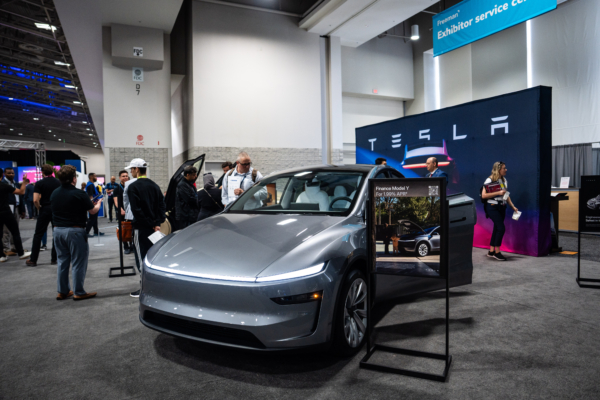
The Automobile Association of Australia (AAA) conducted a range test on electric vehicles (including Tesla Model Y, SAIC MG4 from China, Smart#1, and Kia EV3 from South Korea) and found that the actual driving range of all models was lower than the official figures. Among them, the MG4 had the largest discrepancy, with a tested range 31% lower than the official claim.
The AAA has been conducting a series of tests on new electric vehicles near Geelong, Victoria, comparing the manufacturers’ lab-tested range data with their real-world performance on a 93-kilometer circular track.
The tests revealed that the actual range of the four electric vehicles was between 3% and 31% lower than the official claims.
The Tesla Model Y 2025 model had the closest actual range to the lab test results, being able to drive 450 kilometers on a single charge, only 3% less than the official claim.
Ranked second was the Kia EV3 2025 model with a tested range of 537 kilometers, 11% less than the official claim.
The Smart#1 2024 model came in third with a tested range of 367 kilometers, 13% less than the official claim. The Smart brand is operated as a joint venture between Geely Auto Group from China and Mercedes-Benz from Germany.
Meanwhile, the SAIC MG4 2023 model from China had a tested range of only 281 kilometers, 31% lower than the official claim.
Michael Bradley, the Managing Director of the AAA, noted that these test results help consumers understand the actual on-road performance of electric vehicles and distinguish between those that meet the official range claims and those that do not.
The AAA’s electric vehicle range tests follow European regulations, ensuring result reproducibility and minimizing the impact of human factors such as driving styles and traffic conditions.
This is not the first time the AAA has found discrepancies between actual and advertised electric vehicle ranges. Previous test results in August showed several electric vehicles falling short of their official claims.
For example, the Tesla Model 3 had a tested range of 441 kilometers, 14% less than the official data; BYD ATTO 3 fell short by 23%. The test for Tesla Model Y and Kia EV6 both showed an 8% lower range compared to their official figures, while Smart #3 was 5% lower.
Following the emission scandal involving Volkswagen in 2015, the AAA established this testing program with a $14 million funding support from the Australian government.
According to the latest data from the Federal Chamber of Automotive Industries (FCAI) in Australia, sales of battery electric vehicles (BEVs) saw a continual increase in November, reaching a market share of 9.1%, up from 6.5% last year, with a year-to-date market share of 8.2%, surpassing last year’s 7.4%.
Tony Weber, the CEO of the FCAI, attributed this growth to the introduction of multiple new models. He stated that there are now 110 battery electric vehicle models available in the market in 2025, offering consumers a wider selection. He encouraged governments to invest further in charging infrastructure to boost consumer confidence in this new technology.
In Australia, the sales of Plug-in Hybrid Electric Vehicles (PHEVs) also saw rapid growth, surging by 83.3% in November to reach 4,768 vehicles sold.
In November, Australians purchased a total of 97,037 new vehicles, with conventional gasoline and diesel vehicles still dominating the market.
However, Weber noted a shifting focus among consumers in vehicle purchases.
Weber stated, “Plug-in hybrid electric vehicles continue to be popular because they offer the convenience of daily electric driving while addressing concerns about range anxiety.”
“The decline in gasoline vehicle sales reflects a long-term trend in the global automotive market. We see strong demand for hybrid electric vehicles and plug-in hybrid electric vehicles, with this trend set to accelerate as more models become available.”
So far this year, sales of plug-in hybrid electric vehicles surged by 131%, reaching 47,565 vehicles.