
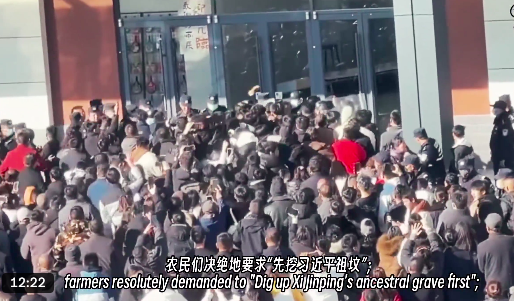
In 2025, against the backdrop of China’s continued economic downturn and frequent public affairs controversies handled by the Chinese authorities, a series of mass protest events emerged in various parts of China. These actions were mostly initiated spontaneously by ordinary citizens, revolving around livelihood, safety, and dignity, with some events lasting for a long duration and involving a large number of participants. Based on public information and online records, a domestic project in mainland China named “Yesterday” compiled and selected the “Top Ten Mass Protest Events of 2025”.
Topping the list was the anti-bullying protest in Jiangyou, Sichuan. In the summer of 2025, a case of bullying of minors in a school in Jiangyou, Sichuan Province sparked social discontent. A minor suffered prolonged bullying at school. After the incident, local authorities announced the handling results, but some parents and local residents expressed dissatisfaction with the accountability and handling methods, feeling that there was insufficient explanation and the key issues remained unclear.
Li Ming, a rights activist who has long been concerned about grassroots rights issues in China, told Daiji World on January 8 that such events are often not sudden outbursts but the result of long-term accumulation. Many problems initially begin as individual cases, but the lack of public explanation and effective response in the follow-up exacerbates the situation, leading to the release of accumulated emotions through collective actions.
Ranked second was the student’s fatal fall in Pucheng County, Shaanxi Province. In early January 2025, a student fell to their death on the school campus in Pucheng County, Weinan City, Shaanxi Province. The incident was initially classified as an accident, but the family raised questions and demanded a public investigation process. Due to the limited information disclosed by the school, the family’s questions went unanswered, causing the incident to escalate.
Several days later, a large number of local residents gathered at the school where the incident occurred and the surrounding areas, demanding the truth to be revealed, leading to clashes with the police. An eyewitness at the scene told reporters that people kept gathering, and the situation became difficult to control.
Li Ming pointed out that these types of mass protests are not occasional social conflicts but the result of the long-term suppression of social expressions and the blocking of normal grievance channels by the Communist Party of China (CPC). Under the CPC’s one-party rule, public affairs lack independent oversight, making it difficult to hold anyone accountable. When ordinary people face injustice, they often have nowhere to turn but to attract attention through collective action.
The third selected event was the student’s fatal fall at No. 6 Middle School in Xuchang, Henan Province. In May 2025, after a student fell to their death, the handling of the situation by the school authorities led to dissatisfaction among students and parents, with over a thousand people besieging the school and facing off with the police. A parent of a student told a reporter that this action was not just for one child.
Li Ping, a teacher at a high school in Hunan who focuses on campus bullying issues, pointed out in an interview with reporters that internal power imbalances in schools have long existed, but there is a lack of effective grievance channels. These conflicts intensify during sudden events. In many primary and secondary schools, students lack reliable avenues of appeal when they face bullying or unfair treatment.
The fourth event was the medical accident involving the infant “Xiao Luxi” in Ningbo. “Xiao Luxi,” a five-month-old infant in Ningbo, Zhejiang, experienced a medical accident during treatment, which gained attention after his mother’s rights protection experience spread on the internet. A netizen who has long been involved in online public welfare activities told reporters that many people came forward out of concern that a similar situation could happen to them or their families.
Li Ming stated that while the authorities often classify such events as individual cases, in the eyes of the public, the frequent occurrences of protests reflect long-standing institutional problems. If these issues continue to be suppressed and remain unresolved for a long time, similar protests will continue to emerge.
Other selected events cover various fields of group protests. In the realm of public safety and regulation disputes, after the exposure of a poisoning incident at a kindergarten in Tianshui, Gansu Province, parents persistently demanded the disclosure of testing data. A parent told a reporter that even after their child was poisoned, they had to strive to find out the truth, which was hard to accept.
In the labor and livelihood domains, food delivery riders in Changsha, Hunan protested jointly over neighborhood regulations issues, and factory workers at the Yilisheng plant in Shenzhen went on strike due to income decrease resulting from institutional adjustments. Interviewees indicated that these actions not only concern income but also involve basic living standards and dignity, reflecting a crisis of governance in various aspects by the authorities.
Conflicts arising from land disputes saw night market vendors in Guandu District, Kunming, Yunnan facing off with urban management personnel due to rectification and charging issues; villagers in Nabai Village, Qiongzhong, Hainan resorted to blockading businesses over land ownership and crop felling issues; collective actions opposing cremation policies emerged in Zhenxiong, Yunnan, and Xifeng, Guizhou. Villagers interviewed said that without taking collective actions, related demands often go unanswered.
The project organizers concluded that the common thread among these events was that the participants were mostly ordinary people forced into public spaces under real pressure.