
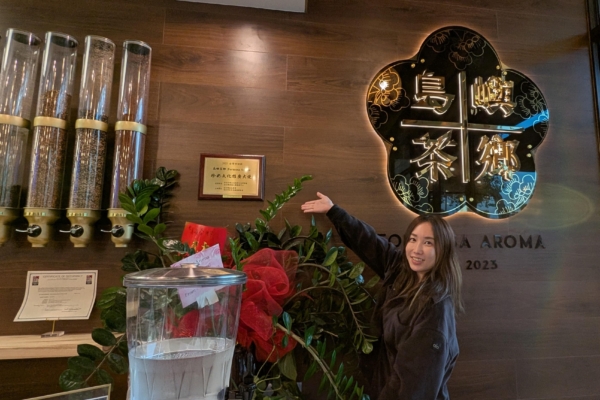
In recent years, Taiwanese bubble tea brands have been gradually entering the United States, with Southern California becoming one of the important bases. From large chains to unique boutique stores, Taiwanese tea drinks are not only favored by the Chinese community but also attracting mainstream market attention. In an increasingly competitive market environment, a group of young Taiwanese immigrants have chosen to start businesses in response to the changing times, venturing into their own “slash-life”.
Located in the Chinese enclave of San Gabriel Valley in Los Angeles, “Island Tea Village” is one such example. Founder Li Mengru, originally from Taiwan, did not start her business to follow trends, but rather from a daily habit – enjoying a reassuring bubble tea every day.
Li Mengru has had a habit of drinking bubble tea since she was young and therefore understands the ingredients and components well. She mentioned that the formulas of drinks on the market are often opaque, “It’s hard to know what’s in the drinks outside, so I wanted to create a product that I can drink every day without worries and be willing to drink.” Based on this philosophy, the tea leaves and raw materials in her store are all sourced from Taiwan, and she personally tastes and selects them before finalizing.
In addition to ensuring quality, Li Mengru also aims to promote Taiwanese culture through her drinks. For her, introducing the “hometown” tea drinks and lifestyle to more people is not just about offering tasty products, but extending a cultural aspect and presenting a way of life. This is also the origin of the name “Island Tea Village”.
In designing the products, Li Mengru transformed her habit of brewing tea at home into bubble tea forms that are more appealing to the younger generation. She believes that traditional tea brewing is less familiar to the younger demographic, so by modernizing the presentation, she lowers the barriers, making it easier for more people to engage with tea itself. “Island Tea Village” is also a designated store for the Overseas Community Affairs Council’s “iCard” program, offering special discounts for Taiwanese expatriates using the iCard.
Facing the taste differences between the Taiwanese and American markets, Li Mengru has made corresponding adjustments. She observed that while Taiwanese prefer light and refreshing milk tea, American consumers generally prefer drinks with a stronger tea flavor. Therefore, even though the ingredients come from Taiwan, the proportions and presentation methods still need to be adjusted according to the demands of the local market in Los Angeles.
Li Mengru came to the United States in 2012 for higher education, initially working in the medical field and currently serving as an assistant professor at a university. She admitted that choosing entrepreneurship was to keep her life passionate and driven. “If you don’t enjoy what you do every day, it will be hard to sustain. That’s why I chose to pursue a business I truly love, beyond my academic role, and embarked on a slash-life.”
Before officially establishing her personal brand, Li Mengru entered the beverage industry through franchising, accumulating practical experience. Upon completing her studies in 2019, she began contemplating her future direction, wanting to explore a path different from her original profession, thus choosing to start with a beverage shop operation.
Li Mengru recalled that after renovations and preparations, the business was officially launched in early 2020. Unexpectedly, shortly after, the pandemic hit. While she initially worried about the impact on operations, the demand for delivery platforms surged, bringing in a large number of orders, making the store exceptionally busy.
However, as she delved further into the actual operation, she gradually discovered limitations in the franchising system regarding contract terms, supply of raw materials, and operational flexibility, which also brought considerable stress. For first-time entrepreneurs who are not familiar enough with the franchising system, it’s easy to become passive in the subsequent operations.
“During that time, I realized that instead of being constrained by the system, it’s better to create my own brand.” After a careful assessment, Li Mengru decided to end the franchising model and re-examine sourcing raw materials, product development, and operational processes. Although the process was tough, it laid the foundation for her future self-established brand.
Li Mengru admitted that at the time, she had to rebuild the supply chain from scratch, familiarize herself with the tea market, raw material quality, and cost structure. “It’s a slower and more laborious path, but at least the direction and philosophy are in my own hands.”
Considering factors such as population density, consumer habits, and convenient on-site support, Li Mengru chose to establish “Island Tea Village” in the Chinese-populated “626 area”. She believes that consumers in this area have a relatively mature acceptance of Taiwanese tea drinks and that her ability to quickly address issues at the store during the initial stages of her entrepreneurship was crucial.
The overall cost of opening a bubble tea shop is around hundreds of thousands of dollars, with renovations and equipment often being the major expenses. Therefore, careful evaluation of fund allocation and partnerships is essential. Regarding future development, Li Mengru stated that she is currently not opting for traditional franchising models and is more inclined to cooperate through partnerships to reduce risks for both parties.
Beyond the operational aspect, Li Mengru also hopes the store can become a community space for interaction. She does not rule out integrating small exhibitions, book clubs, or family activities in the future, extending the tea space to cultural and lifestyle dimensions.