
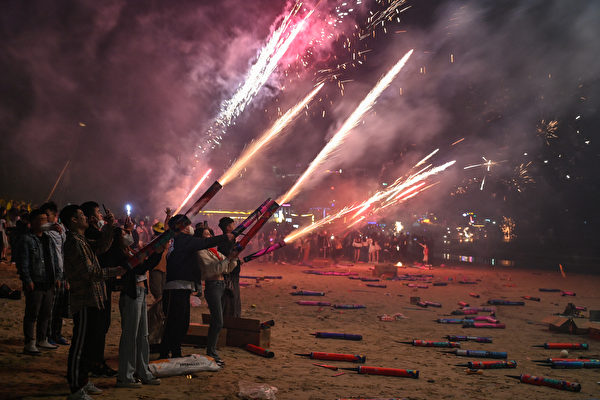
As 2026 approaches, many local governments in China have announced that they will not organize any form of New Year’s Eve activities this year and have banned public gatherings. Commentators believe that the social unrest in China and the further restrictions imposed by the Chinese Communist Party on people’s freedoms will only lead to more social issues.
On December 27th, Taihua City in Qingzhou, Shandong Province announced that they have received work requirements from relevant departments to no longer hold outdoor New Year’s countdown events on December 31st. The reason cited was to “ensure the safety and order of customers and friends on New Year’s Eve and to avoid the risks of large gatherings.”
Earlier, Tangye Central Park in Jinan, Shandong Province also canceled the scheduled “Starry Music Festival” New Year’s Eve event. The organizers stated that due to “force majeure” factors, they could not hold the event as planned.
Anhui Province’s Suzhou City also mentioned that due to “force majeure,” the “2026 Suzhou New Year Music Carnival” event scheduled for December 31st will be canceled.
Suzhou Center Mall in Jiangsu Province stated that they will operate normally until 10 p.m. on December 31st, but the New Year’s countdown event is canceled, and any related New Year’s activities in the public areas surrounding the mall are prohibited.
On December 25th, the Zhengdong New District of Zhengzhou City, Henan Province issued a notice stating that public places such as Dongshankou, Guangzhou Tower, Yongqingfang, Huacheng Square, and the surrounding areas of the Pearl River banks are not allowed to organize any form of official New Year’s countdown, New Year’s Eve performances or large-scale public events.
The notice also mentioned that during the festival period, the public security, traffic management departments, etc., will implement crowd evacuation or temporary traffic control measures on some roads as deemed necessary.
Hefei City in Anhui Province also announced the temporary cancellation of New Year’s Eve activities at Huaihe Road Pedestrian Street and Luogang Park this year.
Tianjin City declared that there will be no city-wide fireworks this year, and the New Year’s fireworks show at the Taida Aircraft Carrier Theme Park has also been canceled.
The Guangzhou Public Security Bureau in Guangdong Province reminded that on the night of December 31st, there will be no organized large-scale public events such as New Year’s countdowns at public places such as Beijing Road, Dongshankou, Guangzhou Tower, Yongqingfang, Huacheng Square, and the surrounding areas of the Pearl River. Residents are urged not to bring drones, balloons, sky lanterns, or other flammable items into the mentioned areas.
The organizing committee of the “Encounter Beauty – Beihai New Year Music Festival” announced on December 25th that the music festival scheduled for December 31st and January 1st, 2026, will be canceled.
Shanghai City also declared that there will be no New Year’s Eve light show and countdown activities along the Bund this year, and strict traffic and crowd control measures will be implemented.
Screenshots uploaded by mainland netizens showed that New Year’s Eve activities have been canceled in Xi’an, Shaanxi, Hefei and Suzhou in Anhui, Guangzhou, Suzhou in Jiangsu, Zhengzhou in Henan, and there are appeals for residents not to gather.
Even in the fully controlled by the Communist Party, the Hong Kong Special Administrative Region has canceled the Victoria Harbour New Year’s Eve fireworks event.
Regarding this, mainland netizens have questioned: “What happened? Why are there so many places canceling New Year’s Eve activities?” “Isn’t the aim to boost consumption?” “On one hand, they want to stimulate consumption, and on the other hand, they are not allowing events, how can they boost consumption?”
On overseas platforms, many netizens speculated: this is “afraid of large-scale events.” “The Communist Party is surrounded, hence the panic and vigilance.” “The Communist Party fears all public gatherings.” “The economy is not doing well, large-scale events are prone to chaos.” “The main reason may be that local governments are running out of money, including expenditures on stability maintenance. Canceling New Year’s Eve activities can reduce large-scale gatherings and help alleviate the pressure on the Communist Party for stability maintenance.”
In recent years, China’s economy has continued to deteriorate, with various sectors facing decline, waves of business closures, layoffs, wage reductions, and wage arrears. The entire Chinese society is simmering with discontent, and movements demanding rights and owed wages are surging, with incidents of violence and vehicular attacks occurring frequently.
At the end of 2014, cities like Guangzhou, Nanjing in Jiangsu, and Changsha in Hunan also announced the cancellation of New Year’s Eve activities, prohibiting large public gatherings in public places, and indicated that public security departments would implement crowd and traffic control measures.
Columnist Chen Shuhan of “Beijing Spring” commented that by not allowing New Year’s Eve activities, “This shows that the authorities of the Communist Party are very nervous. Now that the economy is collapsing, they fear the people causing trouble. If the grassroots people cause trouble indiscriminately, retaliate against society, attack people, and trigger a herd mentality, then there will be trouble everywhere, right?”
Chen Shuhan stated that the Chinese society is volatile, and the Communist Party wants to solve problems by restricting people’s freedom, addressing symptoms but not the root cause. By not allowing New Year’s Eve activities, “this is a precursor to the collapse of the Communist Party, the collapse of the economy marks the beginning of the collapse of political power, this signal is already very clear.”