
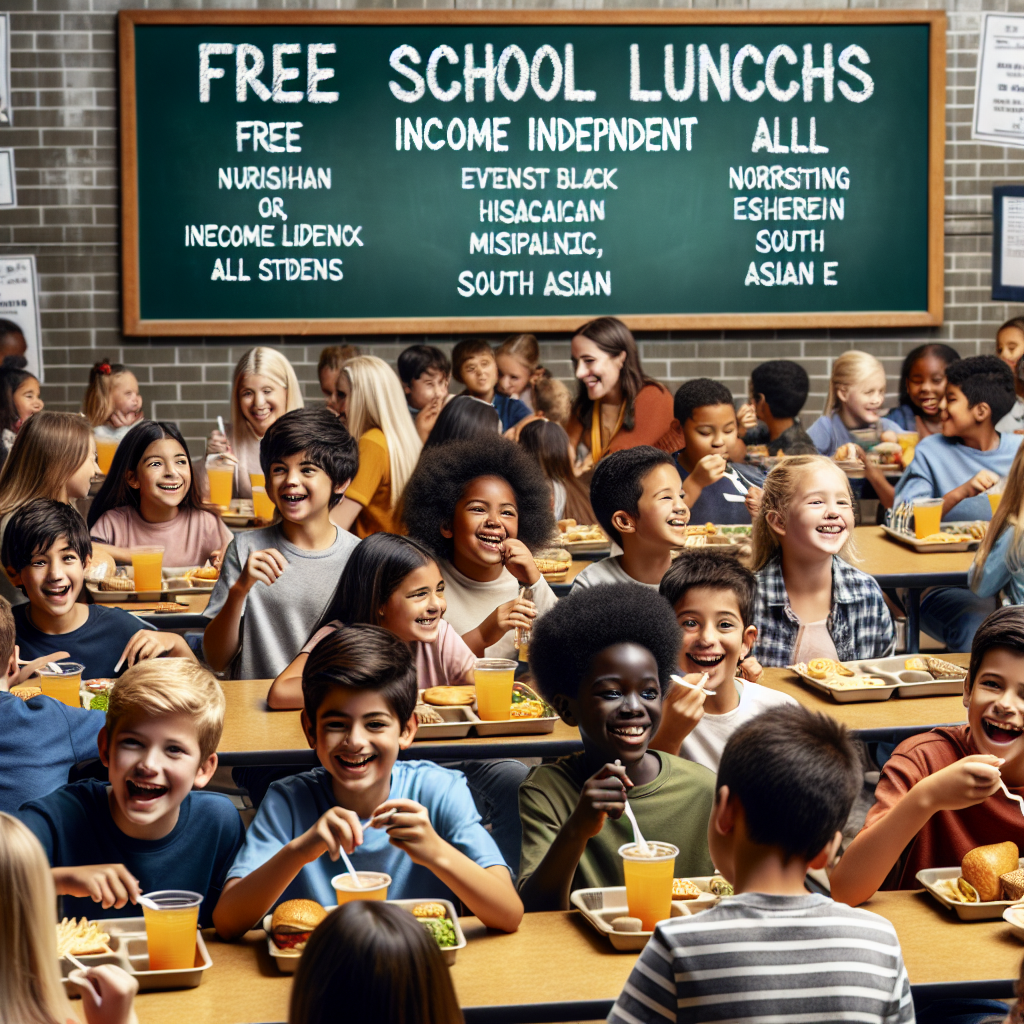
In an increasing trend across the United States, more and more public schools are starting to provide free lunch to all students, regardless of their families’ income levels. This practice has sparked criticism.
According to data from state government websites and the National Conference of State Legislatures’ education legislation database, currently, 11 states and the District of Columbia are considering “free school meal” bills, which may be discussed in the upcoming 2026 legislative sessions.
Since September, New York has been providing free school meals to all students, becoming the 9th state to pass related legislation, joining California, Colorado, Maine, Massachusetts, Michigan, Minnesota, New Mexico, and Vermont.
New York Governor Kathy Hochul stated in a release on December 12 that free school meals can help families save money and ensure that every student receives the nutrition they need for growth, without any barriers.
Arkansas and Pennsylvania currently provide free breakfast to all students but do not offer lunch. Several other states have also proposed related bills, but either they have not passed or have made no progress.
According to the Food Research and Action Center, only 14 states’ legislatures have yet to introduce free school meal bills for all students.
This trend began after the outbreak of the COVID-19 pandemic when schools temporarily provided free meals to all students. Some state legislators introduced bills in 2022 in an attempt to make this arrangement permanent.
A report released in January by the Institute for Education Sciences indicated that over a quarter of public schools in the U.S. currently provide free meals to students through state or local programs.
This also means that in states where it is not mandatory, many school districts have decided to fund free breakfast and lunch for all students.
For decades, the U.S. Department of Agriculture has been providing free or reduced-price school meals for disadvantaged children. However, the Food Research and Action Center argues that the income eligibility threshold for federal programs is too strict. For the 2024-2025 school year, most states set the qualification income for a family of three at below $34,000 to receive free school meals.
Republican State Senator Dennis Guth of Iowa stated that legislating compulsory free school meals weakens the autonomy of local governments and school districts, which have long been able to help truly needy low-income students.
“Free meals should only be provided to those who truly need it,” Guth told the Epoch Times. He added that the free school lunch bill proposed in Iowa last year did not even pass the committee review stage.
“We shouldn’t add any more costly government programs,” he said. “I don’t believe the government should include everyone in the welfare system, thereby exerting control over everyone.”
The Foundation for Government Accountability criticized that free school meals are an unprofitable deal for both state governments and students, leading to millions of students from middle and high-income families becoming dependent on government-provided meals before “leaving the nest.”
“This is a large-scale expansion plan of food vouchers paid for by taxpayers for those who do not need it,” the foundation stated in a report in 2024, emphasizing that it is not about child hunger and mentioning President Biden’s policy of promoting free school meals at the federal level.