
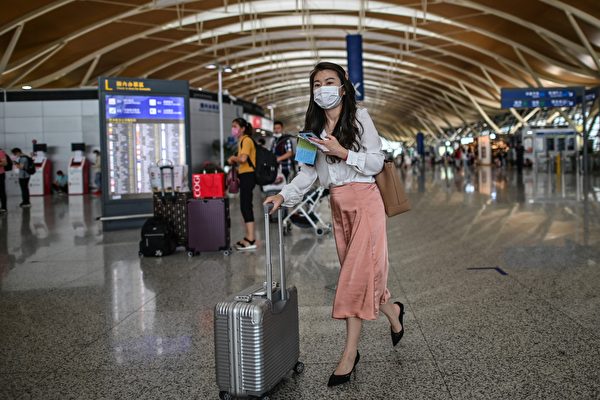
In recent times, there has been a turnover of duty-free shop operating rights at the major airports in Shanghai and Beijing. This shift is no longer seen solely as a commercial transfer of operating rights but is regarded as the end of an era in the power structure of the Chinese economy: the capital affiliated with the Jiang family, deeply entrenched in the duty-free entrance system at airports, is formally and completely withdrawing.
According to mainland capital market insiders, Sunrise Duty Free (Shanghai) Co., Ltd., the former primary operator of duty-free shops at Shanghai Pudong and Hongqiao airports, as well as Beijing Capital International Airport, is no longer listed in the new round of duty-free operating rights. Based on the results of public tenders, China Duty Free Group (CDFG) and Dufry won bids for the three segments at Shanghai Airport; in Beijing, according to information disclosed by the Beijing Municipal Commerce Department and China Duty Free Group, CDFG and Wangfujing Group respectively took up duty-free operations. Reports from The Paper indicated that this move signifies the “farewell of Sunrise Shanghai to the duty-free business at Shanghai Airport.”
Mr. Yao, a researcher on China’s political and business relations, pointed out in an interview that duty-free operating rights have long been seen in public discourse as a symbol of old-capital era, so once there is a change, it is easily interpreted by outsiders as “the end of a certain cycle.”
He emphasized that such interpretations are not facts stated in official documents but are part of political structure deductions. “Some will interpret it as with the change of power, eventually leading to a change in capital. Many see it as the Jiang family capital fading out of the market.”
The political significance of duty-free rights stems from historical capital chains. Sunrise Duty Free, founded by Chinese-American Fred Kiang in 1999, obtained duty-free operation entrances at Pudong Airport at the time, later expanding to Hongqiao and Beijing. In 2011, Boyu Capital, founded by Jiang Zemin’s grandson Jiang Zhicheng, acquired around 40% of Sunrise Duty Free, marking the first time airport duty-free, this “entry-type resource,” was widely seen by the capital market as directly associated with the Jiang family. Though family details were not listed in regulatory documents, Reuters disclosed relevant transaction paths, leading China’s duty-free shops to be long seen as a crucial channel of Jiang-connected capital by outsiders.
Since 2018, CDFG acquired 51% of Sunrise Shanghai shares for about 1.505 billion yuan, gradually transitioning duty-free operations into state-owned enterprise dominance. The re-tendering of Shanghai duty-free shops marks the ultimate point of this transition: the Jiang family capital completely exiting the duty-free entrance is not a result of falling behind in commercial competition but a consequence of a shift in era structure.
Mr. Yao stated: “Jiang Zemin has passed away, and the political force of his family is fading out of the power hierarchy, and the entry resources are no longer ‘needs to consider’ or ‘needs to bypass’ by the current rulers.”
As per the announcement of Shanghai International Airport Co., Ltd. on December 17, 2025, CDFG and Dufry Business Limited from France obtained the duty-free operating rights at Pudong and Hongqiao, ending Sunrise Duty Free’s 26-year dominance in the entrance market. The announcement revealed that CDFG gained the duty-free shop operating rights at Pudong Airport T2 and S2 Satellite Hall and Hongqiao Airport exit and entry, employing a “5+3 year” mechanism; Dufry obtained the operating rights at Pudong Airport T1 and S1 regions, following a “3+5 year” system. The operating system has shifted from fixed rent to a “fixed rent + sales commission” model, linking airport revenue to duty-free sales.
According to The Paper, the new contracts require an expansion of duty-free sales categories, including mobile phones, drones, health foods, baby products, pet food, and non-prescription drugs; the operational areas have expanded – 1181 square meters added to Pudong and 383 square meters to Hongqiao.
An industry insider familiar with the bidding process revealed that Sunrise Duty Free did not voluntarily withdraw but was unable to submit a bid due to lack of authorization from CDFG. This means their exit was not a natural commercial decline but a “repartitioning of entry rights” under the central economic governance logic.
A researcher from Shanghai University of Finance and Economics, when interviewed recently, stated: “In recent years, there have been signs of state-owned entities reclaiming control over land, publishing culture, and medical resources. With fiscal pressure and economic slowdown, the central government prioritizes reclaiming assets with high cash flow, controllability, and entry attributes. Duty-free shops are just one node; the key observation lies in Beijing.”
As of now, official explanations of the policy nature regarding the changes in duty-free operations have not been provided.