
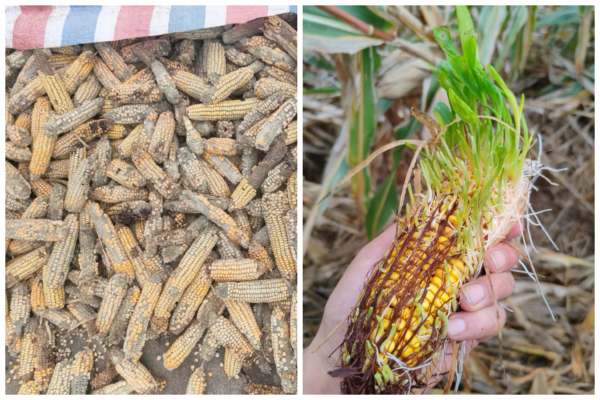
In autumn this year, major grain-producing areas in China such as Anhui, Henan, and Shandong experienced rare and prolonged rainy weather, causing damage to the autumn grain. Some sources indicated that local governments did not organize disaster relief efforts, and moldy grains may have already entered the market.
Recently, a netizen from Shandong told a reporter from the Epoch Times that the peanuts in the street markets taste bad with a strange flavor, attributed to the earlier rainy weather causing mold. It was suggested to avoid consuming peanut oil, corn oil, and similar products as these widely used items have seeped into various aspects of life. After deep processing, it is difficult for the naked eye to distinguish, unless professionally tested.
The netizen mentioned that a month of rainy weather in the north delayed the harvest of corn and peanuts. In these grain-producing areas, many corn and peanuts sprouted and became moldy in the fields. Even with early harvesting, coupled with limited sunny days for sufficient drying, the accumulation of moisture led to mold. With declining social morals, these moldy grains, if not properly handled, will ultimately reach the public’s dining tables. Moldy corn may be ground into corn flour, while moldy peanuts may be pressed into peanut oil, inevitably causing chronic harm to the public.
“That month of rainy weather quietly changed many things,” he said.
During this autumn, many northern regions in mainland China experienced continuous rainy days, raising concerns among netizens that the corn and peanuts in the fields may have molded, leading to potential aflatoxin exceedances in future food consumption. “When it’s time to harvest the corn but it rains, the harvesters can’t get into the fields, and all the corn is already molded in the fields. Due to rain, the harvested corn cannot be dried properly, resulting in a lot of mold.”
Peanuts are prone to contamination by aflatoxins, while corn is mainly affected by Fusarium fungi. It was previously clarified by CCTV that moldy grains do not necessarily mean exceeding toxin levels. Upon storage, grains are not only tested for mold but also for the level of mycotoxins. It’s mandatory to comply with the national standard that limits aflatoxin levels to 20 micrograms per kilogram for both feed and food grains.
Experts point out that in high humidity conditions, harmful fungi proliferate rapidly, increasing the risk of corn mold. If corn exhibits mild fungal toxin exceedances, it can be utilized for industrial alcohol production. However, severely contaminated corn with aflatoxins cannot be used for alcohol production and must be destroyed.
Nevertheless, questions arise regarding the fate of these toxic corn. A netizen from Shandong informed the Epoch Times that, “It’s really hard to say. There are specialized collectors heading to the rural areas to collect grains; both moldy and good quality corn is gathered together.” Many netizens reported experiencing allergic reactions, coughing, fever, skin rashes, and swelling after handling corn for a few days. Some expressed respiratory issues and skin irritation due to exposure to moldy corn.
Recent reports from local media highlighted multiple cases in hospitals in Henan where elderly individuals fell ill after handling moldy corn. On October 31, a 54-year-old man in Zhumadian, Henan, suffered respiratory failure and severe lung infection with a “completely white” appearance due to exposure to damp moldy corn, requiring emergency ICU care.
An insider source revealed to the Epoch Times concerns over food safety and quality. Most farmers still rely heavily on natural conditions, but this year’s crops have been devastated by heavy rains in Anhui, Henan, and Shandong, resulting in mold growth and high humidity indoors. The continuous rainfall for two months disrupted wheat planting, necessitating replanting. The autumn grain harvest this year is in jeopardy.
“This year’s disaster is so severe, but no one is taking responsibility. Under normal circumstances, the government should allocate funds, organize manpower for rescue operations, salvage and re-seeding, manage downstream drainage, or flood prevention measures. In the past, there used to be extensive efforts to relocate residents to safer places and drain excess water, but now no one seems to care,” the source stated.
He mentioned that as long as the corn only sprouted, it would still be edible, but once moldy, it becomes useless. Moldy corn is often sold to feed mills for animal consumption, raising concerns about subsequent contamination of meat, milk, and eggs through metabolized mycotoxins.
On November 11, a food safety whistleblower released a video revealing sudden detection of fumonisin toxins in corn in multiple regions, with feed mills rejecting nine out of ten corn deliveries due to toxin contamination. The increased testing for fumonisins is crucial, as exceeding these toxins can harm horses, pigs, as well as the internal organs and immune systems of chickens, ducks, and other poultry. With the heightened humidity in North China during this fall and subsequent cooling of harvested corn, fumonisin toxins are becoming more evident.
The insider forecasted that highly moldy corn will face diminishing prospects in the market, whereas uncontaminated corn with lower toxin levels will become more sought after. This disparity will widen the quality-price gap of corn, exacerbating differences among various production areas.
A netizen from Jiangsu recently mentioned, “Many dogs and pigs have already been poisoned.” Another netizen determined to avoid consuming corn for at least two years.
Expressing concern over food quality and safety issues, the insider highlighted the inadequacy of quality inspection facilities at the city, county, district, and town levels. While these facilities are in place, the tight financial situation has hindered their operational effectiveness; enforcing officials require transportation, meals, and reimbursable expenses, leading to the lack of inspections.
“The government hasn’t coordinated with large-scale manufacturers for drying processes. Each one is acting independently, some families airing their grains themselves. If salvage operations were conducted promptly, like in the past, by engaging large processing facilities for massive procurement, then supplemented by governmental aid to minimize the losses incurred by farmers. But no one seems to care,” he lamented.
“In China, many food items are inherently unsafe, often containing multiple preservatives. Even with food safety concerns, it’s considered good enough if people can eat their fill,” he concluded.