
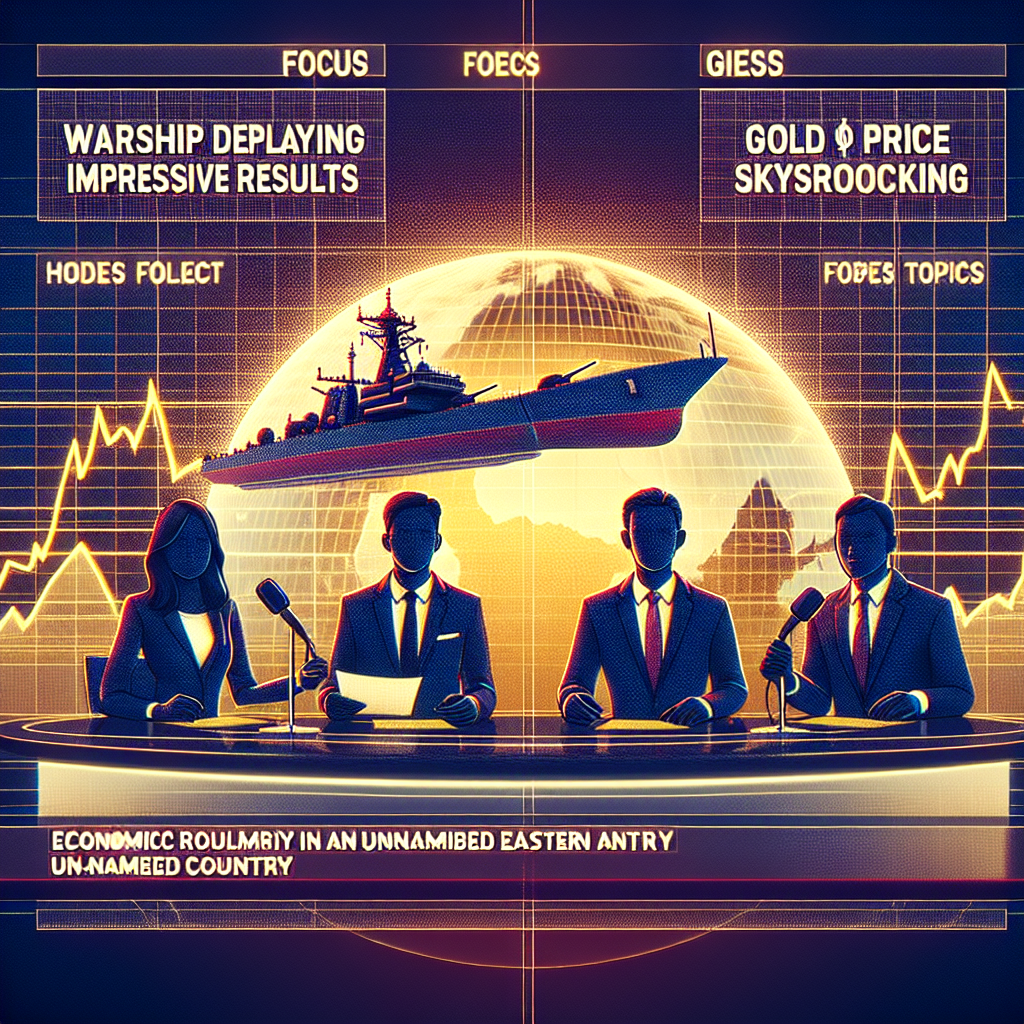
Today’s Focus: Gold Price Soaring! Giant Warship Showcasing Impressive Results! Is China’s Economy in a Terrible State While Still Seeking Hegemony?
Our guests for this episode: American economist David Huang and veteran media personality Li Su; Hosts: Jin Shi and Fu Yao.
First, let’s focus on the report released by the U.S. Department of Commerce on the 23rd, showing a GDP growth rate of 4.3% in the third quarter of this year, far exceeding the expected 3.2%, marking the fastest growth rate in two years. Now let’s connect with Washington correspondent Zhang Liang for more details.
President Trump announced on Monday (December 22) the launch of the “Gold Fleet” plan, which includes approving the construction of two state-of-the-art “super battleships.” Please allow Zhang Liang to provide a detailed introduction to President Trump’s “Gold Fleet” plan.
Indeed, this is a piece of news that military enthusiasts would find exciting.
The new warships will have a displacement of up to 30,000 to 40,000 tons, unprecedentedly close to the level of a medium-sized aircraft carrier. However, since the appearance and wide application of aircraft carriers, the concept of naval warfare has undergone significant changes, with naval battles essentially turning into aerial battles. The side with more carrier-based aircraft, stronger firepower, and air superiority will win the war.
Therefore, most developed countries nowadays focus on building aircraft carrier fleets, entering the era of carriers. The giant warships that Trump is planning to build now evoke the nostalgia of the era before aircraft carriers, dominated by large battleships and heavy artillery. At that time, aircraft were unable to participate in naval battles, so the competition was about the size of the ships and the power of their guns.
Mr. Li Su, in your opinion, why does Trump want to build such giant warships now? In today’s era, what roles can these warships play, or are they possibly a bit outdated?
The U.S. Department of Commerce released the latest data showing that the U.S. GDP grew by 4.3% in the third quarter, marking the fastest growth rate in two years.
The data indicates that consumer spending remains the main engine of economic growth in the third quarter, with personal consumption rising by 3.5%, higher than the 2.5% in the second quarter.
President Trump posted on his social media platform “Truth Social” on Tuesday morning, saying, “The just released U.S. economic data is great, thanks to the tariffs! And it will only get better in the future! There is no inflation, and national security is becoming stronger.” He also emphasized in his tweet that he will pray for the Supreme Court’s tariff ruling.
Mr. David Huang, overall, the GDP data for the U.S. in the third quarter appears quite impressive. This year has been marked by tariffs, and many were worried that tariffs might lead to price increases, impacting consumption. Why hasn’t there been a related situation after the implementation of reciprocal tariffs?
Mr. Li Su, actually, the U.S. GDP data for the third quarter was originally scheduled to be released at the end of October, but due to the 43-day government shutdown, the data release was delayed. However, because of the government shutdown, the nonpartisan Congressional Budget Office estimated that this would cause a 1.0 to 2.0 percentage point decline in the GDP for the fourth quarter. How do you view this expectation?
While the U.S. economy in the third quarter has shown remarkable figures, the price of gold has been soaring. As the saying goes, in chaotic times, gold prices tend to rise only during economic downturns. Yet the current gold prices are showing an anomaly.
Gold prices surged over 2% this week, reaching over $4500 per ounce, hitting a historic high.
In 2025, gold rose from $3000 in March to surpass the $4000 mark in October. The cumulative increase in gold prices has reached a staggering 65-68% this year.
More surprisingly, JPMorgan predicts that by the fourth quarter of 2026, the price of gold could surpass $5055 per ounce, and even hit the $6000 mark in 2028.
Analysts believe that the gold market has undergone a “permanent revaluation,” with previous price ceilings now becoming new benchmarks for support.
Mr. David Huang, gold is often seen as a hedge against economic downturns or inflation. Now, as the economy doesn’t seem to be experiencing a significant recession and even boasts attractive figures, why is the price of gold continuously soaring? What do you think are the core factors influencing gold prices at present?
Follow-up question: Gold prices have been steadily rising, with analysts even predicting a breakthrough of $6000 in the next two years. This inevitably leads many to view it as a good time to buy gold. However, it also raises concerns about the significant fluctuations in gold prices. When will it peak? When can we expect a downturn in the future?
Mr. Li Su, would you recommend friends in mainland China to buy gold?
Moving on from the U.S. economy, let’s shift our focus to the Chinese economy. The Chinese authorities have set a target of 5% economic growth for 2025, but the latest estimates from American think tanks suggest that the actual growth is only between 2.5% and 3%.
Rhodium Group released a report on the 22nd estimating that China’s real GDP growth for 2025 ranges between 2.5% and 3.0%, roughly half of the official 5.2% growth rate claimed by the Chinese government up to the third quarter. The reason for the halved economic growth rate is the significant decline in fixed asset investment in the latter half of the year.
The Rhodium Group report also mentions that historically, no economic entity has achieved a 5% real GDP growth under continuous contraction for ten consecutive quarters, raising doubts about whether China can be the first to do so.
Mr. David Huang, what is your view on the Rhodium Group’s report? Is the estimated GDP for China in 2025 between 2.5% and 3.0% closer to reality?
An article published by The Wall Street Journal on Tuesday, titled “China Striving for Technological Dominance but Fails to Conceal Economic Flaws,” points out in its opening that in various cities and towns across China, two seemingly contradictory facts coexist: on one hand, China is narrowing the gap with the United States in global technological dominance, while on the other hand, many sectors of the Chinese economy are in disarray.
The article describes some symbolic scenes: domestically developed electric cars zooming through deserted apartment buildings; factory robots powered by artificial intelligence mass-producing products that recent college graduates who cannot afford them.
The article believes that in the pursuit of technological dominance against the U.S., the Chinese government annually invests billions of dollars in domestic technology, resulting in oversupply in industries such as electric cars and robots. On the other hand, this investment is squeezing resources that are more essential to people’s livelihoods, such as rural education and strengthening the social security system.
This is why China appears to be approaching the U.S. in technology while facing numerous economic challenges.
Mr. Li Su, how do you view the coexistence of these two phenomena in China’s economy? Is this a sustainable model?
Mr. David Huang, I would like to hear your perspective on this issue as well. China is pouring heavy investments into catching up with the U.S. in technology, yet its economic system faces significant challenges. What do you think the future holds for this kind of economy?
China’s pursuit of so-called “technological independence” has its origins. In the 1950s and 1960s, amid deteriorating relations with the Soviet Union, Mao Zedong advocated for “technological independence.” During the “Great Leap Forward,” Mao sacrificed agricultural production to pursue steel output, leading to a widespread famine that caused the deaths of tens of millions.
The former Soviet Union also had a similar economic model, with a severely unbalanced economic structure leaning heavily towards heavy industry and military industry while neglecting light industry.
History has shown that both Mao and the former Soviet Union’s economic models were dead ends.
Mr. Li Su, now, Xi Jinping is once again following a path of technological self-reliance prioritizing national security over people’s livelihoods. Of course, times have changed, and there have been significant changes in both internal and external environments. How do you view Xi’s approach compared to Mao Zedong’s strategy back then? Do you think Xi can find a way out?
Subscribe to our YouTube channel:
https://www.youtube.com/channel/UC_78IIcKAIDpp6SJOlf3vDA
Subscribe to the Clean World channel:
https://www.ganjingworld.com/channel/1eiqjdnq7go5grer6fQLmhsYe1g60c