
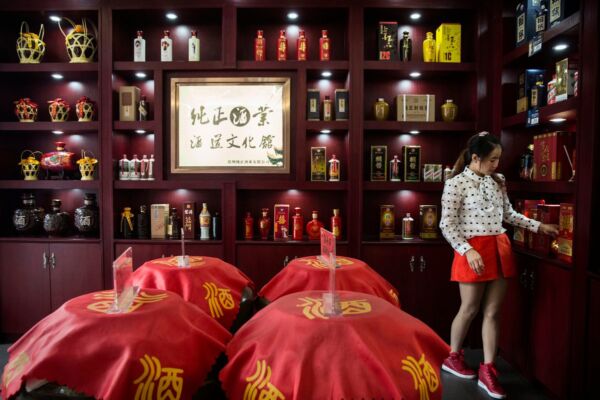
In 2025, the soaring price of Feitian Maotai has been continuously falling this year, with prices falling below the official guidance price for the first time in 12 years. Compared to the beginning of the year, the price has dropped by over 30%, causing some distributors to incur losses of nearly 500,000 yuan. In contrast to large and well-known liquor companies, small and medium-sized liquor enterprises have been experiencing a series of setbacks. Industry experts point out that the current “collapse” of the liquor industry is mainly attributed to three main reasons: traditional distribution channels failing, supply-demand imbalance, and erosion of brand value.
The Beijing Time on Tuesday, December 23, reported that data from a third-party liquor price monitoring platform showed that on December 12, 2025, the wholesale reference price for a bottle of 53% Feitian Maotai dropped to 1485 yuan (RMB) per bottle, while the quoted price for a case was 1495 yuan per bottle, both falling below the official guidance price of 1499 yuan per bottle for the first time in 12 years.
This price change marks the first instance of Feitian Maotai experiencing price inversion in the regular market conditions since 2013, becoming a landmark event signaling structural adjustment in the liquor industry.
The wholesale price of Feitian Maotai has been continuously declining this year: breaking the 2000 yuan mark in June, slipping below the 1700 yuan mark in October, breaching the 1600 yuan mark in November, and briefly touching the 1499 yuan guidance price in mid-December before plummeting below it on Tuesday (23rd).
As of December 12, the wholesale price per bottle had plummeted by 33.1% from around 2220 yuan at the beginning of the year for loose bottles, and by 33.7% for cased products. The drop within six months exceeded 28%, marking the largest quarterly drop in recent years.
According to a report by Southern Weekend on Monday, a white liquor sales store manager with eight years of experience mentioned that the once lucrative Maotai, where “buying meant earning,” has now become a hot potato for stockpilers.
Before, 1499 yuan was seen as the psychological bottom line, but this time it directly hit rock bottom.
Mr. Zhang, engaged in the tobacco and liquor business, revealed that a few months ago, he stockpiled a batch of goods at around 2150 yuan per bottle, with a total investment exceeding 2 million yuan, which now translates to a loss of nearly 500,000 yuan.
One liquor dealer disclosed that among his acquaintances, quite a number have incurred losses exceeding 300,000 yuan from a single shipment.
A veteran liquor distributor, Mr. Peng, with over 15 years in the industry, told “Da Xiang Xin Wen” on Monday that a loose bottle of Feitian Maotai that once sold for over 3100 yuan at its peak now fetches only around 1500 yuan, with shrinking profits. Some Maotai series products are selling at a loss, leading to a dilemma of either selling at a deficit or tying up capital, presenting a situation where “previously earning money effortlessly has turned into a struggle for survival.”
A recent video from Xi’an Fufa Trading Co., Ltd. on Douyin stated, “The drop from 2500 yuan to 1500 yuan for Maotai has reasons – those who sell Maotai are closing down and those who drink Maotai are prospering!”
In comparison to large and well-known liquor enterprises, the days are even more challenging for small and medium-sized liquor enterprises, with many facing a series of setbacks.
Previously, a large number of dealers of Tan Liquor (Sichuan Xian Tan Liquor Industry Group Co., Ltd.) gathered at the factory gate on November 10, holding banners demanding the return of their hard-earned money. Similarly, in November, Guizhou Wuyou Liquor Co., Ltd., known as the “Second Legend of Maotai Town,” became a judgment debtor with a total execution amount exceeding 62 million yuan.
The devaluation of production capacity has become a nightmare for many small and medium-sized liquor enterprises. On November 24, Alibaba’s judicial auction website displayed that 560 tons of 68% sesame-flavored raw liquor from Shandong Bandaojing Co., Ltd. was publicly auctioned with an appraisal value of 11.2 million yuan, eventually selling for 8.96 million yuan. Data from enterprise search platforms indicate that Shandong Bandaojing Co., Ltd. is involved in over dozens of execution cases, with amounts exceeding 1.66 billion yuan.
In the same month, 5549.55 tons of raw liquor from Sichuan Luzhou Luhe Liquor Co., Ltd. were auctioned after 30 rounds of bidding, finally selling for 13 million yuan, equivalent to a raw liquor price of 1.25 yuan per kilogram.
Recently, white liquor independent commentator Xiao Zhuqing told “First Finance” that the current situation in the white liquor industry is quite complex, facing challenges such as insufficient liquor consumption power, changes in population structure, high channel inventory, and price inversions, all of which are wreaking havoc on the market. Therefore, in the next three years, many small and medium-sized liquor factories are expected to undergo more significant adjustments, deepening industry-wide restructuring.
The “Mingren Huiketing” new media platform recently published an article after a dialogue with a senior expert in the domestic liquor industry, stating that the current “collapse” of the white liquor industry is primarily due to three reasons.
First and foremost is the comprehensive malfunctioning of the channel system, which is the concentrated outbreak of a long-accumulated structural contradiction.
Channels, as the core hub connecting production and consumption, have now become “clogged.” Data shows that the social inventory of the white liquor industry currently far exceeds the healthy threshold. The inventory turnover period for most brand channels ranges from 12 to 18 months, while the normal healthy inventory turnover level is only 3 to 6 months. The excessive accumulation of products has transformed the channels from “circulation pipelines” to “inventory reservoirs,” ultimately evolving into an inextricable “reservoir.”
Blogger “Maoyou Zhang (Wine Selection Guide)” said in a video on the 22nd that in recent years, there has been excessive pressure in the liquor industry. Liquor factories pressuring distributors, who then press distributors, and further down the chain, creating a congestion that leads to inefficiency. Ultimately, consumers are wise to these practices, storytelling and price hikes are now ineffective, and distributors are reluctant to accept more stock.
Liquor industry expert Cai Xuefei analyzed, “Maotai has been attributed too many financial attributes in the past.” “High social inventory and limited actual consumption lead to excess supplies.”
More dangerously, the collapse of the price system has led to a complete “inversion” of factory prices, wholesale prices, and terminal retail prices, plunging the channels into a vicious cycle of losses.
Within the high-end segment, besides Feitian Maotai, Wuliangye’s eighth-generation Pu-Five has a factory price of 969 yuan per bottle, with wholesale prices fluctuating between 920 and 940 yuan, resulting in losses of nearly 30-50 yuan per bottle for distributors; Luzhou Laojiao National Cellar 1573 has a factory price of 980 yuan per bottle, with wholesale prices dropping below 900 yuan at one point. The situation is even more dire for the mid-range and regional liquor companies, with price inversion ranges as high as 15-20% for products like Jiannanchun’s Ginseng and Taste products, as well as Gujing Gongjiu’s regional core products.
This abnormal state of “selling a bottle at a loss” has caused a continued collapse in the confidence of channel distributors, shifting from active promotions to passive clearance, and even instances of dumping stock and exiting the market, exacerbating price chaos and inventory pressures, resulting in a death spiral of “the higher the inventory, the lower the price, the lower the price, the harder to clear the inventory.”
Secondly, the article from “Mingren Huiketing” states, “Channel issues are just the surface; the severe imbalance at both ends of the supply-demand spectrum is the core cause of the industry’s ‘collapse.'”
On the supply side, the golden period of the past decade in the industry led to a large-scale expansion spree, with liquor enterprises ramping up production capacity, and some regional liquor companies expanding blindly regardless of market capacity, resulting in a severe industry-wide oversupply issue. Taking mid-range liquor enterprises as an example, most companies have less than 60% production capacity utilization, with many production resources lying idle.
Additionally, the demand shrinkage and structural changes on the demand side have further compounded the supply-demand imbalance problem. On one hand, changes in the macroeconomic environment have led to contractions in traditional core scenarios like business banquets and official consumption, resulting in a sharp decline in consumption of mid to high-end white liquors, with market purchase quantities continuing to decline.
“Maoyou Zhang (Wine Selection Guide)” also mentioned that business is currently slow, with the economy not as lively, leading to a decrease in demand for premium liquors as the clientele for Maotai and Wuliangye seek fewer services. During the real estate boom, everyone was drinking and gifting liquor, resulting in large daily sales. But with the economic downturn, high-end liquor sales have stagnated.
Finally, “brands are the core assets of the white liquor industry, and the continuous erosion of many brands’ values is one of the deep-rooted causes of the industry’s ‘collapse.'”
The article points out that the phenomenon of “price inversion” directly triggers a crisis of brand trust, becoming a “fatal blow” eroding brand value. When consumers realize that the actual market selling price is far below the official guidance price, it not only calls into question the brand’s pricing system but also creates a cognitive conflict in the brand’s high-end positioning.
“Maoyou Zhang (Wine Selection Guide)” bluntly stated that the bottom of the white liquor industry is when the distillery prices collapse, and distilleries’ performance explodes. 2025 marks the turning point where the distilleries begin to collapse. Looking at the financial reports for 2025, from the third quarter to the fourth quarter, and even into the first and second quarters of the following year, the forecast is unfavorable.
Against the backdrop of shrinking volumes and falling prices, A-share listed liquor companies have generally shown poor performance. In the first three quarters of 2025, out of 20 A-share listed liquor companies, only Guizhou Maotai and Shanxi Fenjiu achieved a “double growth,” with the other 18 companies experiencing varying degrees of decline.
According to statistics, during the first three quarters of 2025, the total revenue of the 20 A-share listed liquor companies was 320.231 billion yuan, down by 5.83% year-on-year; the total net profit was 122.771 billion yuan, down by 6.76% year-on-year. The performance in the third quarter was particularly dismal: total revenue down by 18.42% year-on-year, and total net profit down by 22.03% year-on-year.