
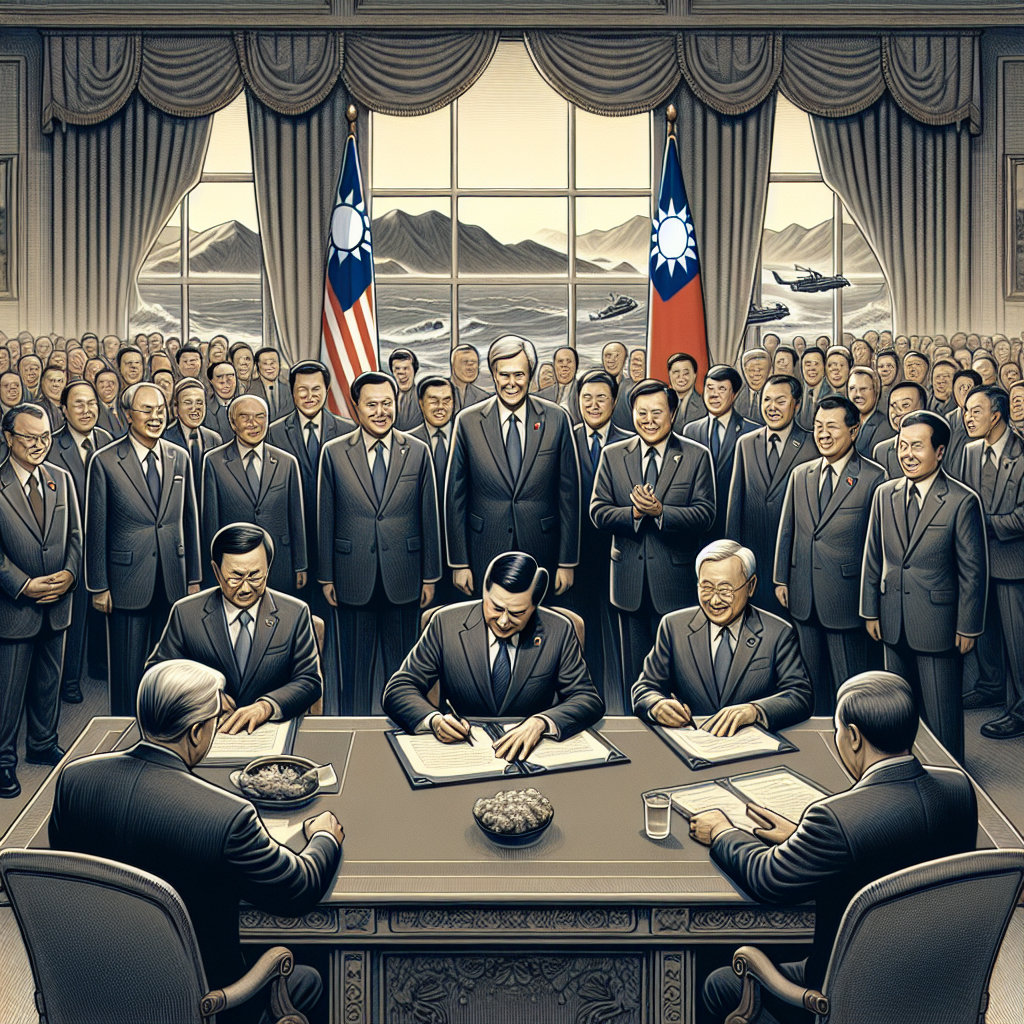
In 2018, President Trump signed the Taiwan Travel Act, breaking long-standing restrictions on official interactions between the United States and Taiwan. This act allows officials from both sides to visit each other at various levels, enabling Taiwanese officials to officially meet with leaders at the state level in the United States. The law is seen as a significant milestone in U.S.-Taiwan relations, symbolizing a gradual move towards normalization in exchanges.
A year later, Taiwanese President Tsai Ing-wen visited the states of Colorado and New York in 2019, marking a concrete manifestation of the warming interactions between Taiwan and the United States.
Shortly after the passage of the Taiwan Travel Act, New York Democratic District Leader John Yu sent a letter to then Governor Cuomo on March 6, 2018, urging the state of New York to seize the opportunity to organize a delegation to visit Taiwan and expand cooperation in agriculture and tourism. He mentioned in the letter that the newly erected American Institute in Taiwan (AIT) building would serve as a de facto embassy, guarded by the United States Marine Corps, symbolizing an elevation in U.S.-Taiwan relations.
However, this advisory letter to the governor was later secretly transferred to the Consulate General of China in New York, rather than being submitted to the governor as intended. This detail was later exposed in court proceedings, revealing Sun Wen’s role as a central figure in handling Asian diplomatic affairs within the state government.
In July 2019, the Taipei Economic and Cultural Office in New York sent out invitations to Governor Cuomo and Sun Wen to attend a dinner with Taiwanese President Tsai Ing-wen. The invitation was only sent to Sun Wen, the state’s Asian affairs contact point. Evidence presented in court showed that her initial reaction was not to pass on the invitation to the state government as per procedure, but to report it to the Consulate General of China in New York.
Two days before Tsai Ing-wen’s arrival in New York, Sun Wen received a call from Consul General Huang Ping of the Consulate General. Following the two-minute call, she urgently checked within the state government for any means to ensure the invitation reached the governor without bypassing her. She even requested technical staff to inquire about any “Taiwan-related activities in the governor’s schedule.”
Ultimately, at the dinner with Tsai Ing-wen that evening, only Governor Murphy of New Jersey attended, while the governors and mayors of New York did not. Only Senator Yvonne Cookie attended from the New York State Legislature and later faced pressure from officials at the Consulate General of China. This incident was later deemed by prosecutors as crucial evidence of Sun Wen obstructing high-level exchanges between Taiwan and local officials within the state government system.
After the case was exposed, public opinion surged. The court revealed that Sun Wen was not just a “bridge” between the state government and the Asian community, but also played the role of a “gatekeeper” at critical moments – deciding which external exchanges could proceed and which should be blocked, with the judgment standards not in the best interests of New York state, the prosecution stated.
John Yu admitted in an interview that the letter he wrote to Governor Cuomo was originally intended for him and he did not expect it to be intercepted or handled separately. He remarked that it was only after the court proceedings revealed related evidence that he realized many decisions involving Asian affairs and diplomatic exchanges were consolidated in Sun Wen’s hands. “I had no idea about these things back then, only now do I know,” he said.
Seven years later, on December 2, 2025, President Trump further signed the Taiwan Assurance Act. This law requires the State Department to regularly review guidelines for exchanges with Taiwan and assess whether there are still unnecessary self-imposed restrictions, considered an upgraded version of the Taiwan Travel Act.
John Yu pointed out that the core significance of the new law lies in clearly requiring all levels of the U.S. government – federal, state, or local – to have normal exchanges with counterpart units in Taiwan without self-limiting under the pretext of “policy ambiguity,” making interactions between the two sides “normalized and institutionalized.”
Regarding Beijing’s response, he believed that the Chinese Communist Party would inevitably strongly oppose it, but the United States’ One China Policy has never explicitly stated that the People’s Republic of China is the sole legal representative of China. He noted that while the U.S. recognizes the “One China” policy, it does not necessarily equate “One China” with the People’s Republic of China, intentionally leaving room for definition. In his view, “One China” should refer to the Republic of China as it has legal continuity, unlike the Chinese Communist Party.
He further emphasized that the U.S. policy towards Taiwan has long been maintained in a “strategically vague” manner to avoid being hijacked by any party. In practice, Taiwan has quasi-official diplomatic status.
John Yu specifically mentioned the symbolic significance of the American Institute in Taiwan (AIT). He pointed out that the AIT not only has a large scale, exceeding many official U.S. embassies, but also houses a significant number of intelligence units, indicating that the strategic importance the U.S. places on Taiwan far exceeds formal diplomatic titles.
He also bluntly stated that the state of New York has long lacked international perspective, resulting in a sluggish response to foreign affairs. One reason is the influx of foreign missions in the state, which the state government pays little attention to, focusing only on local affairs and appearing conservative as a result. He cited that while New York City is a melting pot of international organizations, the state government’s response to foreign affairs often ends with mere formal replies, lacking substantive follow-up actions compared to other states, showcasing a passive approach.
Today, U.S. law clearly guarantees the legitimacy of U.S.-Taiwan exchanges, with excuses previously used to block interactions fading away. While the Republic of China may still not have formal diplomatic relations, its quasi-official status in both institutional and practical aspects is hard to deny.
In the continued tense geopolitical landscape, John Yu believes that substance matters more than appearance. As systems gradually take shape, local governments will inevitably have to readjust their roles and face international responsibilities and realities.
The Sun Wen case, at this historic turning point, reveals how the previous gray operating methods have gradually moved toward the edge of criminal risk.