
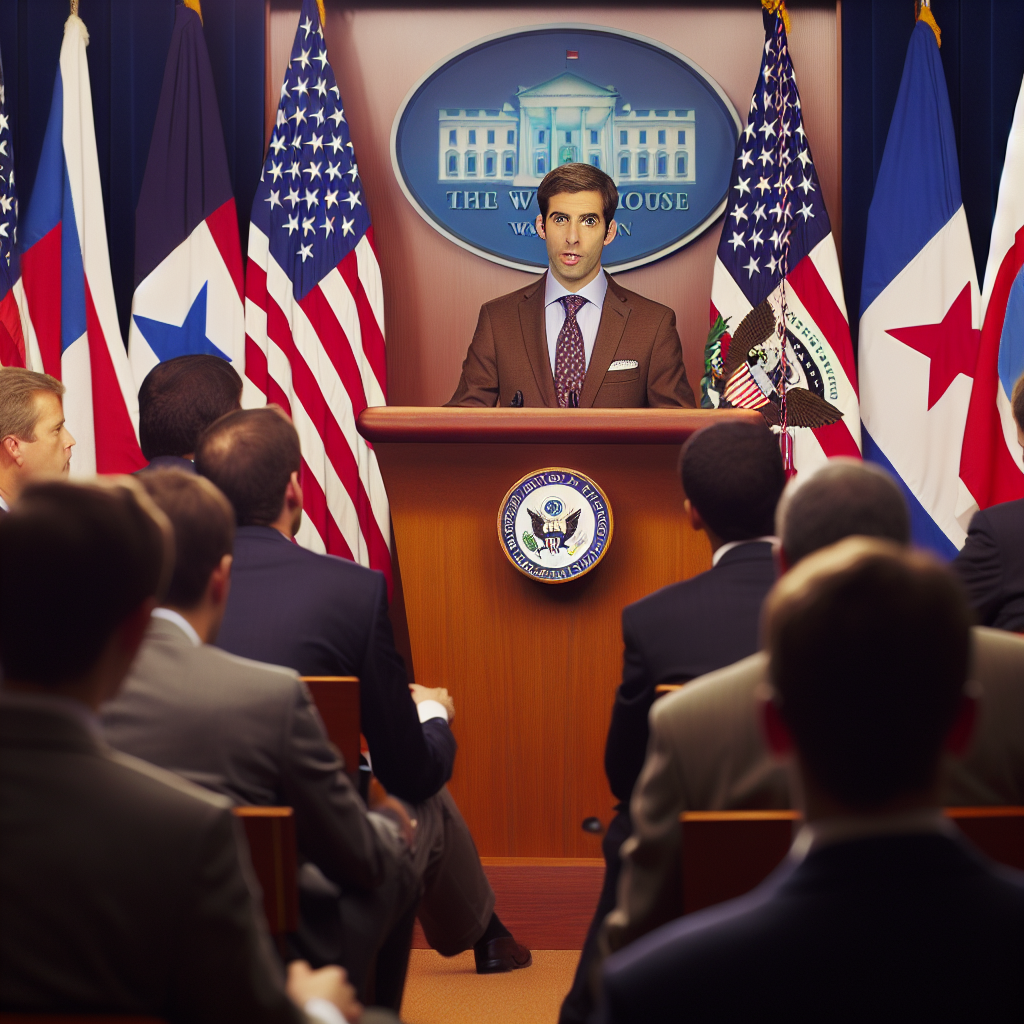
On the occasion of the upcoming New Year, on Friday, December 19th, US Secretary of State Mike Pompeo held a press conference at the State Department to review US foreign policy, covering topics such as the conflict in Ukraine, the situation in Gaza, the Maduro regime in Venezuela, NATO, US foreign aid, immigration policy, as well as US relations with China, Japan, and others.
Pompeo holds three key positions in the Trump administration as Secretary of State, National Security Advisor, and Director of the International Development Agency, making him a pivotal figure in this administration.
He emphasized at the year-end press briefing: “The core principle of our foreign policy must be our national interests… We support foreign policies that make America safer, stronger, or more prosperous, ideally achieving all three, but at least one.”
Here are the key points summarizing Pompeo’s over two-hour press conference.
One of the key concerns raised by reporters was US military action in Venezuela.
Pompeo stated, “Transnational terrorist groups engaged in drug trafficking pose the most serious threat to the US in the Western Hemisphere… There is one place that does not cooperate — that is the illegitimate regime in Venezuela.”
He mentioned that the Venezuelan regime openly collaborates with terrorists and criminals. “For example, they invited Hezbollah and Iran to operate on their territory.”
The Secretary of State suggested that negotiations with Venezuela would be futile due to the lack of credibility of the country’s president, who has never honored any agreements in the past.
“He has never complied with any agreements in the past, making it difficult for us to consider any future agreements with him,” Pompeo said about Maduro.
Pompeo emphasized that the US goal is “regional stability and security.”
“Our national interest, especially regarding the Venezuelan issue, is definitely like this,” he said. “We are facing an illegitimate regime collaborating with Iran, Hezbollah, drug cartels, and terrorist organizations.”
He added that the US does not recognize the “legitimacy” of the Maduro regime.
Pompeo defended the Trump administration’s military actions against drug traffickers near Venezuela. “We reserve and have the right to use all national resources to defend the national interests of the United States,” he said. “This is beyond doubt. Every country in the world reserves the same right. We just happen to have more power than some countries.”
The Secretary of State mentioned that the US is not concerned about escalating conflicts with Russia over the Venezuela issue.
When discussing negotiations between Russia and Ukraine, Pompeo stated: “This is not our war… but there is only one entity on Earth that can truly dialogue with both sides and find a peaceful end to this war, and that is the United States.”
On Saturday, Pompeo, Trump’s envoy Steve Witkoff, and Trump’s son-in-law Jared Kushner will meet with Putin’s advisor Kirill Dmitriev in Miami to discuss the latest version of the US proposal to end the Russia-Ukraine conflict.
The Secretary of State stated that a peace agreement will not be reached unless both Ukraine and Russia agree on the terms, emphasizing that the US cannot force either party to accept the agreement. Instead, the US is working towards “seeing if we can get them to reach a consensus.”
He said that reaching a negotiation solution requires both sides to make concessions.
“We need to figure out what Ukraine can accept, what Russia can accept, that is to determine the positions of both sides and see if we can push them towards some kind of agreement,” Pompeo said.
“If an agreement is desired, both sides must compromise. We may ultimately fail to reach an agreement. We may fail to reach an agreement. That is regrettable,” he said.
The highest US diplomat stressed that the US is working to complete the first phase of a Gaza ceasefire so that the second phase can begin.
The three elements emphasized by Pompeo include: establishing a Palestinian technocratic committee to aid in governance, creating an internationally-led “peace committee,” and deploying an international police force to the region.
“This is a goal we aim to achieve soon. This is what we are currently focusing on like a laser,” he said.
Regarding the situation in Gaza, Pompeo said, “Everyone wants peace… If Hamas has the opportunity to threaten or attack Israel in the future, there will be no peace. If people believe there will be war in two or three years, you cannot convince anyone to invest in Gaza.”
When asked if Hamas must completely disarm, he stated that as long as Hamas cannot threaten Israel, it is acceptable.
Pompeo stated that countries willing to support peace efforts in Gaza first need to know the mission and the “financial mechanism.”
“I am very confident that we have some countries… willing to step up and be part of a stabilizing force,” he said. “I believe the next step is to announce the establishment of the peace committee, announce the establishment of a Palestinian technical expert group that will assist with daily governance.”
“Once these institutions are in place, we will be able to determine the details of the stabilization force, including how the costs will be paid, rules of engagement, and their role in disarmament,” he added.
The top US diplomat further stated that Israel’s attacks on Doha, resulting in the deaths of five individuals, including a Qatari security official, serve as a catalyst for reaching a ceasefire agreement in Gaza.
“If you look at what happened in Gaza, it seemed impossible to resolve,” he said. “Then a series of events occurred that made it possible. For example, the attack by Israel at that time within the Qatar territory, though somewhat dramatic, to some extent prompted a sense of urgency for people to end this crisis before it escalated.”
Pompeo expressed that the US hopes to “enhance” the Lebanese government’s ability to clear Hezbollah’s weapons, mentioning Israel’s warning of taking action against the Lebanon armed group.
“For peace, we all hope to avoid this situation, and the best way to avoid this situation is to establish a strong Lebanese government that can truly control the country so that Hezbollah no longer poses an armed threat to Israel or Lebanon,” he said.
Regarding US-China relations, Pompeo emphasized that the US seeks to balance tensions and cooperation with China. He said that Washington and Beijing both understand the necessity of cooperation, although tensions on many issues may persist.
Pompeo told reporters, “If there are global challenges that the US and China can cooperate to address, then we can solve it.”
“Of course, there will also be some points of tension. We recognize that our task is to balance these two aspects. I think both sides understand that,” he said.
Recently, due to Japanese Prime Minister Sanae Takichi’s remarks on “Taiwan’s situation,” Sino-Japanese relations have escalated sharply.
Pompeo stated on Friday that the US will find effective ways to cooperate with China while not “jeopardizing or in any way undermining our firm commitments to Japan and other partners in the Indo-Pacific region.”
The Secretary of State also mentioned that “Japan is a close ally of the United States.”
During the press conference, Pompeo stated that the State Department cannot conduct reviews on some immigrants based on existing information and currently has no specific timetable for restarting the refugee program.
When responding to a question from a journalist from Le Monde, he said that in many cases, thorough reviews depend on information provided by local authorities of the applicants’ home countries. He added that the State Department is studying the immigration review process but did not disclose when the review process would be restarted.
In October, the Trump administration reduced the 2026 refugee admission ceiling to 7,500, primarily reserved for South Africans. Trump also directed the State Department to reevaluate every immigrant admitted through the US Refugee Program during the Biden administration.
Pompeo expressed, “We will study the program, and until we are sure we understand the identity of each entrant and whether they meet US entry standards, we will not restart the program at the previous scale and scope.”
He stated that in terms of legal immigration, the US is the most generous country globally, citing the fact that nearly one million people received green cards in the past year.
“But like every sovereign nation, we have the right to know who you are, why you’re coming, what you have done in the past, and what we believe you may or may not do in the future,” he said. “We have the right to ensure that you will not come to this country and burden our social welfare system.”
Pompeo mentioned that NATO’s collective defense under Article 5 serves as a deterrent to any military action by Russia outside Ukraine.
“That’s why we joined this alliance, and that’s why Article 5 of NATO is so important,” he said.
The top US diplomat also stated that foreign aid “is not charity” and must be used to advance US agendas.
“The funds we use for foreign aid and humanitarian assistance are limited,” Pompeo said. “These funds must be used in a way that aligns with our national interests.”
“Foreign aid is not an independent activity of the US government. It is a component and tool of our foreign policy and should be used to promote national interests,” he added.
Pompeo expressed that the US hopes to maintain its relationship with Colombia but criticized President Petro, calling him “unstable.”
He told reporters that the US will not let “the words of an unstable individual” disrupt its relationship with Colombia.
“This is an important relationship, an important alliance. It covers business, cultural exchanges, culture, and of course security and stability,” Pompeo said.
The Secretary of State seemed relieved that the term of Petro, Colombia’s president, will end in May next year as the country prepares for the presidential election.
Petro has criticized US support for Israel and hostility towards the Maduro regime in Venezuela.
Under the mediation of the Trump administration, Thailand and Cambodia reached a ceasefire agreement, but shortly after, Thailand launched airstrikes against Cambodia.
Pompeo stated that these agreements help formulate a series of commitments, which can now be utilized to compel both parties back to the peace negotiations.
“These commitments were not kept today,” he said regarding the Thai-Cambodian conflict, “the current work is to get them back to the negotiating table.”
Pompeo expects Thailand and Cambodia to resume complying with the ceasefire agreement early next week.
He stated that the US hopes to promote Thailand and Cambodia to resume complying with the ceasefire agreement brokered by President Trump within now and early next week.
Pompeo added that the US cautiously optimistically sees this matter likely to be concluded by early next week.