
The internal power struggle within the Chinese Communist Party (CCP) that started in 2023 and extended into 2025 was partially revealed during this year’s Fourth Plenary Session, with leaders like He Weidong being dealt with. Experts believe that the severe infighting, primarily led by the “Xi family army,” is still fermenting, and there might be significant changes at the Fifth Plenary Session next year (2026). Whether the CCP’s Twenty-First National Congress in 2027 can proceed smoothly remains uncertain.
The most significant internal power struggle point of the CCP in 2025 may have been the Fourth Plenary Session held in October. In the days leading up to the Fourth Plenary Session, a faction within the military from Fujian Province, led by Xi Jinping’s confidants He Weidong and Miao Hua, was exposed.
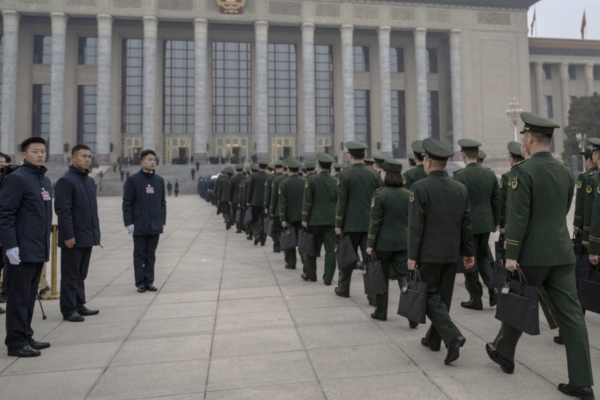
On October 17, Vice Chairman of the Central Military Commission He Weidong, former Director of the Political Work Department of the Central Military Commission Miao Hua, and former Executive Deputy Director of the Political Work Department of the Central Military Commission He Hongjun, along with 9 other senior generals, were expelled from the party and the military. The Fourth Plenary Session of the CCP concluded on October 23. During the session, four major generals, including Deputy Commander of the Rocket Force Wang Liyan, were bypassed for promotion to Central Committee members, indicating they had “fallen out of favor.” The conference report revealed that nearly 60 people were absent from the meeting, with a high absence rate of 64%, including 27 absentees from the military delegation, out of the 42 who were supposed to attend.
At the Fourth Plenary Session, Xi Jinping’s former military secretary Zhong Shaojun, who attended the meeting, was confirmed to have been relieved of his position as Political Commissar of the National Defense University, a role he held for just over a year, with his whereabouts unknown. Both former and current presidents of the National Defense University, including former President and current Minister of Equipment Development Xu Xueqiang, and current President Xiao Tianliang, have also been rumored to be implicated.
Corruption is not limited to the military but is a systemic issue within the entire CCP. The self-reported anti-corruption data released by the CCP has skyrocketed.
According to the data announced by the CCP’s Central Commission for Discipline Inspection, a total of 90 provincial and ministerial-level officials were placed under investigation in the first three quarters of this year, exceeding the total for the entire previous year. In the third quarter alone, 47 individuals were investigated, setting a new record.
At the same time, the CCP officially acknowledged that officials, especially young officials, are showing negative emotions.
On December 10, the People’s Daily of the CCP published an article stating that young cadres must not lose their focus in blind competition and must not dampen their drive by being idle all day.
Shen Mingshi, a researcher at the Taiwan Institute of National Defense Security, told Epoch Times that the People’s Daily’s article acknowledges that under the tense situation of internal power struggles, many young officials are choosing to react passively or “lying flat” amidst the competition and pressure.
“Young officials are anxious all day long, not knowing which faction their superiors belong to or when they might leave for what reason, so they dare not make decisions and are passive in their governance,” he said.
Independent commentator Du Zheng recently wrote in Taiwan’s “Up Media,” revealing that, due to the successive downfall of the Political Commissars and Presidents of the National Defense University, there is now a sense of anxiety among the people, with uncertainty regarding the constant turnover of high-ranking officials, making it difficult for individuals to know who will be the next to fall from grace, hence no one is in a hurry to curry favor with the upper echelons.
A recent study released by the Stockholm International Peace Research Institute on December 1 showed that due to the Ukraine and Gaza wars and the global and regional tensions, the revenues of global major weapons and military services companies have surged. In stark contrast, the revenue of CCP military-industrial enterprises has declined. The report suggests that this decline is due to the CCP’s anti-corruption crackdown slowing down the completion of arms contracts and procurement.
Multiple reports suggest that the intensified purges within the CCP military may weaken its combat capabilities, directly affecting its military deployment and operations near Taiwan.
After a series of high-ranking military officials were confirmed to have been purged, in November, the CCP Central Military Commission issued revised supplementary regulations, claiming that the primary focus is on “strictly enforcing political discipline and political rules,” and “elaborating and adjusting the discipline on circumstances of weak implementation of the Chairman of the Military Commission’s responsibility, the expression of erroneous political views and inappropriate remarks, and the inadequate implementation of the Central Military Commission’s decision-making deployments.”
Shen Mingshi stated that currently, young military officers or soldiers increasingly have different views on the CCP’s “sustained governance,” and are merely cooperating passively for the time being. The authorities’ rollout of new amended military regulations following the extensive purges reveals concerns about the weakening of the mechanism for CCP party control over the military.
“Especially, after the online release of the video of Xu Qinxian, the 38th Army Corps Commander, being tried for insubordination during the June 4th incident, the authorities have been strengthening propaganda about the party’s control over the military, intensifying control,” he said.
Since Xi Jinping came to power, he has been known for his “selective anti-corruption” approach, primarily targeting individuals associated with the Jiang and Tuan factions in his first two terms, consolidating his power. However, after the CCP’s 20th Congress, the Xi family army, which Xi personally cultivated, has been significantly purged, with the highest-ranking official to fall being Political Bureau member He Weidong.
Shen Mingshi told the Epoch Times that the internal purges within the CCP have always had two interpretations: one is that Xi Jinping is conducting the purges himself, and the second is that different factions are attacking Xi Jinping or aiming to dismantle his peripheral power.
One noticeable phenomenon is that in recent years, some of the high-ranking CCP officials who have been purged were initially publicly processed under the pretense of being disciplined members of the Party’s governing organs, such as Tang Renjian from the Ministry of Agriculture and Rural Affairs, Jin Xiangjun, Governor of Shanxi Province, and Lan Tianli, Chairman of Guangxi. However, individuals like He Weidong, former Minister of the Ministry of Foreign Affairs Qin Gang, recent Minister of the United Front Work Department Liu Jianchao, and the recently rumored Political Bureau member Ma Xingrui were not publicly handled initially, seeming to have closer ties to Xi, making their treatments more discreet.
Shen Mingshi explained that since most of the important officials who have fallen from grace recently belong to the Xi Jinping faction, if the situation cannot be publicized, then they have no choice but to handle it discreetly first. However, after the confidential investigation, the evidence becomes increasingly clear, and some cases cannot be avoided from being officially announced.
“This also shows that Xi does not have the determination to purge his own people. If the misconduct of these trusted aides is linked to Xi, he will try to protect them as much as possible; if it is not related, he will also consider the personnel difficulties that dealing with this person can bring. Therefore, they are first allowed to disappear for a period of time before gradually announcing the removal of their various positions,” Shen Mingshi said.
Current affairs commentator Li Linyi also agrees with this view, stating, “The most obvious example is Qin Gang; he is Xi’s man, but compared to Tang Renjian, Jin Xiangjun, and Lan Tianli, who are not considered authentic Xi family army members.”
It has been observed that the CCP authorities are creating a narrative after this year’s purge, whitewashing high-ranking officials who were “promoted while ill.” The CCP’s military newspaper has repeatedly emphasized the disloyalty of the fallen leaders. The CCP’s theoretical journal “Qiu Shi” recently published a speech made by Xi Jinping at the end of June, reiterating “self-revolution” and “self-criticism,” seemingly to justify the frequent downfall of Xi’s confidants.
During the purge process, in September, the CCP issued the “Regulations on Ideological and Political Work,” emphasizing Xi’s ideological education.
On December 7, official news revealed that the CCP Central Committee had issued revised regulations for the CCP’s “work institutions.” Compared to the 2017 edition, which demanded loyalty to the Central Party, the revised version now emphasizes loyalty to Xi, incorporating phrases like adhering to Xi Jinping Thought as guidance and upholding Xi Jinping’s core, the “central party authority and the centralized and unified leadership.”
Veteran commentator Mark believes that while Xi Jinping has initiated this purge, the drastic “cleansing” also signifies a very challenging period for his rule.
Mark pointed out that Xi Jinping places a strong emphasis on ideological issues to safeguard the Communist Party, believing that corruption could lead to the party’s demise. However, the entire CCP system is inherently corrupt, with all officials focused on promotion and personal gain, while some harbor political ambitions, hoping to rise to higher positions. Yet, currently, many are feeling hopeless due to Xi’s excessive suspicion and inconsistency, with numerous officials fearing implication in the purge campaign and thus choosing to stay inactive.
“This is a prevailing mentality among many mid-level and even high-ranking officials. They are also hoping for the day when Xi’s health fails, and he suddenly collapses from power,” Mark stated.
Since Xi Jinping’s third term, the situation has taken a sharp turn, with the Chinese economy continuing to deteriorate, and international relations becoming tense. Mark believes that many Chinese people are anti-Xi, but they dare not speak out. While officials may outwardly seem to follow Xi’s orders, internally they may feel differently. Xi’s authority is not as strong as it seems; he relies on strict punishment of officials to uphold his authority.
Mark added that Xi Jinping has adopted some of Mao Zedong’s tactics, but he lacks Mao’s charisma, which is his biggest weakness.
“His only advantage is the so-called ‘red second generation with revolutionary roots.’ However, even after conducting purges, he cannot achieve the same effect as Mao Zedong or Stalin, as he lacks prestige. He aims to consolidate his power through purges, but this will ultimately disappoint many people,” Mark remarked.
If Xi continues to cling to power, people will transition from disappointment to despair. This sentiment is not only prevalent among the general public but also within the system itself. When society reaches a state of complete despair, new forces may emerge, leading to potential changes in Chinese society.
The ongoing purges related to Xi Jinping’s allies have not ceased. Ma Xingrui, a member of the CCP Central Political Bureau who was removed from his position as Secretary of the Xinjiang Uygur Autonomous Region in July, was absent from the recent Central Economic Work Conference. This is at least the second time in half a month that he has been absent from a significant high-level meeting. Some analysts believe he may become the first “tiger” to fall in the Ma year (next year).
Ma Xingrui has long been considered a member of Xi’s military faction. Rumors circulating online about his downfall point to corruption issues during his tenure in the military system, in Guangdong and Xinjiang, possibly even involving Xi Jinping’s wife, Peng Liyuan.
Shen Mingshi believes that Ma Xingrui is essentially now in trouble. With a series of trusted aides falling from grace, although Xi Jinping still holds his current position, his authority has been compromised. If Ma Xingrui’s case expands further, many provincial-level officials from the Xi faction could be implicated, ultimately leading to a significant upheaval in the CCP’s officialdom.
“Next year’s Fifth Plenary Session may need to focus on personnel issues, possibly even forcing an early convening of the CCP’s Twenty-First National Congress,” he remarked.
Since the Fifth Plenary Session of the Fourteenth CCP Central Committee in 1995, every subsequent Fifth Plenary Session has discussed the “Five-Year Plan.” However, this year’s Fourth Plenary Session had already reviewed the “Five-Year Plan” in advance. The Fifth Plenary Sessions of the Eleventh Central Committee in 1980, the Twelfth Central Committee in 1985, and the Thirteenth Central Committee in 1989 all involved personnel matters.
For instance, the Fifth Plenary Session of the Eleventh Central Committee re-established the Central Secretariat, elected Hu Yaobang as General Secretary, and rehabilitated Liu Shaoqi, focusing on political life within the party and personnel matters. The Fifth Plenary Session of the Twelfth Central Committee adjusted members of the Central Political Bureau and the Secretariat, accomplishing a transition of leadership from the older to the younger generation. The Fifth Plenary Session of the Thirteenth Central Committee agreed to Deng Xiaoping stepping down as Chairman of the Central Military Commission, with Jiang Zemin succeeding him.
Commentator Li Linyi believes that the severe internal power struggles in 2025 have indeed subtly impacted Xi Jinping’s power consolidation, and it would not be surprising if the Fifth Plenary Session in 2026 brings about a “new-old handover” in the leadership. As the internal struggles intensify, whether the CCP’s Twenty-First National Congress can proceed smoothly remains uncertain.