
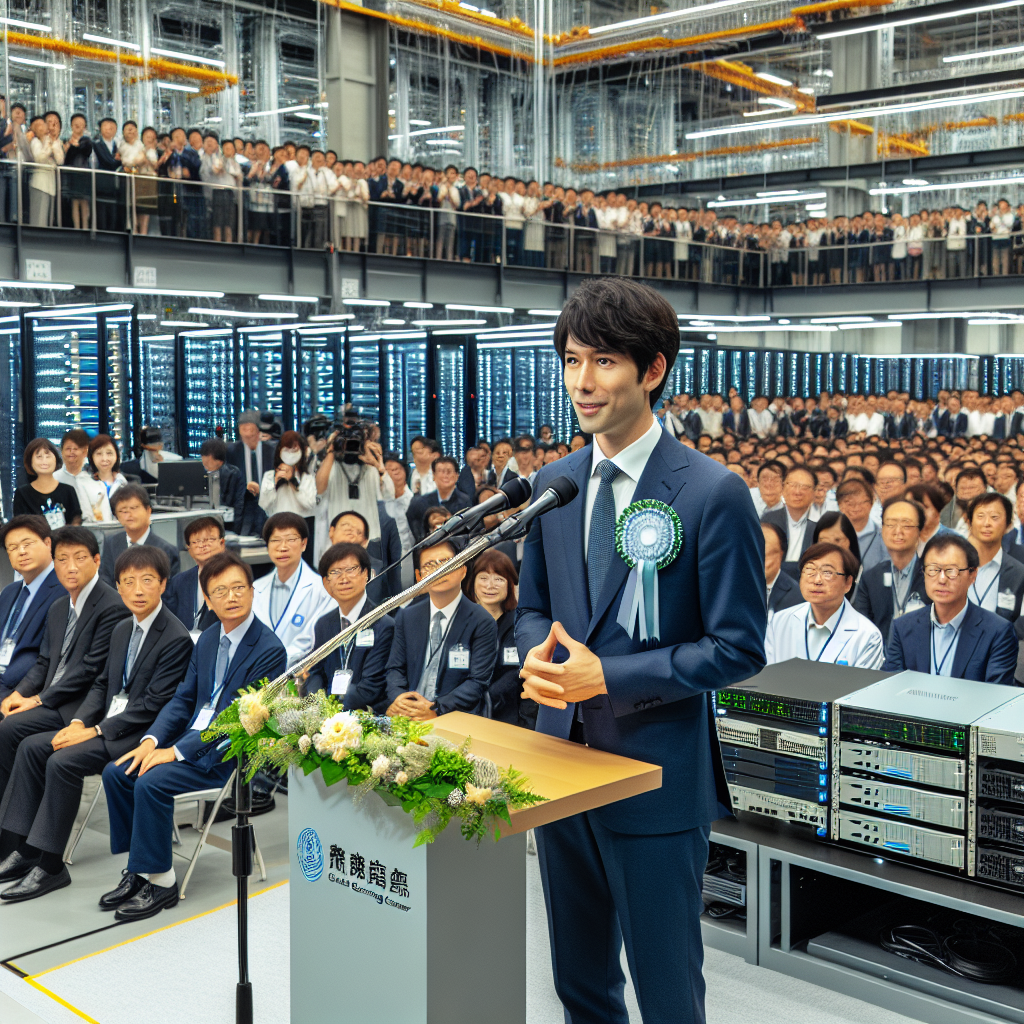
President of the Republic of China (Taiwan) Lai Ching-te attended the opening ceremony of the “National Network Cloud Computing Center” in Tainan today (12th), announcing the introduction of full optical network in collaboration with the National Research Institute, National Network Center, Japan’s NTT, and Chunghwa Telecom. The optical communication will fully replace the copper wire network. This collaboration deepens Taiwan-Japan friendship and will propel advancements in transmission technology.
In the morning, Lai Ching-te arrived at the venue of the opening ceremony of the “National Network Cloud Computing Center” and first watched the video “The Power of AI in Southern Taiwan.” He gained insights into the features of the center.
In his speech, Lai Ching-te expressed his joy at the official opening of the “National Network Cloud Computing Center,” marking a historic moment. It symbolizes Taiwan’s transition from a manufacturing powerhouse to an artificial intelligence island and is a crucial step toward becoming a smart nation. He acknowledged the efforts of the team led by Chairman Wu Cheng-wen of the National Science and Technology Council, Director Tsai Hung-ying of the National Experimental Research Institute, Director Chang Chao-liang of the National Network Center, and all staff, as well as the administrative support from the Tainan City Government.
The Executive Yuan of the Republic of China is promoting the “Top Ten AI New Construction.” Lai Ching-te stated that this is a national policy that Taiwan must implement to embrace the upcoming global era of comprehensive intelligence. It aims to ensure and maintain competitive advantages in the next generation for continuous and prosperous development. He hopes that everyone will understand the specific contents of the “Top Ten AI New Construction.”
The first includes four “infrastructure” projects, such as computing centers, AI data centers (sovereign AI), talent cultivation, and power equipment.
The second involves promoting research and development in key technologies, including silicon photonics, quantum computing, and robotics. The Robotics Center will be located in Tainan, driving the development in southern Taiwan.
The third goal is to achieve the objectives of the “Top Ten AI New Construction,” including assisting software application platform companies in achieving a trillion-dollar output value, helping 1 million small and medium-sized enterprises adopt artificial intelligence to enhance competitiveness, and building a smart living circle. In the future, artificial intelligence will be integrated into various aspects of life, with the government investing billions before 2040 to stimulate private sector investment, creating NT$15 trillion (USD 0.5 trillion) in output value and 500,000 job opportunities. This initiative will not only prosper Taiwan but also drive global economic development.
Lai Ching-te highlighted three significant strategic implications of the opening of the “National Network Cloud Computing Center.”
Firstly, it showcases world-class technological capabilities. The center has established the AI supercomputer “Crystal 26,” which is currently Taiwan’s fastest, most efficient, and highest computing density system, proving Taiwan’s prowess not only in advanced chip manufacturing but also in world-class system integration and supercomputing. Additionally, the center adopts advanced energy-saving technology, demonstrating Taiwan’s commitment to developing “green computing.” Moreover, with high-spec seismic-resistant design, service interruptions are ensured, showcasing Taiwan’s resilience and innovation.
Secondly, it creates the development momentum for various AI application services. The “National Network Cloud Computing Center” and the future AI Data Center to be built in Shanlun, Tainan, will become the computing hub of southern Taiwan, consolidating a total computing power of 23MW. The Science Council appreciates providing the Shanlun site for new entrepreneurs to boost smart living development. Through the intermediary platform created by the Science Council, the government will drive myriad industries to collectively develop various AI tools, making AI applications more embedded in industries for people’s convenience.
Thirdly, it establishes a public-private partnership for innovative ecology. The government is building infrastructure and establishing platforms for enterprises and the government to collaboratively boost company competitiveness and help the country enhance overall resilience. Apart from government investments, the joint efforts of the National Experimental Research Institute’s high-speed network and computing center with private enterprises enable computing power to be easily accessible by small and medium-sized businesses and startups.
Lai Ching-te announced a significant cooperation project on site: collaboration between the National Research Institute, National Network Center, Japan’s NTT, and Chunghwa Telecom to introduce the full optical network, replacing the copper wire network to significantly reduce energy consumption and enhance transmission speed. This Taiwan-Japan collaboration not only deepens Taiwan-Japan friendship but also propels advancements in transmission technology, a critical cooperation plan beneficent to the world.
He stated that the technology corridor in southern Taiwan has already taken shape in recent years and is expanding and strengthening. The government will continue to create more high-quality job opportunities for young people across regions through forward-thinking to achieve the concept of “Balanced Taiwan.” He expressed gratitude to the Science Council, the team from the National Research Institute National Network Center, and all public and private sector partners involved in the project for their continuous efforts in building this high-standard computing center.
Emphasizing the high strategic value of the center, which connects submarine cable landing stations and spans high-speed optical fiber networks across Taiwan, he underscored its role not only as the foundation for AI development but also as a pivotal stronghold ensuring the country’s digital resilience, cybersecurity, and communication redundancy. He mentioned that all government efforts aim to prepare Taiwan for more challenges and enable it to march towards a fully intelligent future, creating a more prosperous Taiwan.
Subsequently, Lai Ching-te, together with the guests on site, conducted the activation ceremony and visited the Taiwan Computing Development Vision Corridor and the server room with Director Chang Chao-liang of the National Research Institute National Network Center introducing the cloud data center and computing equipment.