
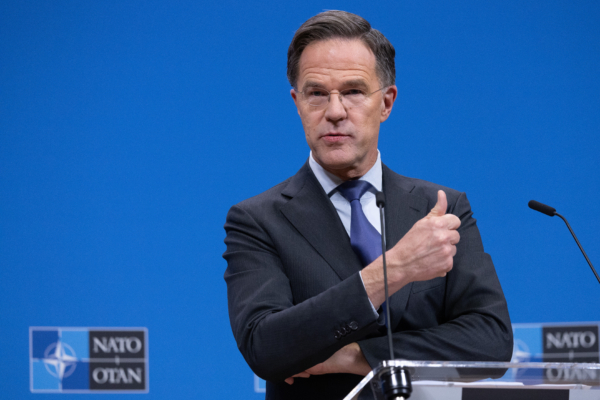
NATO Secretary-General Mark Rutte issued a stern warning on Thursday that the key to Russia’s ability to sustain its operations in Ukraine lies in Beijing – the Chinese Communist Party is “Russia’s lifeline,” and NATO has become its next target.
Rutte delivered a keynote speech during the Munich Security Conference in Berlin on Thursday, as reported by Newsmax, and warned in the strongest terms in recent years that the risk of a large-scale war breaking out with Russia will sharply increase if the West does not significantly strengthen its defenses and readiness. He emphasized that China is the crucial factor enabling Moscow to continue its military operations.
“Why can Putin wage war to this extent? The answer is China. China is Russia’s ‘lifeline.’ Without China’s support, Russia simply cannot sustain its war machine at its current scale,” Rutte said.
He cited intelligence data indicating that approximately 80% of key electronic components in Russian drones and other weapon systems are sourced from China, and that China’s technology is being utilized directly in attacking civilian targets in cities like Kyiv and Kharkiv in Ukraine.
Rutte emphasized that Beijing’s provision of dual-use military supplies, including navigation equipment, drone components, thermal imaging sensors, and key raw materials for propellants such as nitrocellulose, makes China a “decisive military and industrial supporter” of Russia.
He also specifically mentioned North Korea and Iran continuing to provide Russia with ammunition, missiles, and other munitions, further complicating NATO’s efforts of containment.
Rutte disclosed the latest battlefield data, stating that as of December 11, 2025, Russia has launched 46,000 drones and missiles at Ukraine. The Russian military produces 2,900 combat drones and an equivalent number of decoy drones each month. 40% of the Russian budget is allocated to warfare, with 70% of the mechanical capacity directly serving the military-industrial complex.
He went on to warn, “We are Russia’s next target, we are in danger.”
Rutte pointed out that Russia may have the capability to use force against NATO within the next five years. If Russia fully occupies Ukraine, its forces will directly approach NATO’s eastern flank, necessitating a significant expansion of NATO’s forces.
He criticized some allied nations for still harboring a sense of “inadequate self-sufficiency” and stressed that “time is not on our side, now is the time for action.”
Although Rutte acknowledged NATO’s progress over the past year – including commitments at The Hague summit in June to reach defense spending at 2% of GDP by 2035, a sixfold increase in the production of 155mm shells compared to 2023, and the PURL program delivering 75% of Patriot missiles to Ukraine – he made it clear that “it is not a time for celebration now,” as Russia has become “more ruthless” towards Ukraine and NATO.
Rutte urged allied nations to “swiftly boost” defense spending and production, prioritize increasing the capacity for missiles, shells, and air defense systems, and deter potential aggression against NATO territories while supporting Ukraine.
In his final remarks, Rutte stated, “War has reached our doorstep. We must prepare for a war that could rival the scale of the World War of our grandparents’ generation – but it is still possible to prevent its outbreak.”
Meanwhile, Russian Foreign Minister Sergei Lavrov responded in Moscow by stating that the Kremlin has no intention of militarily striking the EU or NATO and is preparing to provide reciprocal guarantees in the form of legal documents.
Recently, Russian drones have repeatedly violated Romanian and Polish airspace, and Russian military aircraft have entered Estonian airspace, prompting NATO to launch the “Eastern Sentry” program to enhance air defense in the eastern flank.