
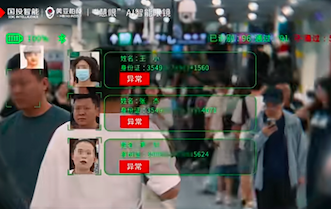
In recent days, a video from the Chinese social platform has surfaced, showing Tianjin police officers wearing AI smart glasses patrolling the streets. The footage also demonstrates that the AI devices can identify pedestrians’ identity information, facial expressions, vehicle data, and connect to the police database. The content has drawn attention from netizens, with many expressing concerns about the Chinese authorities’ expansion of monitoring technology.
The video is subtitled with “Tianjin Traffic Police Utilizing Technology” and “Locking Onto Car Owners with a Glance.” The screen shows green identification frames, activation prompts, and scanning progress, presenting the data matching process. Another segment of the video captures three pedestrians at a subway station being tagged, with the “abnormal” label in the facial expression field, along with the names and partial ID numbers of these individuals simultaneously displayed. The video claims that the glasses can be used in large-scale events, street patrols, and traffic management scenarios.
Mr. He, an IT professional at a technology company in Shenzhen, told reporters that such devices are mainly used by law enforcement departments for street recognition and image collection. He said, “This technology was tested in Beijing and Xi’an as early as 2018, and in recent years, the deployment speed has significantly increased, but the details have not been publicly disclosed.” He believes that the exposure of this video may stem from the promotion of related companies, and this view only represents his personal opinion.
The video also captures two police officers wearing short-sleeved uniforms and glasses observing pedestrians, with a traffic officer scanning license plates, and the screen displaying data feedback prompts. Many netizens in the comment section expressed uncertainty about when their images are being scanned and the duration of data retention; some comments mentioned that technical misjudgments could lead to additional troubles.
According to public data correlated based on the markings “Guotou Intelligence” and “Meiyabama Technology” in the video, it is shown that Meiyabama Technology produces various image processing equipment, digital forensics tools, and identification modules, including wearable smart glasses and facial recognition systems. The enterprise product manual lists the glasses’ functions as capturing images, voice commands, tracking tagging, data querying, location feedback, and interfacing with multiple police systems.
Liu Quan, a professional in Xi’an’s technology sector, told reporters that many Chinese companies are continuously developing equipment capable of capturing images and data in real-time, with some products already adopted by surrounding countries. “Once the market demand is established, the sales volume of the products will rapidly expand, even selling to third-world countries such as Malaysia,” he pointed out. The rapid popularization of wearable devices has widened the gap between technological advancement and the general public’s understanding, representing his personal viewpoint.
Liu Quan highlighted that public concerns about the flow of personal information have increased, fearing data leakage without authorization. He said, “Many cases of telecom fraud are related to personal data leaks, which may involve internal company or department sources.” This is the interviewee’s perspective, and the reporter cannot independently verify it.
Some cybersecurity researchers are skeptical about the Chinese Communist Party monitoring pedestrians’ facial expressions. They believe that emotional analysis technology for individuals is still in a developmental stage, with accuracy influenced by lighting, angles, facial texture changes, potentially leading to tagging errors. More importantly, it lacks respect for the individuals involved, bordering on insult.
The Communist Party’s surveillance network has been expanding for many years, claiming that street cameras are commonly used for public security management, but transparency raises questions. Some netizens mentioned, “When a child goes missing, no clues can be found, but many cases involving politics can locate individuals in a short period, even showing the whereabouts of the person’s relatives and friends.” Other comments pointed out that surveillance footage in cases involving police incidents often cannot be accessed due to malfunctions, sparking skepticism.
Since the 2000s, the Communist Party has gradually constructed a surveillance network covering urban and rural areas, with wearable and mobile devices such as smart helmets, chest cards, and smart glasses emerging in addition to fixed cameras, diversifying street monitoring methods. Some scholars believe that extending surveillance from fixed points to mobility will alter the public’s psychological perceptions of public areas.
A report from market research institutions estimated from 2019 to 2022 showed that China has about 600 to 700 million public and commercial cameras, making it one of the world’s largest image monitoring networks. In an urban contrast list compiled by international research institutions, many Chinese cities rank high in camera density, with certain cities having significantly more cameras per capita than major cities in Europe, the United States, and Asia. Chinese surveillance equipment is also exported to numerous countries, including those in Southeast Asia.
With the continuous increase in the applications of wearable devices, public concerns about image data storage, usage methods, and the risk of leakage are rising. The related discussions on social platforms continue to grow, reflecting the multi-faceted impact of surveillance technology entering public life. In response, a netizen left a comment expressing disdain for surveillance cameras, saying, “It feels like living in a big prison.”