
In early November, Japanese Prime Minister Sanae Takamichi’s statement regarding Taiwan caused a rapid deterioration in Sino-Japanese relations. The abrupt cancellation of Japanese pop diva Ayumi Hamasaki’s concert in Shanghai by the Chinese Communist Party (CCP), leading to a performance in an empty venue, sparked strong reactions both domestically and internationally. The CCP’s attempt to pressure Japan through these actions backfired dramatically.
On November 28th, two prominent Japanese pop musicians had their performances canceled on the same day, generating global discussions.
Japanese pop diva Ayumi Hamasaki announced on social media on November 28th that her concert scheduled for the next day (29th) at the Shanghai Oriental Sports Center was canceled due to uncontrollable circumstances.
The stage was set, the lights were ready, fans had bought tickets, but the concert was abruptly halted 33 hours before the show.
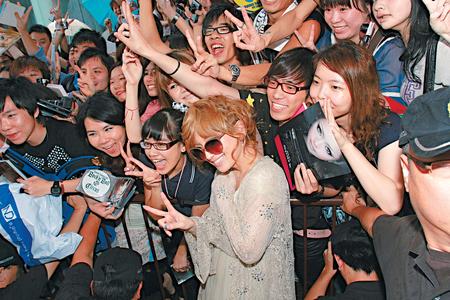
Following the sudden cancellation of Ayumi Hamasaki’s concert, the organizers stated that ticket refunds would be processed. In addition to apologizing to her fans, Hamasaki made an unexpected decision to continue the concert in an empty venue.
On the night of the 29th, Hamasaki wrote, “After receiving the request to stop the performance yesterday, we performed from the first song to the encore without an audience before leaving the venue.” She expressed gratitude towards all performers and staff members who put in their utmost effort, treating the performance as if it were a formal one.
Hamasaki also mentioned that the concert recording would be released at an appropriate time to provide closure to her fans.
As the artist with the highest record sales in Japan and the only female singer to win the prestigious Japan Record Award for three consecutive years, Hamasaki holds significant influence and popularity in the Greater China and Southeast Asia regions, with 1.6 million fans on Instagram.
On the same day (28th), singer Maki Ootsuki, known for singing the theme song of the popular Japanese anime “One Piece,” also had her performance abruptly interrupted in Shanghai. Her official website revealed that due to various unavoidable reasons, the show had to be hastily canceled. The concert on the 29th was also called off.
Footage from X platform showed the lights dimming suddenly during Ootsuki’s performance, with the music stopping. Two individuals who appeared to be staff members ran onto the stage demanding Ootsuki to leave, capturing her shocked expression.
On December 9th, Ayumi Hamasaki’s scheduled concert in Macau for January 10, 2026, was officially canceled.
On the 9th evening, Hamasaki wrote on Instagram, stating that the team was working diligently to ensure that ticket holders for the Shanghai-Macau show would have priority access to the 2026 tour tickets, requesting a bit more time.
Facing unjust oppression from the CCP, Hamasaki’s “concert in an empty venue,” filled with professionalism, gratitude towards her fans, and dedication, touched numerous netizens. Many admired Hamasaki’s professional conduct, even those unfamiliar with her or not typically interested in celebrities, turning into her fans due to her contract spirit.
They simultaneously mocked the CCP’s actions, drawing significant attention from international media outlets.
Bloomberg opined in an article that the CCP’s efforts to diminish Japan’s soft power would backfire, as the “wolf warriors” failed to understand that prioritizing a strong domestic image would inevitably impact their international standing.
Other international Chinese-language media outlets described China (CCP) as the one losing face, with their actions deemed as “crude” and “extreme,” stressing that the incident in Shanghai had escalated significantly.
Netizens on X praised Hamasaki’s display of civility, respect, and dignity, coupled with derision toward the Communist Party’s low-class and embarrassing behavior.
“Hamasaki has showcased to the world what civilization, respect, and dignity mean; Hamasaki, through her actions, has revealed how despicable the Communist Party is—a lesson in how to turn hate into love. Honestly, I wasn’t your fan before, but from now on, I will support you. Ayu, you’re amazing.”
“This concert can be deemed a classic performance of the century; each of the CCP’s actions elevates the event to a new height. This was done well, and now she’s known worldwide, losing a theater but winning the world.”
“A concert without live audience gathered the most applause; originally, only 14,000 watched the performance, but now it reached 1.4 billion; the CCP’s attempt to punish or intimidate artists like Hamasaki and other Japanese performers has backfired.”
After the interruption of Japanese singer Maki Ootsuki’s performance, Japanese netizens expressed anger, pointing out the CCP’s lack of respect for culture and the humiliation of artists. They commented on X platform:
“Interrupting the concert midway is simply disrespectful, showing the socialist state’s demeanor, as the world does not revolve around China (CCP) alone.”
“Forcibly halting the performance midway, an act that embarrasses the artists and demonstrates to the audience behaviors that our countrymen cannot tolerate. There seems to be no consideration for even half of the audience’s expectations.”
“The CCP shows no respect for culture, only focusing on stopping midway, highlighting its disregard for history. If they genuinely wanted to cancel the event, they should have done so before the event started, not midway. Clearly, they deliberately cut off the signal during the artist’s performance to capture their panicked state. Disgusting. Does the Japanese anime music and entertainment industry still need to provide services to China (CCP)?”
Japanese netizens directly pointed out the CCP as the instigator behind the scenes.
“So tasteless, not only is it an insult to the Japanese but also disregards the hopes of our own citizens. This hostility will only backfire against the Communist Party, resorting to choosing to attack maliciously, showcasing narrow-mindedness!”
“A laughingstock worldwide. The CCP government acts merely as hoodlums, exceptionally boring. Will people with integrity gradually distance themselves from it?”
“Turning every event political shows that China (CCP) has been pushed to a corner, forced into a situation where they have no choice. Undermining economically, such actions to disrupt common interests easily breed discontent. The CCP may want to incite a conflict between China and Japan, but the Chinese people should see quite clearly through Hamasaki’s performance. Unlike a few years ago, there are no protests in the streets against Japan’s actions this time.”
“Japanese citizens fully understand that Prime Minister Takamichi did not make any wrong defenses; it is clear that the Chinese side is unilaterally going mad, spewing vile words, spreading false information, and harassing, with their media manipulation ultimately being in vain.”
“The CCP is the source of violence. There are no instances of violence against Chinese in Japan, whereas incidents of violence against Japanese occur in China! The most pitiful ones are the Chinese. Under a dictatorship, they have even wasted the precious concert tickets they managed to secure. Even cultural exchanges are forcibly interrupted by the CCP. It’s as if the Chinese are living imprisoned under a dictatorial regime.”
“Just as the Marcos regime in the Philippines recently banned ‘V for Vendetta’ from being screened domestically, it quickly collapsed during the Edsa Revolution. The remaining reign of the fascist dictatorship suppressing art—the CCP—might also be nearing its end!”
Board Director of the Taiwan Academy of Democracy, Jian-Yuan Tseng, told Epoch Times that Hamasaki’s response showcased her loyalty to art, sentiment, and principles of a highly noble artist. She did not utter a word of ill will toward the audience or the Chinese mainland government, even offering comfort to her fans and supporting them. Her respect for her career and mainland Chinese fans transcended politics, standing as an example incomparable to Chinese officials.
Tseng pointed out that the CCP often oppresses artists in the mainland, Taiwan, or Hong Kong, forcing them to make political statements. Many artists cater to the CCP government to secure performance opportunities, ultimately damaging the general sentiments of their own countries and people and undermining the professional dignity of being an artist. In comparison, Hamasaki’s conduct this time can be seen as setting a model example.
Tseng stated that the CCP’s actions were incredibly foolish, as popular culture is transnational, and politically obstructing things that people collectively enjoy could easily result in public resentment. The CCP’s attempt to incite a conflict between China and Japan was overshadowed by Hamasaki’s performance, providing a clear view for the Chinese populace. Similar to the protests against Japan seen a few years back, there’s no sign of it happening this time around.
Tseng emphasized that art transcends borders and that Hamasaki’s performance was tailored for the Chinese audience, who also paid for their tickets. The abrupt interruption of the concert infringed upon the rights of Chinese music lovers.
“Such a method is very crude, very poor, giving off the impression of being at a loss.”
Apart from a friendly period in the 1980s, the Sino-Japanese relations have been viewed by the CCP as an outlet for releasing nationalistic sentiments and shifting hate targets throughout the remaining years. Japan has been a prominent supporter of China’s economic and social development since the reform and opening up era; however, there is a complete absence of any positive reports on Japan within CCP propaganda. One scholar estimated that 70% of mainland TV dramas revolve around anti-Japanese plots, with over 200 anti-Japanese films and television works released in just 2012.
Particularly since the ascension of CCP leader Xi Jinping, relations between the two countries have sharply deteriorated at both official and grassroots levels. To date, Xi has not visited Japan.
Over the past decade, 17 Japanese citizens have been detained on allegations of espionage or other charges; in 2024, two incidents of Japanese nationals being attacked occurred on the mainland; the number of Japanese businessmen and scholars visiting China has significantly decreased.
A survey by a non-profit organization revealed that over the past decade, approximately 90% of Japanese respondents viewed (Communist) China unfavorably. Since 2017, about half to two-thirds of Chinese people have held unfavorable views of Japan, a proportion that skyrocketed from 63% in 2023 to 87.7% in 2024.
The CCP’s foolish actions have backfired—in Japan, the popularity of Sanae Takamichi continues to soar, with the latest Nikkei poll indicating a support rate of up to 75%, exceeding 80% among the working-age population.
Sanae Takamichi posted a response on X platform regarding the canceled concert, stating that the Japanese government would support musicians and assist them in holding performances in more diverse markets across Asia, Europe, North America, and beyond. “We will create a future where Japanese music resonates in a diverse range of markets.”
Observing the Japan-China relations, Mr. Lǐang, a relationship expert, told the Epoch Times that the strong countermeasures this time were due to the ongoing diplomatic crisis between China and Japan having evolved into the “Xi Jinping issue.” The cancellations of the concerts in Shanghai and the interruptions during performances of Japanese artists were localized officials’ understanding of this being tied to Xi Jinping, hence the stringent execution.
Mr. Lǐang stated that China’s economy has been in decline since the start of the pandemic, currently under immense pressure. Under such tension, provoking conflicts externally is a convenient way to divert societal discord.
It is noteworthy that in previous anti-Japan activities, the CCP would often target Japanese cultural elements within mainland territory. However, this time, Japanese singers engaged in cultural exchanges with China fell in the CCP’s crosshairs.
Tseng remarked that conflicts between nations or armies should only target soldiers or governments; creating opposition between ethnicities should be avoided. China and Japan are neighboring countries, and a visionary politician would not pit the destiny of one nationality against another.
He stated that involving both nations’ ordinary citizens in this incident was unnecessarily childish, resulting in self-defeat.
Tseng believed that this was the CCP’s stance and did not represent the will of the Chinese people. Over time, the Chinese populace would also understand that the CCP was trying to incite anti-Japanese sentiment among the public to support its diplomatic agenda, which in many respects, did not align with public opinion. People would also reflect on whether this was beneficial for the CCP.
Tseng emphasized that the CCP continues to bring up events from the last century’s World War II, emotionally extorting Japan and dragging an entire nation into antagonism, aiming to provoke and bully Japan. However, such tactics will see diminishing returns in the future.