
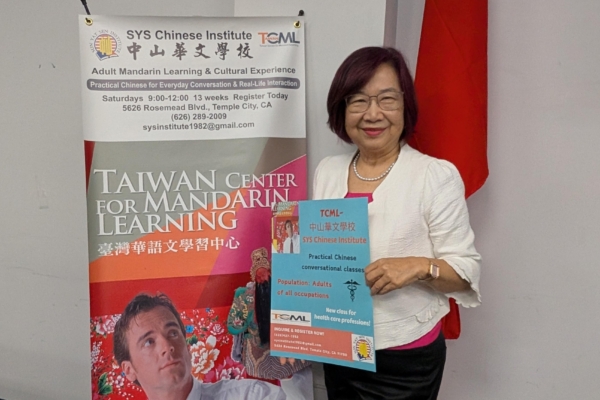
Taiwanese media veteran Che Qingyu, who has been deeply engaged in the media industry in Taiwan for over thirty years, was invited to the United States in 2017 to serve as the general manager of a local Chinese-language television station. Through her years of dedication to the media field, she has accumulated rich experience in management and cross-cultural communication. As her family gradually settled overseas and with the changing landscape of the American media industry, Che Qingyu decided to stay in Los Angeles after stepping down from her role and embarked on a new mission – promoting overseas Chinese language education.
For Che Qingyu, teaching Chinese language is not a foreign field as she has been engaged in educational administration and curriculum design in Taiwan for a long time. Therefore, at this turning point in her life, she chose to bring her expertise in education to the local community and engage in adult Chinese language teaching. She established the Taiwan Chinese Language Learning Center (TCML) in the Chinese immigrant-populated cities of San Marino and Monterey Park in Los Angeles, where she also set up special classes for city government employees to provide them with a professional platform for learning Chinese.
TCML, promoted by the Overseas Community Affairs Council of the Republic of China, is designed for adults aged 18 and above overseas, with traditional Chinese and Taiwanese culture as the core teaching content. In recent years, the center has rapidly expanded to multiple countries globally, collaborating with local community organizations to offer classes that emphasize practical conversation, real-life situations, and cultural experiences including festivals, cuisine, handicrafts, making it an important platform for foreign adults to understand Taiwanese culture and learn traditional Chinese.
In recent years, the Chinese population in Southern California has continued to grow, and various city government departments are facing multilingual demands. Against this backdrop, Che Qingyu’s teaching at TCML has become an important training opportunity for city government personnel.
Che Qingyu stated that the students mainly come from various departments such as community services, public administration, and urban planning. Some need to interact with Chinese residents for work purposes, while others are preparing for trips to Asia, where Chinese language skills become an indispensable tool in practice.
“Their time is very limited, so the courses must focus on immediate usability,” said Che Qingyu. The content she designs primarily revolves around practical situations, enabling students to directly apply what they learn in class to their daily work, such as interacting with the public, telephone communication, and basic administrative exchanges.
Having just stepped down as the president of the Southern California Chinese School Association, Che Qingyu pointed out the notable differences between adult learners and overseas Chinese children. Adults often start from scratch and cannot be taught using traditional methods. She follows the principle of “oral first, gradual progression,” and customizes teaching materials based on the students’ backgrounds and workplace needs.
“For example, a doctor who cannot fit into group classes due to time constraints switched to one-on-one lessons. I focus on medical field phrases and dialogues, allowing them to immediately apply it at work,” Che Qingyu explained.
Regarding pronunciation systems, she believes that adults are more acceptable to learning Mandarin Pinyin and do not necessarily have to learn complex phonetic symbols. Communication is more crucial than writing, and writing can be gradually reinforced once the foundation is established.
Currently, the courses Che Qingyu is involved in typically run 13 weeks per session, enabling basic conversation within a short period. She admitted that adults have to balance work, family, and travel, making continuous long-term learning challenging, which is why course design emphasizes efficiency and flexibility.
“They may have interruptions in learning due to business trips or assignments, so each class must be valuable for the students,” she added.
Transitioning from media management to language education may seem like crossing boundaries, but Che Qingyu’s new role continues her long-term commitment to social communication and cultural promotion. She emphasized that Chinese language proficiency is not just a skill but can promote understanding and friendly interactions between different ethnic groups.
“When government officials can communicate with Chinese residents, the quality of city services can improve,” Che Qingyu said. She hopes that through teaching, more people will come to appreciate Chinese culture and establish deeper connections in the diverse multicultural city of Los Angeles. ◇