
Archaeologists in Israel’s Jezreel Valley, a region shadowed by its association with Armageddon – the final battleground of good and evil in the Biblical account, have uncovered a treasure trove of ancient relics along a busy road that cuts through the area. These discoveries shed light on 5,000-year-old sacrificial rituals and wine-making activities of ancient civilizations.
The archaeological survey work is being conducted by experts from the Israel Antiquities Authority (IAA) along Highway 66, which runs southeast from Haifa towards the West Bank of the Jordan River. Recent excavations have unearthed ancient Canaanite ritual items and a wine-press carved directly into solid bedrock.
Canaanites were a diverse group of people consisting of city-states and kingdoms who inhabited the Levant during the Bronze Age, predating the arrival of Israelites on the land that is now Israel. Decades ago, ancient Canaanite ruins, including city gates and temples, were discovered and identified as the ancient city of Megiddo, now designated as the Megiddo National Park.
The newly discovered wine press and ritual items provide a more complete picture of how this ancient culture functioned. According to Amir Golani, a researcher from the IAA, the wine press is considered a “smoking gun” that confirms long-held suspicions of archaeologists.
While there has been some direct evidence to suggest that humans may have been producing wine 5,000 years ago, a complete chain of evidence was lacking until now. The carved incline on the rock served as a stomping surface where grapes were crushed to extract juice, which then flowed into a collection vat. This wine press, dating back to the Early Bronze Age I period 5,000 years ago, is believed to be one of the oldest in the country, indicating its significance in the ancient society.
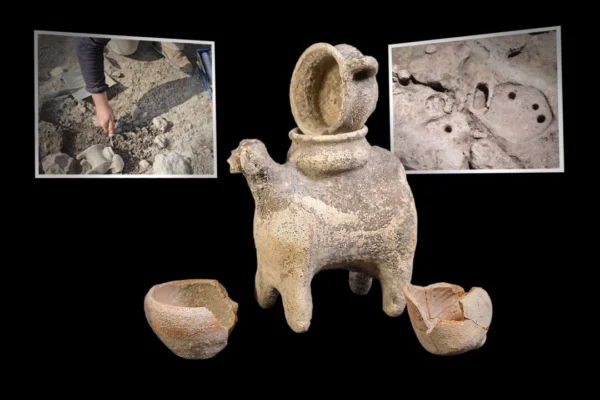
In addition, archaeologists discovered several small pits containing fascinating artifacts dating thousands of years after the wine press. These artifacts, believed to be used in religious rituals or libation ceremonies, could provide insights into the “folk rituals” of the Canaanite people before the arrival of the Israelites.
A broken miniature terracotta shrine was found and reconstructed, along with various multi-purpose pottery vessels. Among them was a set of pottery resembling tea sets, which included a small jug for pouring liquids designed to be filled from a large vessel shaped like a ram, with the liquid flowing out through the ram’s mouth into several small cups, comprising a complete set of vessels. These vessels were likely used for storing milk, oil, wine, or other precious beverages.
Near a large exposed rock outcrop that may have served as an altar, researchers uncovered more buried artifacts, including shattered pottery similar to the ones depicted in the accompanying photos. The site is believed to have been a rural worship site where farmers offered agricultural products such as wine or olive oil, unable to access the city or temple during the Late Bronze Age II period.
These discoveries provide new contextual connections, showing how worship activities expanded from urban centers to rural areas during the Canaanite expansion. Moreover, as the upgrading of Highway 66 in Israel’s surrounding areas facilitates closer connections with its interior, new excavations have begun nearly a mile away. The IAA, in collaboration with the Israel National Roads Company, is utilizing this opportunity to retrace Israel’s connection to its Canaanite roots in the Jezreel Valley.
“This is of great interest to us,” Golani remarked, “because when the Israelites entered the Promised Land, they encountered these Canaanites and their pagan worship practices.”