
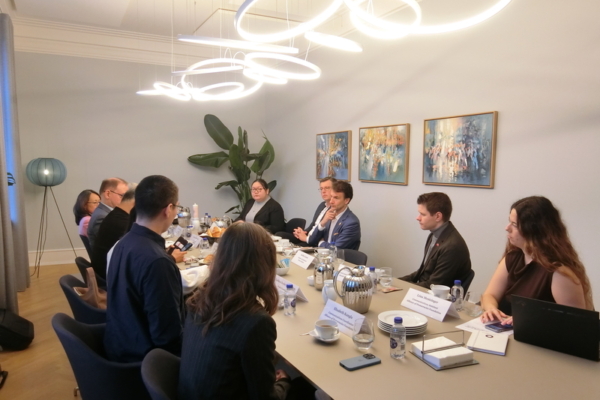
On December 5th, a closed-door seminar was held jointly by Taiwanese civil groups and the Danish Alliance of Democracies Foundation, focusing on “Chinese cross-border repression and authoritarian expansion.” Participants at the meeting expressed concerns about the impact of the Chinese Communist Party on the global democratic system.
The Chinese Democracy Academy Association issued a press release stating that Hu Jiaying, project manager of the association, Tashken Davlet, project manager of the Taiwan Democracy Lab, and Taiwanese human rights activist Li Mingzhe, participated in the closed-door seminar held in Copenhagen with the Alliance of Democracies.
The three Taiwanese representatives shared their insights on how the Chinese Communist Party has deeply impacted the global democratic system through means such as judiciary, technology, information control, and overseas infiltration. They highlighted the ongoing reality of cross-border repression for Taiwan, emphasizing the need for cross-national cooperation and information sharing to strengthen democratic defenses.
Hu Jiaying pointed out that cross-border repression is not an abstract concept for Taiwan but a continuing reality. He highlighted how the CCP extends domestic legal powers limitlessly beyond its borders through arbitrary arrests, judicial abuse, information manipulation, and overseas influence organizations, a model that has been replicated in several democratic countries.
He stressed the importance of Denmark’s observation and action as a key model of democracy and human rights, calling for democratic countries to enhance their defense through international cooperation and information sharing. The frontline experience of Taiwan is not only crucial for its security but also for the resilience of the global democratic community.
Li Mingzhe further illustrated the direct harms of cross-border repression through his own experience of being abducted and imprisoned. He recounted his arrest, trial, and five years of imprisonment by the Chinese government on charges of “subversion of state power” since 2017.
He pointed out that the statements he was charged for were legally made within Taiwan’s borders, yet the CCP pursued prosecution against Taiwanese citizens, extending its domestic laws unrestrictedly overseas, undermining sovereignty and international norms. During his incarceration, he faced forced labor, restricted communication, and deprived visitation rights, with products possibly entering the international supply chain, transforming human rights issues into global trade risks.
Li Mingzhe also raised concerns about Denmark labeling Taiwanese residents’ residence permits as “Chinese citizens,” which, although stemming from diplomatic and administrative considerations, increases the risk of Taiwanese individuals facing cross-border repression from the CCP. He urged the Danish government to reevaluate this policy to avoid unintentionally aiding authoritarian pressures from China.
Tashken Davlet, from the perspective of project management and research practices, dissected the global layout of CCP’s authoritarian technology and information infiltration. He highlighted how the CCP exports surveillance systems, smart city technologies, and censorship mechanisms, shaping opinions and disrupting political processes in the global digital space through social platforms, content manipulation, and bot accounts.
Research from Taiwan’s Democracy Lab showed that frequent users of Chinese social platforms are more susceptible to CCP narratives, and the algorithms of these platforms pose risks to democratic elections. Tashken emphasized that Taiwan has long been at the forefront of information warfare, providing crucial insights and experiences for Denmark and other democratic countries.
The discussion also revealed Denmark’s deep concerns. Danish parliamentarians, civil society groups, and local council members present expressed that Denmark’s excessive economic retaliation worries in its China policy have led government agencies to exercise caution when dealing with China-related issues. The exchange between Taiwan and Denmark enabled a clearer understanding of the impacts of cross-border repression on overseas Taiwanese, the diaspora community, and local democratic governance in Denmark.
Anders Engelbrecht Storgaard, a local council member and Conservative Party parliamentary candidate, pointed out that the governance of digital platforms, including TikTok, with opaque regulations, algorithm black boxes, and susceptibility to influence from foreign authoritarian regimes, has significantly influenced political engagement among young Danish voters. They emphasized the tangible consequences of foreign digital infiltration in Denmark and the necessity for democratic countries to heighten their vigilance.
Both individuals called for the EU to establish more consistent regulations, including storing data within the EU, improving algorithm transparency, prohibiting state-driven propaganda and censorship, to reduce the intervention risks in democratic elections and public domains by the CCP and other authoritarian regimes.
The Danish Alliance of Democracies Foundation stated that Taiwan has accumulated rich experiences in enhancing media literacy, combating disinformation, and strengthening social resilience, presenting a model worth emulating for European countries. Participants unanimously agreed that the pressure from the CCP on Taiwan is not an isolated incident but a systematic strategy involving judiciary, technology, information, diplomacy, and overseas communities. The resilience of Taiwan’s democracy is not only vital for itself but also for the robustness of the global democratic defense line.
This meeting deepened cooperation between Denmark and Taiwan on democratic, human rights, and cybersecurity issues. The three speakers and the Danish Alliance of Democracies Foundation look forward to establishing a more effective joint defense line through continued exchanges, policy collaboration, and international advocacy to resist authoritarian expansion, defend human rights, and maintain freedom and order.