
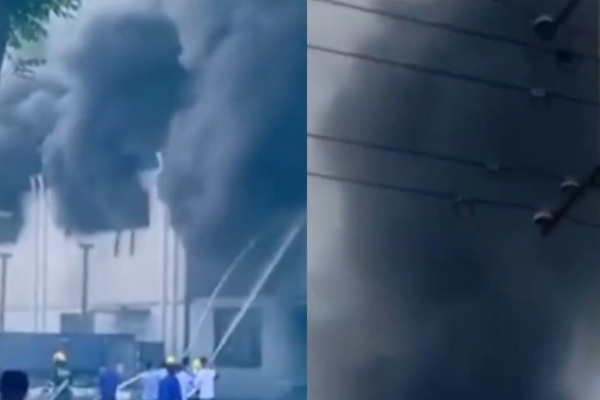
In a surprising turn of events this year, the Chinese Communist Party’s “anti-corruption storm” has for the first time reached the fire department, with seven provincial-level fire brigade commanders falling from grace before the year’s end. This has made the firefighting sector a “hotspot” for corruption crackdown. Analysts believe that the close relationship between the fire department and people’s livelihoods has led to longstanding corruption within the sector. The timing of the anti-corruption campaign in the fire department by the CCP may be seen as an attempt to pacify public anger by targeting high-profile cases, but it does not address the fundamental issue of systemic corruption within the CCP.
The “anti-corruption storm” within the CCP has extended to the fire department this year. Even before the year ends, at least seven provincial-level fire brigade commanders in mainland China have been investigated by the Central Commission for Discipline Inspection and the National Supervisory Commission. Yunnan Province has even revealed a leadership “nexus case,” making the firefighting sector a key focus of the CCP’s anti-corruption efforts.
According to incomplete statistics, the seven provincial-level fire brigade commanders who have fallen from grace include:
In addition, following the investigation of Qi Xingbin, the commander of the Yunnan Forest Fire Brigade on June 30, his deputy commander Luo Shuang voluntarily surrendered on September 5, and the political commissar and party secretary of the brigade, Zhang Fuyan, was investigated on November 25. Prior to them, the deputy party secretary and commander of the Dali Prefecture Forest Fire Brigade in Yunnan, Ji Xinyang, voluntarily surrendered and was formally investigated by the provincial disciplinary committee and supervision commission on May 6.
China issues expert Wang He told Epoch Times that corruption within the CCP’s firefighting sector is “long-standing,” and the frequent downfall of officials in the sector is not surprising. “What’s strange is why it’s only now their turn to be targeted for anti-corruption. Why wasn’t this done earlier?” Wang He noted that the anti-corruption efforts in the firefighting sector are “actually very late.”
In January of this year, the Central Commission for Discipline Inspection cited “concentration of power, intensive funding, and resource enrichment” as reasons for including firefighting in the list of key areas for anti-corruption efforts this year. Other areas on the list include finance, state-owned enterprises, energy, tobacco, pharmaceuticals, universities, sports, development zones, engineering construction, and bidding.
Shao Ping, head of the Overseas Chinese Human Rights Lawyers Alliance, told Epoch Times that the anti-corruption efforts of the CCP are often just a passing phase. The focus on firefighting this year might be because the sector had been overlooked, and since firefighting is a department with real power, there is indeed a “very large chain of corruption.”
Prior to 2018, the CCP’s firefighting sector was under the public security and armed police ranks, with dual leadership from the Ministry of Public Security and the Military Commission, funded by military allocations. After the establishment of the CCP Emergency Management Department in 2018, firefighting was incorporated, forming the vice-ministerial level National Fire Rescue Bureau. Firefighters were transformed into civil servants or institutional staff, funded by central finances along with local guarantees.
Shao Ping pointed out that the CCP military is among the “most corrupt places in China”. Before the reform of the firefighting sector, there were no effective external supervision mechanisms, and internal supervision was ineffective, making it impossible for anyone to effectively monitor the sector. Given that firefighting is related to various aspects of people’s lives and involves the entire industry chain, it has “tremendous power” and is “an extremely corrupt and highly problematic area.”
Wang He stated that there is a “serious exchange of power and money” within the firefighting department, indicating “systematic corruption.” Every unit, building, or project involves firefighting, including the adequacy of firefighting equipment and whose equipment is used, creating a market with murky rules and large scale.
The firefighting department easily engages in “rent-seeking behaviors”. “If they don’t grant you a ‘fire safety permit’, your business cannot operate. If you don’t have good relations, even a ‘fire safety rectification report’ can hold your business back. Firefighting can also serve as a ‘veto’ in many places, making it a lucrative but corrupt department,” added Wang He.
Shao Ping mentioned that apart from engineering inspections and firefighting checks, the firefighting department also suffers from severe “personnel corruption.” Especially after the restructuring, gaining entry into the firefighting team as an institutional employee equates to getting a “lifelong job security,” providing more opportunities for monetary gains. Those in leadership positions within the firefighting team “all need to be bought,” making it an “extremely corrupt field.”
Furthermore, Shao Ping highlighted that the firefighting sector is a subject of significant public grievances. He cited cases in Shanghai where individuals were frequently extorted by the fire department, becoming a common occurrence, even for small establishments like hotels, implying that substantial amounts of money were coerced.
Wang He reiterated that any interaction with the fire department for a company results in grievances that are not easily voiced.
He also emphasized that the issue of corruption within the CCP is not isolated to the firefighting system or Yunnan province, but rather reflects a broader “political and systemic corruption” across all of China. “As long as they don’t crack down, everything is fine; but once they do, many corrupt individuals and double-dealers are found everywhere.”
Shao Ping believes that the concentration of power within the firefighting department, combined with the lack of effective internal and external oversight, exemplifies a “typical case of systemic corruption” under the CCP’s regime. The CCP regime holds absolute power, leading to a scenario where officials across all systems are corrupt.
Zhang Fusheng, former party committee member and deputy director of the CCP Emergency Management Department’s Fire Rescue Bureau, was investigated in November 2022 and subsequently sentenced to 13 years in prison in 2024 for bribery dating back to the 1990s.
Wang He remarked that with public discontent simmering in Chinese society, the CCP fundamentally cannot resolve anything. “It’s just for show, grabbing a few typical cases and putting on an anti-corruption facade in some areas. The CCP actually does not dare to truly tackle corruption on a large scale; its anti-corruption efforts are selective, and many are just political performances.”
Shao Ping noted that since firefighting is a lucrative department, the CCP may be able to recoup some money through anti-corruption efforts to make up for financial shortfalls. However, the officials within the CCP are not genuinely willing to combat corruption because each of them is corrupt. They only come out to perform and put on a show, without addressing the core issues.
“After this storm passes, things may return to normal next year. The CCP is just playing a game of anti-corruption to deceive the people,” Shao Ping added.
“If the CCP truly wants to tackle corruption, it should implement a system of public disclosure of officials’ assets. Why hasn’t it been done? Globally, disclosing officials’ assets is a very effective method, but the CCP doesn’t do it, so its anti-corruption efforts are merely superficial,” concluded Shao Ping.