
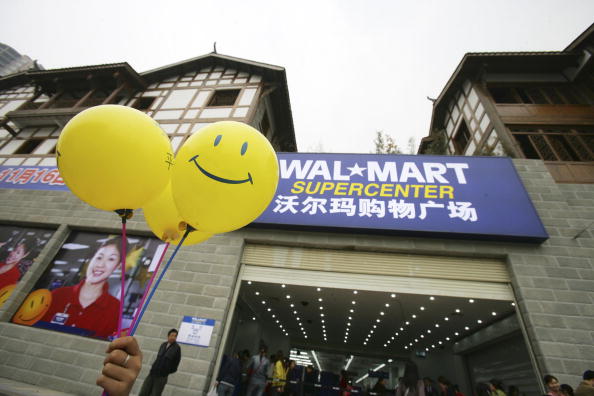
Recently, two Walmart stores in Dongguan have successively posted closure notices and will cease operations on December 27th and 30th respectively. This news has sparked discussions among the public regarding the changing retail environment. Some scholars have pointed out that the urban atmosphere in Dongguan has been declining in recent years, and the closure of stores is just one manifestation of the trend of declining consumption.
The closure notice was prominently displayed outside the Walmart Nancheng Hongtu Road store, informing customers that operations will cease starting December 27th. The notice advised customers to shop at other Walmart stores within the city or use the Walmart app for purchases.
Similarly, the Walmart Dongcheng Expo store also posted a notice announcing its closure on the 30th. According to online sources, this mall has been operating for about 22 years and is one of the earlier stores established in the area. Local government officials have not provided public explanations for the closure of these two Walmart stores.
A resident of Dongguan, Ye Xiaoqiang, shared that in recent years, there have been frequent changes in the major supermarkets near his residence, with fluctuations in rent, foot traffic, and businesses. He mentioned that the number of shoppers has decreased over time, leading to increased pressure on retail businesses.
Some businesses have shifted towards online operations, but physical stores remain essential for many households. However, foot traffic is not as robust as it used to be, indicating a shift in consumer behavior towards online shopping.
The news of the two Walmart stores closing down has been widely circulated on social media platforms like Douyin, Kuaishou, and WeChat. Comments from netizens expressed concerns about the closure of large shopping centers and pedestrian streets, affecting migrant workers who rely on such establishments for their livelihood. These sentiments reflect observations of some residents regarding economic decline and population movement.
In response to the closures, some netizens expressed worries about the impact on individuals who may lose their jobs due to the closures. Others noted the increasing challenges faced by physical retailers in the face of competition from online platforms and changing consumer habits.
Dr. Wu Xianzhong, a scholar from Guangdong, mentioned in an interview that the closure of foreign retail enterprises reflects adjustments in their operations and indicates changes in the local commercial environment, rental structures, and residents’ consumption habits. He emphasized that retail changes in neighborhoods often reflect urban vitality, and store closures are just one aspect of this phenomenon.
Dr. Wu also highlighted that in recent years, foreign supermarkets such as Walmart and Carrefour have been closing stores in cities like Guangzhou, Shenzhen, and Foshan, citing downgraded consumption patterns leading to operational challenges for these stores.
According to Walmart’s quarterly report released in November 2025, the net sales in the Chinese market increased by 21.8% compared to the previous year, reaching approximately $6.1 billion. The company disclosed that the net sales in the Chinese region for the fiscal year ending on January 31, 2025, were around $20.3 billion. Analysts attribute this rebound in business to the expansion of Sam’s Club stores and growth in e-commerce channels.
Regarding Walmart’s closure of stores in China despite profitability in the market, Mr. Weng, an economist in Shenzhen, explained that the overall sales growth primarily stems from Sam’s Club and online channels. The continual losses incurred by traditional stores are due to rental costs, foot traffic changes, and shifting consumer preferences. He emphasized that the store closures do not contradict the financial profitability and reflect a structural diversification of the business landscape rather than overall operational improvements.
Since entering the Chinese market in 1996 while focusing mainly on first-tier cities, Walmart has been adjusting its store structure in various locations in recent years. The closure of the two Walmart stores in Dongguan has invoked nostalgic sentiments among residents. One online user reminisced about the past prosperity brought by foreign investors to Dongguan in industries like electronics, manufacturing, and commerce, contrasting it with the current scenario. Such transformations could mark a significant historical shift from rise to decline for Guangdong.
Local retail enterprises are also facing similar pressures. Yonghui Supermarket recently announced the closure of its urban store in Chizhou, Anhui on December 30th, clearing out merchandise beforehand. Onlookers note that many supermarket chains are struggling with losses, leading to closures of underperforming stores as a means of damage control.
Yonghui had previously shuttered two stores in Shenzhen, namely the Lai Foshan and Luohu Sun Plaza outlets on December 16th. Dr. Wu commented that these closures are not isolated incidents but rather choices made by multiple companies under operational stress. He projected that traditional stores unable to reverse the trend of declining foot traffic may face further contraction in the future.