
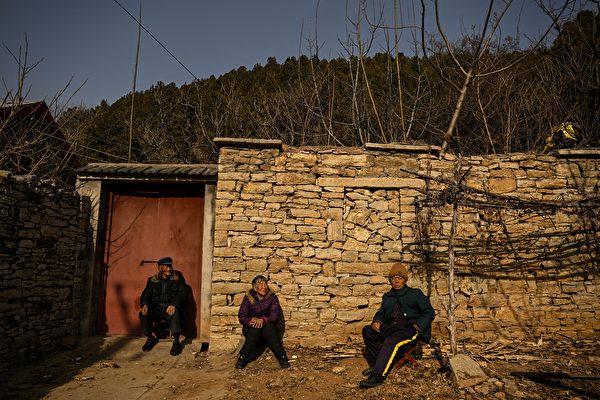
The Chinese Communist Party’s official newspaper, Economic Daily, recently published an article on the front page, stating that “unstable poverty alleviation households” and “easily impoverished households on the edge” should be prioritized for monitoring to ensure there is no large-scale return to poverty. This comes after Chinese Communist Party leader Xi Jinping declared a “comprehensive victory” in China’s poverty alleviation efforts in early 2021, referring to it as a “miracle on Earth.” What is the truth behind “poverty alleviation”? What kind of predicament is “large-scale return to poverty”? The people have something to say.
In an interview, a villager named Yang Bo (pseudonym) from Wuxuan County, Guangxi, born in 1974, shared with reporters from Epoch Times his experience with the Chinese Communist Party’s poverty alleviation efforts.
“Generally, the targets of poverty alleviation are those with connections. There are still many people who truly need poverty alleviation, like me. No one even looks at us for loans, let alone poverty alleviation,” he said.
From childhood to the present, Yang Bo’s family has always been poor and never escaped poverty. With three brothers and three sisters, he is the youngest. Yang Bo dropped out of school in the first year of junior high and started working as a grinder at a furniture factory in Panyu, Guangdong. In 2000, he earned just over 300 yuan per month. He got married in 1998. His father suffered a stroke and was bedridden for two years before passing away in 1992.
His mother, over 90 years old now, used to support Yang Bo and his siblings by selling firewood. After getting divorced, Yang Bo raised two children on his own and had to work outside to support their education, with his elderly mother taking care of the kids at home.
During the National People’s Congress in 2019, Liu Yongfu, director of the Leading Group Office of Poverty Alleviation and Development of the State Council, stated that the poverty alleviation standard for impoverished households by 2020 should result in an annual income of around 4,000 yuan per person, ensuring no worries about food, clothing, basic medical care, compulsory education, and housing security.
However, Yang Bo mentioned that the government doesn’t help everyone. “The government didn’t provide us any assistance. When we approached the government, there were too many policies and restrictions. It was a complex situation, and as ordinary people, we were clueless,” he explained.
He gave an example regarding the so-called “housing security with guarantees”: “In 2010, our old house collapsed (the wooden tiles were infested with insects and collapsed). It was uninhabitable, and coincidentally, the rural dangerous house renovation project was ongoing. We submitted the materials, and they said the quota was full. The following year, we submitted the materials again, and they said only one brother can be subsidized.”
Yang Bo clarified that the house was an old adobe house built by his father, and as they were connected, if one collapsed, the others would too. However, at that time, one of his brother’s children had just entered university and was also a veteran, so the village only provided the renovation subsidy to him, leaving out Yang Bo.
“At that time, we had 4 adobe houses—two for each family. We had submitted all the necessary documents. My mother and my two children lived in one, and since I wasn’t home often, they used it as a temporary kitchen on rainy days and cooked under the eaves on sunny days. It’s painful to talk about it more.”
He mentioned that they have reconstructed the house now, with two stories, but he is burdened with debt. “Without a house to live in, I had to borrow money to build. I owe 100,000 yuan for constructing the house and my children’s education.”
Yang Bo revealed that the government issued a document stating they could receive a one-time interest-free loan of 50,000 yuan in the last two years, but he never received the money.
He explained, “My child graduated from university last year and found work outside, while I stayed home farming and looking after the elderly. I returned three years ago and started a business at the time of the pandemic. The government mentioned an interest-free loan, so I wanted to start a business and take care of the elderly. Initially, I planned to rent land to grow taro, but after several unsuccessful attempts to obtain loans, I gave up. It’s challenging to do anything without capital. I went to the credit union twice, but I couldn’t secure a loan.”
Yang Bo highlighted several unfair situations, claiming that many impoverished households receiving benefits didn’t actually qualify as poor, while genuinely impoverished individuals struggled to access support. He questioned why so many people vie to become village officials, despite the low pay of around a thousand yuan.
“For example, during the low-income assessment, the village officials proposed candidates, and then people from different natural villages voted. Since I was working outside and hardly known to many, how could they select me? I had informed the village officials to notify me during the elections (leaving my contact information), but I never received any notification.”
During the National People’s Congress in 2020, then-Premier Li Keqiang disclosed that “600 million people in China have an average monthly income of only 1,000 yuan,” sparking controversy.
Yang Bo mentioned that he, an illiterate and ordinary farmer, has struggled to support himself and several others for many years without any savings. “I was incredibly poor! Before 2010, I earned around 600 yuan a month, just a little over 10 yuan a day. We used to get paid monthly with a one-month delay.”
“Like me, those in rural areas are just the tip of the iceberg,” he added.
Chen Dong (pseudonym), a young man from Guangdong who had participated in volunteer activities in western Guangdong five years ago, donated some daily necessities to impoverished individuals. “Back in high school, some classmates and I actively joined an organization set up by a proactive student’s mother, which held occasional volunteer activities, including visits to impoverished areas to help the elderly.”
In one village in western Guangdong, they saw old-style stoves burning firewood in kitchens, dwellings resembling bare-walled shanties, and witnessed disabled individuals—some even bedridden—living in impoverished conditions. “All we could do was offer some rice, oil. We couldn’t really change their lives; it made us feel powerless.”
Dong criticized the government’s claims of successful poverty alleviation. “That’s what they say, but it’s certainly impossible in practice. They probably don’t want to invest so much time and resources in this, and the money is likely embezzled.”
A man named Xiao Long (pseudonym) from a village in Huazhou City, Guangdong, shared that some families in his hometown still haven’t truly escaped poverty. Some are elderly living alone, while others lack labor in the household. Whenever there is a crisis in these families, donations are organized, but they can only provide temporary help.
“There are many elderly and children left behind in the village while their parents work outside. However, not everyone can earn enough by working. Only those with surplus income can build houses for their parents; in reality, most can barely sustain themselves,” he said.
Xiao Long believes that the government’s poverty alleviation efforts only provide temporary relief and don’t address the fundamental issues.
A woman named Pang Qing (pseudonym), who visited a mountain village in Tongren County, Huangnan Tibetan Autonomous Prefecture, Qinghai, to offer consolation, mentioned meeting a local Tibetan boy. She was initially there for leisure but was shocked by the poverty she witnessed. “It’s hard to imagine the conditions there. Even when seeing it in person, it’s unbelievable.”
“The situation was very dire. The children had worn-out shoes, exposing their toes in the cold winter. They lacked clothes, food, and any electrical appliances at home. Most villagers were illiterate, and older people couldn’t find work outside their homes. The children who managed to work could only earn enough to maintain their daily needs. Many families still lived in adobe houses,” she described.
Pang Qing organized an online donation drive in 2024, distributing old clothes, food, stationery, and other supplies to the villagers.
Chunming (pseudonym), a government worker from Guangzhou City currently working on poverty alleviation in the village, admitted, “The poverty in these areas is severe, with destitute conditions that can be distressing and overwhelming at first.”
He noted that illness can push people back into poverty, emphasizing that unforeseen circumstances can lead to a decrease in one’s financial stability.
Chunming, a poverty alleviation official in Guangzhou, mentioned that the current focus has shifted from poverty alleviation to ensuring a smooth transition into rural revitalization efforts, as termed in 2021.
During Xi Jinping’s “Poverty Alleviation Commendation Conference” on February 25, 2021, where the “miracle” of poverty alleviation was declared, the former “Poverty Alleviation Office” was renamed to the “National Rural Revitalization Bureau.” However, the “National Rural Revitalization Bureau” existed independently for only about two years before being merged into the Ministry of Agriculture and Rural Affairs in March 2023.
Since 2023, senior Chinese Communist Party officials have been emphasizing the “Theory of Bright Economic Future.” State media reports show that poverty alleviation is no longer mentioned in such meetings, and the focus has shifted to “preventing a return to poverty.” Authorities have also intensified efforts to curb any discussion related to poverty and have been removing videos and articles deemed to “exaggerate and instigate confrontations, damaging the image of the party and government” from the internet, effectively trying to “make the poor disappear.”
Political commentator Li Lin criticized the Chinese Communist Party’s poverty alleviation efforts, rural revitalization plans, and the current focus on preventing a return to poverty, calling them mere political maneuvers devoid of genuine concern for the welfare of the people.
Professor Xie Tian from the Darla Moore School of Business at the University of South Carolina pointed out that China’s touted success in poverty alleviation, which attracted global attention, was not solely due to Communist Party leadership. He argued that China’s improved economic conditions over the past 20 years were more a result of capitalism’s economic tools since its entry into the World Trade Organization in 2001, rescuing the ailing socialist economy.
Xie Tian highlighted that poverty alleviation statistics reported by the Chinese government are often exaggerated. “While many indeed have been lifted out of poverty, it might not have been as extensive and comprehensive as claimed by the CCP.”
With the economy stagnating and unemployment rates soaring, a massive return of migrant workers to rural areas has been observed. On November 13, the Ministry of Agriculture and Rural Affairs of the Chinese Communist Party held a meeting on “stability in two areas, prevention in one area” in Chuxiong Yi Autonomous Prefecture, Yunnan Province, triggering discussions on preventing large-scale return to rural areas.
The “stability in two areas, prevention in one area” initiative aims to “stabilize the employment of people who have escaped poverty as migrant workers and prevent the return to poverty due to unemployment.”
Xie Tian pointed out that since Xi Jinping’s third term, the Chinese Communist Party has regressed politically and disconnected economically from the international community. China is no longer known as the world’s factory, and the good days of exporting products to earn substantial profits are gone. When rural migrant workers without jobs return to the countryside and become poor once again, the Chinese Communist Party is worried that the false narrative of poverty alleviation might be exposed, revealing to the world that China hasn’t genuinely achieved comprehensive poverty reduction. “Many impoverished populations will soon rebound,” he concluded.