
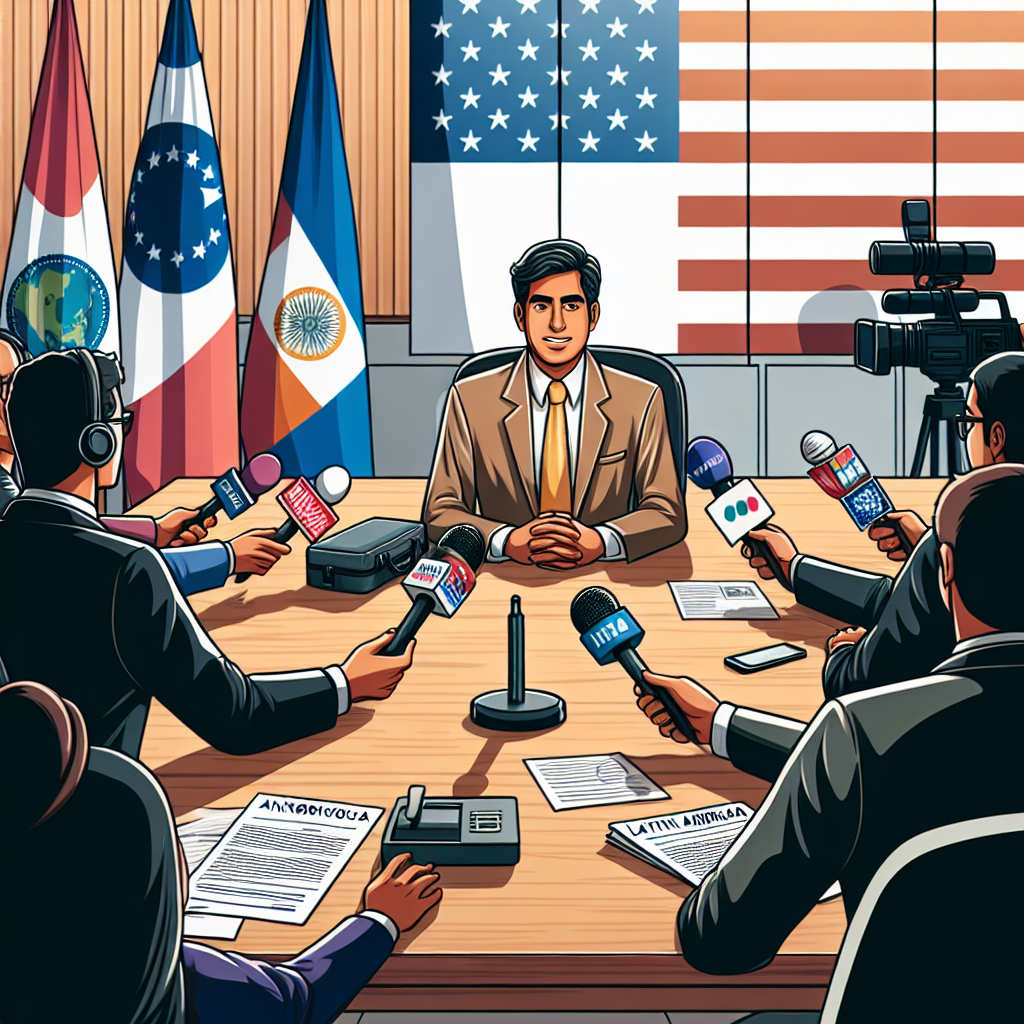
【Epoch Times December 3, 2025 News】Taiwanese Foreign Minister Lin Chia-lung recently gave an interview to foreign media regarding President Lai’s upcoming visit to Latin American ally countries and transit through the United States. Lin expressed confidence that Taiwan will be able to visit Latin American countries via transit through the US in the near future, based on recent communications with Washington.
The Ministry of Foreign Affairs of the Republic of China issued a press release stating that Minister Lin Chia-lung was interviewed by Bloomberg TV host Stephen Engle and Taipei correspondent Li Yian about recent Sino-Japanese disputes, Taiwan-US relations under the Trump administration, regional security issues, and other internationally relevant topics. The discussion was aired on the same day and published on the Bloomberg News official website.
Lin Chia-lung mentioned that the recent tensions between China and Japan sparked by Japanese Prime Minister Takaichi Sanae’s statement regarding possible Japanese intervention if China invades Taiwan, essentially involve “Taiwan’s problem is Japan’s problem, and it is also a US-Japan security issue.” He highlighted the strong communication channels between Taiwan and Japan and their joint efforts to manage the situation to prevent escalation.
Addressing perceptions of Taiwan’s relatively low-key response, Lin Chia-lung explained that Taiwan is supporting Japan through “soft measures” such as encouraging Taiwanese to travel to Japan and purchase Japanese products in order to help ease tensions, as “once Chinese national sentiments are inflamed, the situation could spiral out of control.” He emphasized that escalating tensions benefit no one, including Beijing, as conflict escalation does not serve its interests.
Lin Chia-lung assessed that the current China-Japan tension may take “about a year to gradually stabilize.” He clarified that Prime Minister Takaichi’s remarks have a parliamentary questioning context, and not a policy shift; whereas Beijing may take symbolic actions to display control to give face to Xi Jinping but ultimately will seek stability.
Regarding Japan linking Taiwan’s security to Japan’s security, he noted that both Taiwan and Japan must jointly shoulder responsibilities in defense capabilities and diplomatic coordination. He also stated that the Indo-Pacific region lacks a NATO-like collective defense mechanism, so Taiwan will enhance bilateral cooperation with democratic partners like the US and Japan and mesh these bilateral arrangements into a “lattice-like strategic framework” to collectively uphold regional security and deter authoritarian expansion.
In response to concerns that Taiwan was not mentioned in the leadership talks between the US and China, Lin Chia-lung emphasized that Taiwan’s commitment to the Trump administration’s security pledges in the Indo-Pacific and the First Island Chain is “undoubted.” He explained that this is a different type of strategic arrangement with the US requesting allies to share more defense burdens and show stronger self-defense will.
Lin Chia-lung pointed out that President Lai Ching-te’s efforts to raise defense spending, extend compulsory military service, enhance asymmetric warfare capabilities, and strengthen societal defense resilience demonstrate Taiwan’s determination to defend its democracy.
Regarding South Africa’s request for Taiwan’s representative office relocation, he stated, “We have proposed to hold a meeting with South African officials in January next year to resolve this dispute.”
As for President Lai’s future visits to Latin American ally countries and transits through the US, he expressed Taiwan’s confidence in being able to visit Latin American countries via the US transit route in the near future.
Lin Chia-lung also mentioned that Taiwan and Europe have extensive cooperation opportunities in areas such as security, supply chains, facing authoritarian challenges jointly, and safeguarding democracy. For example, in November this year, Vice President Xiaomei Qin accepted an invitation to speak at the Inter-Parliamentary Alliance on China (IPAC) in the European Parliament, which is a significant result of deepening exchanges between Taiwan and Europe.
The Ministry of Foreign Affairs of the Republic of China stated that Bloomberg is one of the world’s most influential international financial media headquartered in New York, highly valued by government decision-makers, the financial industry, and multinational corporations. Known for its real-time, in-depth financial news, data analysis, and policy commentary, Bloomberg holds significant influence over the international markets and industry developments.